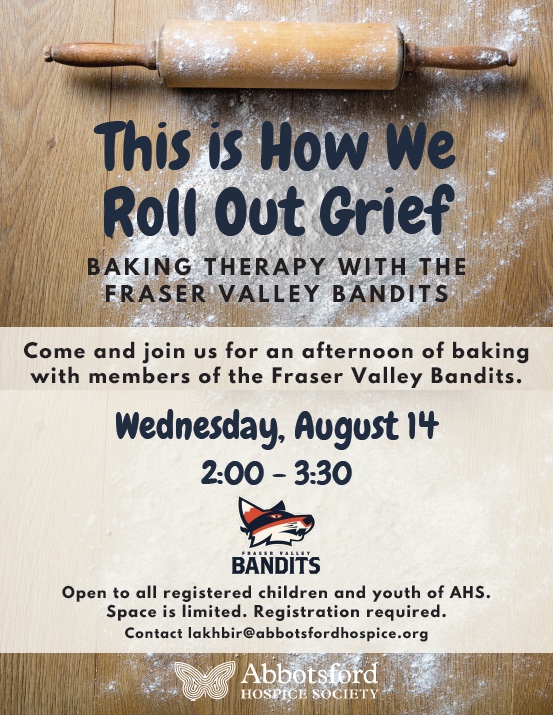
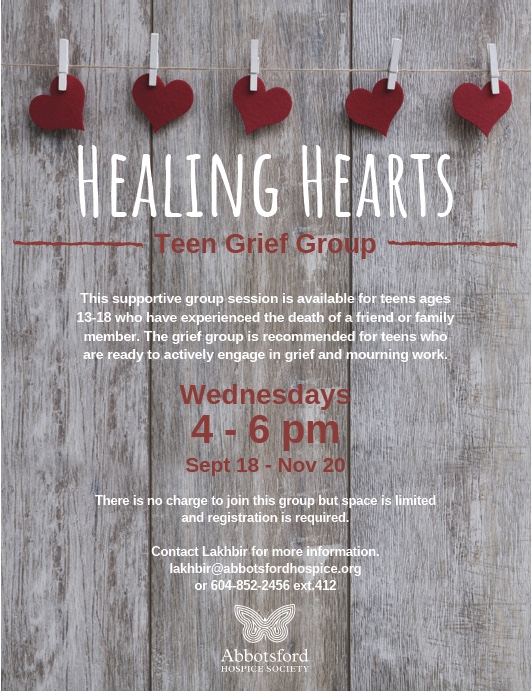
The Abbotsford Hospice Society is hosting a series of events this summer addressing grief and loss. When things get tough for me I either head up a mountain or into the kitchen! It’s wonderful to see the array of activities that acknowledge the many different ways we process grief and loss. And what a great opportunity to meet our new basketball team the Bandits! How cool is that?!
For more information on these activities or to sign up, please contact via email Dr. Lakhbir Jassal or by phone 604-852-2456.
“MDs drive 80% of all healthcare costs (e.g., which patients are seen and how frequently; which patients are hospitalized; which tests, procedures, and surgical operations are administered; which technologies are used; and which medications are prescribed). (Berwick & Hackbarth , 2012)
As leaders in the health care system, physicians regularly engage in the stewardship of health care resources. In a complex system with competing priorities and demands, resource stewardship is often challenging.
…
As a busy clinician teacher, you recognize the importance of stewardship in your practice and in the system every day. You may be wondering though how you will ever find ‘extra’ time to prepare your residents for the challenges associated with stewardship?
…
Introducing three new toolkits (Foundations of Resource Stewardship, Undertaking a Resource Stewardship Project During Postgraduate Training, and Communicating with Patients and Families About Resource Stewardship) to help you teach residents the foundations of resource stewardship. Designed for you to use with as much or as little adaptation as you choose; the toolkits include things like modifiable power point slide decks, annotated bibliographies, how-to guides, etc.”
“Being a living organ donor, or donating your organs after you die, can help save lives and improve quality of life. Registering with the BC Transplant Organ Registry is the best way to record your decisions to be an organ donor, and ensures that health care providers in every hospital in British Columbia have access to your confidential donor information. For information on organ transplants in B.C., visit BC Transplant.” (via HealthLinkBC)
Over 1,600 Canadians are added to organ wait lists yearly.
A 90% majority of Canadians support organ and tissue donation but less than 20% have made plans to donate.
Wilson44691 at English Wikipedia – Photograph taken by Mark A. Wilson (Department of Geology, The College of Wooster)
“The Washington Department of Fish and Wildlife, in collaboration with the Center for Urban Waters (University of Washington Tacoma), reported detecting contaminants of emerging concern (CECs) in transplanted mussels collected in 2012/2013 from locations near urbanized areas around Puget Sound. In 2018 investigators reanalyzed mussel tissues collected in 2012/2013 and identified over 200 pharmaceuticals, including trace amounts of antidepressants, antibiotics, detergents (synthetic surfactants), cardiac medications, and the chemotherapy drug melphalan, among others. They also found traces of oxycodone in mussels taken at 3 of 18 locations (17%).”
Where can I drop off out-dated or leftover medicine or medical sharps in British Columbia? When you pick up your prescription, ask your pharmacist. You can also visit BC’s Medications Return Program to find a location or click on Returning Medicine or Medical Sharps to learn how and where you can dispose of your prescriptions or call the RCBC Recycling Hotline:
“BC’s health care system is undergoing changes that will connect more patients with primary care and enable physicians to help patients access additional services and support. This involves increasing team-based health care through the creation of patient medical homes (PMHs) in family practices and forming primary care networks (PCNs) in communities that support longitudinal care provided by PMHs. As of June 2019, nine divisions of family practice have announced plans to form PCNs in their communities. An additional 16 divisions are planning to undertake the PCN expression of interest process in the coming months.
Data from physician practices are key to taking a practice to the next level as a PMH and enabling participation in team-based care and PCNs. Strong EMR data help identify how many patients are in the practice, what conditions those patients have, and the kinds of in-practice and team-based supports (like allied health providers) that can help provide proactive care for these patients. This in turn helps divisions understand the needs of patient populations and the broader communities as they plan PCNs.”
This transition could make for a great Resident PIP and/or Scholar Project! To learn more about primary care networks, visit the GPSC website and/or contact your local division of family practice.
Fantastic TEDMED talk by Dr. Elizabeth Howell on how we can improve maternal healthcare before, during, and after pregnancy. Becoming observant and aware of how the quality of care and its delivery differs from site to site and practitioner to practitioner appears to be one of the first steps in addressing this global issue.
Read more on:
‘We can’t do it alone’: Indigenous maternal health program aims to address inequality of health care by Whalen via CBC.
BCCFP offers financial awards to residents in the UBC Family Practice Residency Program and fourth-year medical students entering the program.
Nomination Process: Medical Students
The BCCFP awards $1,000 BCCFP Medical Student Scholarships to two fourth-year medical students entering the UBC Family Practice Residency Program
To be eligible for one of the medical student awards, please note that a nominator is required – this may be a family physician, fellow student or resident. Submissions for 2019 are due by July 31. Please use our online form to nominate.
“Several challenges have emerged in clinical education over the past two decades. Health professional programs have increased in both number and size resulting in an upsurge of trainees. The unprecedented growth has increased the workload of clinicians and their office staff as they correspond with university administrators to coordinate learners’ placements. Further complicating the matter are the varying teaching remuneration models. Surrounding the system is the interplay among government, post-secondary, and professional bodies and their social contracts, values, and mandates that inform and bind the profession’s development.
Globally, the ecology of family medicine is evolving and experiencing new challenges. Concerns have been raised about the shifting dynamics and erosion of relationships between healthcare professionals and patients. Compounding matters are patients’ lack of health coverage; system pressures to find healthcare savings and efficiencies; demands for sub-specialization; and changes in the family structure and population demographics. This altered landscape and increasing divide stress the educational paradigms responsible for training learners.
The purpose of this literature review is to better understand the context, challenges, and facilitators of clinical practice education as well as how we, as institutions, can improve the experience for learners, educators, and patients.”
ᐅᖃᐅᓯᓕᕆᔾᔪᑎᕗᑦ ᐅᓪᓗᒥ
Word of the day
ᐊᖅᑲᐅᒪᓂᖅ
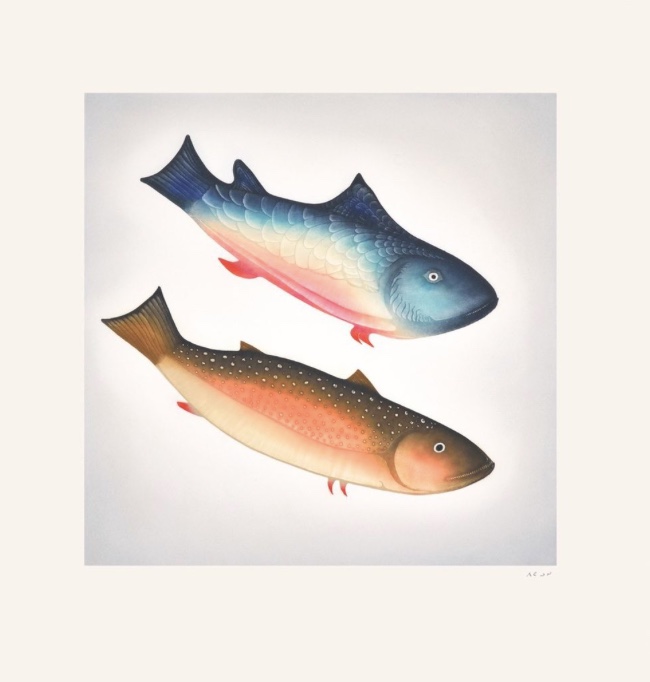
aqqaumaniq: Diving
(image: Pitaloosie Saila’s Diving fish)
via Qikiqtani Inuit
QIA represents over 15,500 Inuit of the Qikiqtani (Baffin) region which includes 13 communities from Quttiktuq (High Arctic) down to Sanikiluaq (Belcher Island).
“Dr. Walter Freeman, left, and Dr. James W. Watts study an X ray before a psychosurgical operation. Psychosurgery is cutting into the brain to form new patterns and rid a patient of delusions, obsessions, nervous tensions and the like.” Waldemar Kaempffert, “Turning the Mind Inside Out”, Saturday Evening Post, 24 May 1941.[1]Greetings All!
Journal Club is tomorrow at my place! A big thank you to our new Journal Club reps Drs. Zhang and Park for stepping forward and our past reps Drs. Dickinson and Hansma for doing such an amazing job handling the club’s logistics.
Dr. Iris Liu, our Site Faculty for Behavioural Medicine & Scholarship, has prepared the content for our session.
Time: Wednesday, July 17, 2019 from 6:30 – 8:30 pm
Location: Jacqui’s Place
Food: Please complete this form to confirm your attendance, your food restrictions including allergies, and your food preference.
Attendance: Please review our Academic Expectations & Guidelines 2019 regarding AHD attendance. As indicated, if you are unable to attend please contact our Faculty Lead Dr. Iris Liu.
Topic & Preparation: This month we’re focusing on the lobotomy. Please visit the StoryCorps website and review and listen to their radio show on My Lobotomy:
“Dully’s personal journey to find out about his lobotomy took him around the country as he interviewed lobotomy patients, their family members, and people who witnessed the operation. ‘This is my odyssey,’ said Dully. ‘Everyone has one thing have to do before they die, and this is mine.'”
Dr. Liu will be facilitating our discussion on this fascinating and controversial topic.


 “MDs drive 80% of all healthcare costs (e.g., which patients are seen and how frequently; which patients are hospitalized; which tests, procedures, and surgical operations are administered; which technologies are used; and which medications are prescribed). (Berwick & Hackbarth , 2012)

 ᐅᖃᐅᓯᓕᕆᔾᔪᑎᕗᑦ ᐅᓪᓗᒥ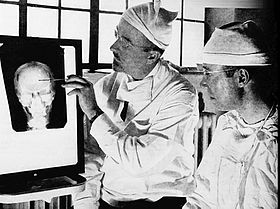
 Family Medicine Residency Site: Abbotsford-Mission