
Video Review in Residency: Learning to See, Hear, and Reflect on Practice
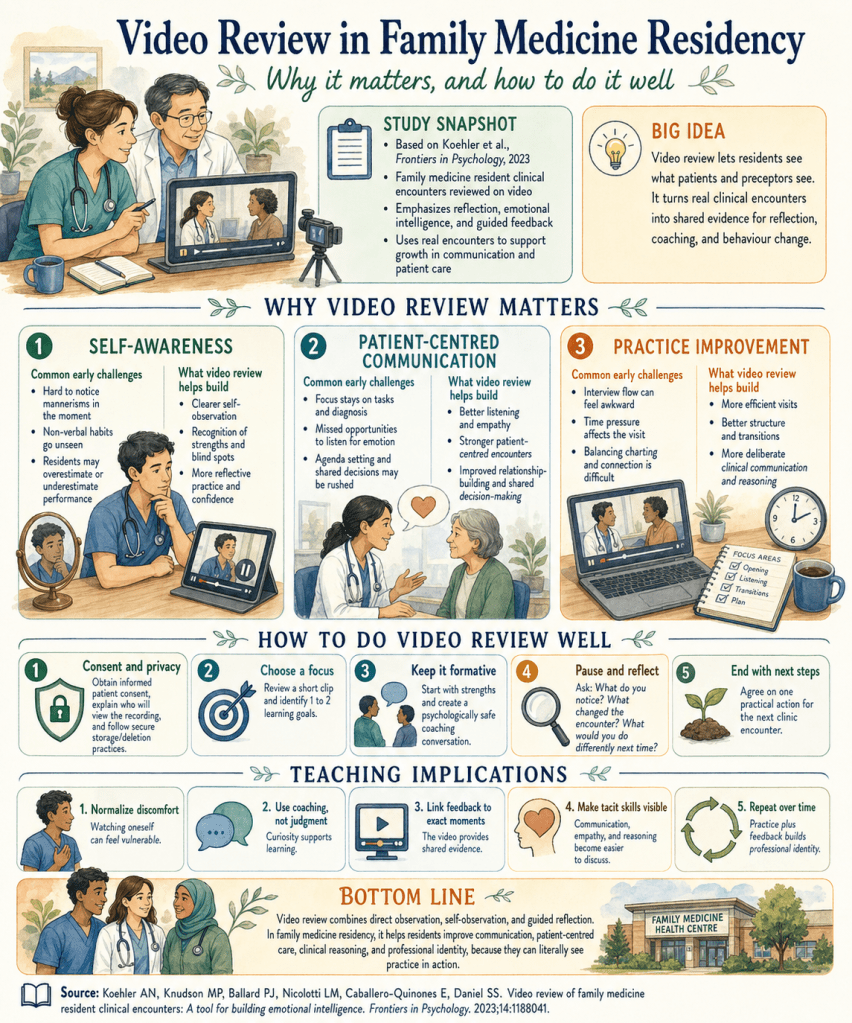
Video review is one of the most powerful learning tools we have in family medicine residency because it gives residents the rare opportunity to observe themselves in clinical practice. Unlike a written field note or a quick hallway conversation, video review allows learners to see and hear the full clinical encounter: the pacing, the pauses, the tone, the body language, the moments of connection, and the places where communication may have shifted. It captures not only what was said, but how care was delivered.
What I appreciate about Koehler et al. (2023) article is that it reminds us that video review is not simply about evaluation. At its best, it is a reflective learning process. It combines direct observation, guided feedback, and self-assessment in a way that helps residents develop greater awareness of their clinical reasoning, communication, and professional presence. For family medicine residents, this matters deeply. So much of family practice happens in the relational space between physician and patient. Residents are learning how to manage uncertainty, respond to emotion, build trust, ask better questions, and support patients through complex health concerns. Video review makes these invisible skills visible.
The article also reinforces the importance of doing video review well. Residents need clear expectations, psychological safety, patient consent, supportive faculty guidance, and enough time to reflect meaningfully. When structured thoughtfully, video review can move beyond “checking a box” and become a formative experience that supports growth, confidence, and professional identity formation. In a busy residency environment, it can be tempting to see video review as one more requirement. But this article is a useful reminder that it is actually one of the few tools that allows learners to step outside the encounter and witness their own development in real time.
That kind of learning is worth protecting.
Koehler, A. N., Knudson, M. P., Ballard, P. J., Nicolotti, L. M., Caballero-Quinones, E., & Daniel, S. S. (2023). Video review of family medicine resident clinical encounters: A tool for building emotional intelligence. Frontiers in Psychology, 14, Article 1188041. https://doi.org/10.3389/fpsyg.2023.1188041


