
You know when you read an article and the content just sticks with you? This article by Martin, Nasmith, Takahashi, and Harvey, Exploring the Experience of Residents During the First Six Months of Family Medicine Residency Training, has stayed with me because it captures something deeply recognizable about the transition into residency that I have observed.
Becoming a family physician is not simply about knowing more medicine. It is about learning to carry responsibility differently: responsibility for clinical decisions, patient relationships, time, uncertainty, follow-up, and the everyday realities of practice.
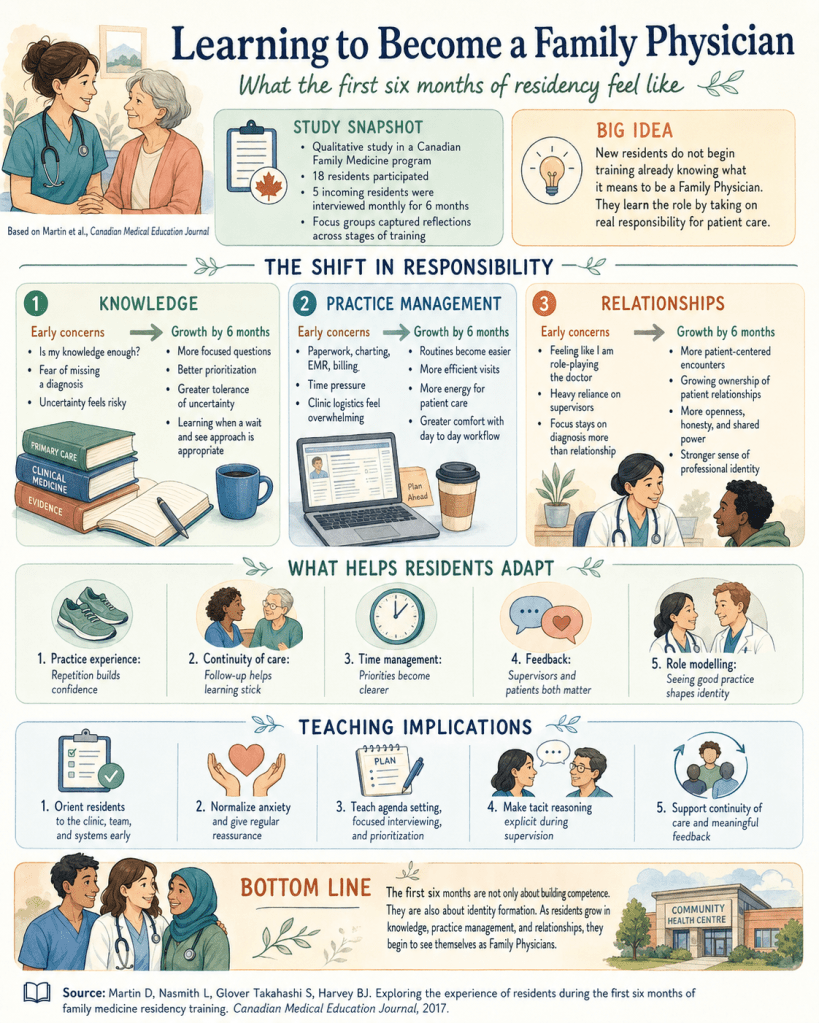
The paper breaks this transition down beautifully across three areas: knowledge, practice management, and relationships. That framework resonated with me again today after speaking with a family physician preceptor who described the importance of helping residents understand that they are no longer students. They are emerging professionals, learning to be reliable, accountable, and responsible within real clinical environments.
What I appreciate most about this work is that it normalizes the anxiety of early residency while also showing how residents grow through continuity of care, feedback, role modelling, and repeated practice. The first six months are not only about building competence. They are about identity formation: learning, slowly and meaningfully, what it feels like to become someone’s doctor.
Read more on Martin D, Nasmith L, Takahashi S, Harvey B. Exploring the experience of residents during the first six months of family medicine residency training. Canadian Medical Education Journal. 2017;8(1):22-36.


