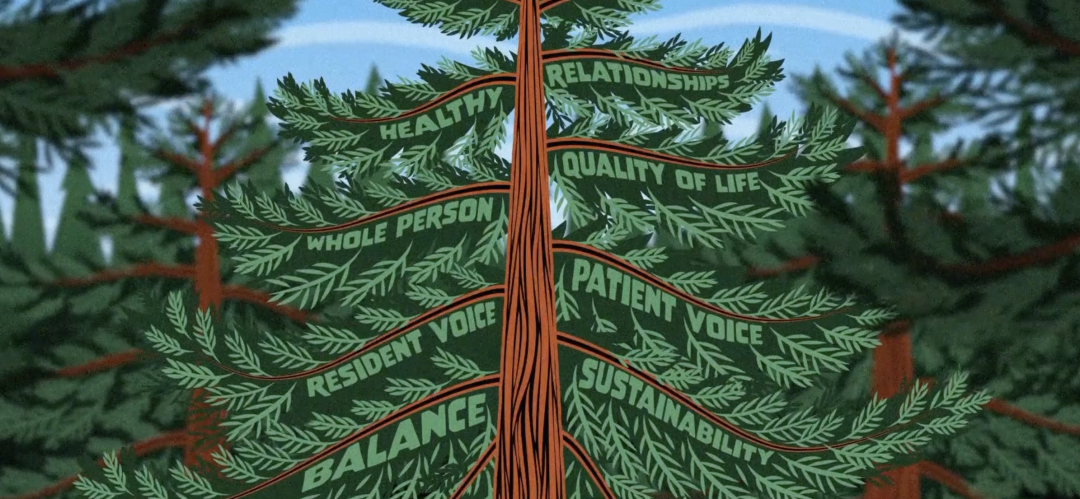

Beyond the Boundaries: Dr. John Pawlovich

issue-3_feature-1 copy
Dr. John Pawlovich is working with Carrier Sekani Family Services to improve the delivery of care for rural and remote Indigenous communities.

“I try to have students appreciate that delivering culturally-appropriate care means learning from the people and these communities. They are your mentors. If you really want to be a healer, and not just a service provider, then you need to build strong relationships.” ~ Dr. John Pawlovich

Our Dr. John Pawlovich is featured in the recent UBC Faculty of Medicine Pathways issue Beyond the Boundaries! Over the years, Abbotsford-Mission Residents have been incredibly fortunate to accompany Dr. Pawlovich on his journeys to British Columbia’s remote and rural regions. When our Residents return from their rotation, they express to me how they’ve acquired new ways of learning and understanding the practice of medicine in small communities. One of the great challenges they describe is that this new context requires planning ahead and coordinating their limited resources with greater efficiency and efficacy. They often highlight the need to develop trust in one another and to work together as team with their fellow healthcare practitioners. Residents explain that this is a key point in their development as they exercise their independence and autonomy as well as discover their latent skills and attributes that emerge in these new unique landscapes. The toolbox was larger than initially thought!

We always appreciate a visit from Dr. Pawlovich during our Academic Half Day. He shares his experience on establishing meaningful relationships and delivering care in these communities. We thank him for his commitment to the program and to the development of our future family physicians. Read more on going above and beyond here!

Warm regards,

Jacqueline
Faculty Development: Okanagan Orchards

unnamed

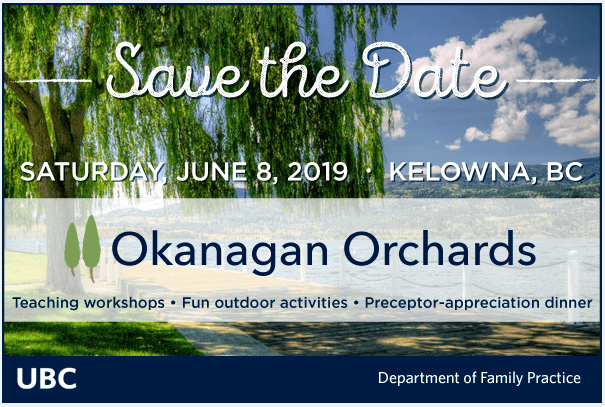
This Faculty Development event is open to all preceptors and faculty from across the province! We will have a half day of workshops, followed by some options for outdoor activities in the afternoon (wine touring, cycling, paddle boarding, etc), and will wrap up with an appreciation dinner in the evening. It’s a great opportunity for some networking and support, and we have a lot of fun too!

A $250 travel reimbursement will be available to eligible preceptors from out-of-town.

There are a set number of guest rooms held at Hotel Eldorado in Kelowna, so booking early is recommended.

Please contact me directly for more information, and we will send further details, including a registration link, as they are confirmed.

Feel free to share this with colleagues at your site.

We look forward to seeing you in June!

Larissa McLean, BA, MHA
Rural Liaison Coordinator
UBC Faculty of Medicine – Family Practice Residency Program – Rural Site

FMF Resources 2018

Thank you to Drs. Rylan Duivestein and Kathleen Ennis for providing the team a recap of their experience at FMF 2018 during our Academic Half Day. Here are a few links they shared:

CFPC Osteoarthritis Tool: Centre for Effective Practice

Handouts & Helpful Tools: Dr. Simon Moore

Prevention in Hand: The College of Family Physicians of Canada

The Impatient Patient Doctor: Dr. John Crosby

Next year FMF will be held in Vancouver! Learn more here.

IDEO: How to Reimagine the Healthcare Experience

Kwéleches, hello and welcome! IDEO has a session next week on “How to Reimagine the Healthcare Experience Through Design and Collaboration” and I thought you might appreciate the heads-up on this free webinar! IDEO has been very active in rethinking and addressing the challenges in the U.S. healthcare system and have a series of podcasts and articles on the topic including Design Thinking in Healthcare and 6 Tips for How to Prototype a Service.

More below on this upcoming webinar:

Description: Join Chris Waugh, Chief Innovation Officer at Sutter Health, and Dean of IDEO U Suzanne Gibbs Howard as they discuss how service design can radically and rapidly change how healthcare is delivered—making it more personalized and a better experience for patients.

Some Topics Covered:

  • How Sutter Health uses service design to identify and prioritize opportunities that improve patient experience
  • Innovation through collaboration: using journey mapping to uncover areas where partnering can complement your core capabilities and drive impact
  • Building a team of co-conspirators to take on massively complex design challenges

Send your questions on healthcare innovation to hello@ideou.com or share via Twitter with #healthcaredesign. Sign up to join the live conversation and get the recording and recap delivered to your inbox.

Date: Monday, December 10, 2018
Time: 9:00 AM in Pacific Time (US and Canada)
Register for this free webinar here!

Warm regards,

Jacqueline

54th Annual Post Graduate Review in Family Medicine

54th Annual Post Graduate Review in Family Medicine
Feb 21-23 (Thu-Sat) | The Vancouver Marriott Pinnacle Downtown Hotel | Vancouver BC
Target audience: family physicians, nurse practitioners, residents, and students
Up to 17.0 Mainpro+ credits
Register here.

This comprehensive three-day review course (Thu-Sat) offers an update of knowledge central to the practice of family medicine in both rural and urban settings. Committed to addressing everyday practical issues, speakers present equally on current and special areas of concern to the primary health care professional.

To complement a morning of group lectures, afternoons include a series of elective interactive workshops which allow conference attendees to customize their learning experience.

Learn more and review the agenda!

Academic Half Day: Elder Roberta Price

ElderRobertaPriceKwéleches, hello and welcome! I’m excited to announce that Elder Roberta Price, UBC Adjunct Professor and Indigenous Co-Lead for the Family Medicine Residency Program, will be joining us at our Academic Half Day:

Thursday, December 20, 2018
ARHCC Baker 103 Conference Room
10:30 a.m. – 12:00 p.m.

Elder Roberta Price from the Snuneymuxw and Cowichan First Nations, has worked tirelessly over the past three decades to educate and raise awareness about issues affecting First Nations people in a positive, informative, and productive manner. She does this by working as a First Nations educator – sharing her traditional knowledge in schools, within the community, and with First Nations people.

Healing is something Roberta is familiar with as she recalls a very painful childhood survived in foster care. Feeling isolated and separated from her culture took a toll on her. Today, she has “risen up” and is completely devoted to being an agent of positive change. The mother of four and grandmother of eight has shared for the longest time that she believed she was doing this healing  work for her children, but that she now realizes it is for her grandchildren.

Roberta is involved with many communities in the Lower Mainland. A former member of the Board of Directors of Pacific Association of First Nations Women and an Elder at BC Women’s and Children’s Hospitals, Vancouver General Hospital and with the Mmmooooooke Na Sii yea Yeaaaa (All My Relations) Program at Vancouver Native Health Society.  For over 10 years, Roberta has been involved with the UBC School of Nursing, as community advisor, researcher & Elder in the CRIiHI unit. She has also been involved with the UBC Centre for Excellence in Indigenous Health for numerous years – presenting with the UBC Learning Circle and teaching the Cultural Competency and Humility course and IHHS 408 course to medical and other allied health professional students. Recently, she has been appointed Adjunct Professor in the Post Graduate Program, Department of Family Practice (UBC) and serves as the Indigenous Co-Lead for the Family Medicine Residency Program.

AMEE-GAME Webinar: Patients and Professionals: Our budding collaboration in programme development

“Patients are becoming increasingly important in the development of educational interventions for health professionals, the European Respiratory Society (ERS) and the European Lung Foundation (ELF) would like to share some key learnings on their budding collaboration.”

AMEE-GAME Webinar Series:
Patients and Professionals: Our budding collaboration in programme development
Presenters: Amy Farr and Pippa Powell
Date: Friday, November 30, 2018
Time: 1400 GMT/UK. (0600 PST)
All AMEE-GAME webinars are free to access; however, space is limited and will operate on a first-come basis.

Join the discussion here. The user guide for the webinar platform can be found here.

CAME Webinar: Diagnosing students/residents in difficulty and providing appropriate pedagogical interventions

Why do clinical teachers have such difficulty acknowledging that a student is in difficulty? One underlying reason is a lack of information about remediation options.

In this webinar, participants will use the analogy of a clinical reasoning process to analyze and take an organized approach to dealing with the daily problems facing learners in difficulty. They will learn how to recognize the signs and symptoms of students in difficulty, how to make a pedagogical diagnosis that takes into account the various dimensions of learning, and how to use a list of relevant pedagogical interventions generated by a BEME systematic review to help learners in difficulty advance in their learning.

Presenter: Dr. Miriam Lacasse
Date: Tuesday, February 12, 2019
Time: 12:00 – 1:00PM Presentation (includes 10 – 15 minute Q&A)

Venues:
UBC Point Grey Campus, Life Sciences Centre
Room 1312 CMR – 2350 Health Sciences Mall Map

and

Diamond Health Care Centre (DHCC)
Room 4115 – 2775 Laurel Street, Vancouver

Interested? Learn more here.

CHES: Moving from Expert to Novice: Teaching an Old Dog New Tricks

During the course of our professional careers, we may anticipate transitioning into new arenas of practice. These may be small leaps (i.e. developing new skills for use within our field) or larger leaps (i.e. re-training for a new field of practice). While the development of expertise has been explored in depth, it’s converse, namely moving from expert to novice, is less well-described. In this WITA, we will share our own stories of transitioning from expert to novice, suggest some relevant theories that may inform our understanding of this transition and foster discussion with participants as to the nature of these transitions.

Presenters: Drs. Rose Hatala, Jennifer Tam & Joanna Bates
Date: Tuesday, December 4, 2018
Time: 12:00pm to 1:30pm

Formal presentations and discussion from 12:00pm – 1:00pm, ongoing moderated discussion 1:00pm – 1:30pm
Feel free to bring a bagged lunch

Locations:

  • LSC CMR 1312 (host venue)
  • DHCC 2262
  • NHSC 9-374
  • RJH CA 011

Remote:

Interested? Learn more here.

Learners In Difficulty

Educating the mind
without educating the heart
is no education at all.
~ Aristotle

In 2017, UBC’s Faculty of Medicine released a 4-part series on Learners in Difficulty. It’s one of the best productions I’ve viewed on depicting the challenges and opportunities experienced by educators and learners in the clinical setting. I particularly like Part 3 when the preceptor seeks advice from a colleague. His colleague carefully probes him about the learner’s clinical performance deficits; she empathizes with his frustrations; and finally she attempts to guide him towards opening up a dialogue with his resident. More importantly, she repositions many of the struggles identified as opportunities to clarify assumptions; to discover the hidden potentials; and to build on the relationship through the ethical elements of care. These elements include attentiveness, responsibility, competence, and responsiveness. Learn more about the ethics of caring and medical education here.

For those interested in the rest of series, please see the links below to follow how the story evolves:

The Difficult Learner: Part 2 History Taking
The Difficult Learner: Part 3 Getting Advice
The Difficult Learner: Part 4 Making the Plan

I strongly encourage you to watch. If you’ve observed or experienced something similar, take notes as to what resonates and determine your communication strengths and areas for improvement.

Sincerely,

Jacqueline

Update! Bill Upward, our UBC Department of Family Practice Teaching & Learning Strategist, suggested a series of handouts that help supplement the videos showcased above. They include:

  • The Laval Benchmarks Scale for Family Medicine, that can help both teachers and learners get a more objective sense of whether the learner is off-track and, if so, in what core competencies;
  • The Lacasse Educational Diagnosis Wheel, that helps structure a conversation with a learner to reveal all the factors that may be influencing their difficulties such as Teaching Environment Issues or Teacher Issues; and,
  • The Learning Plan Template and Sample, to help structure a plan that would be most likely to help everyone involved in the situation (learner, teacher, Site Director, etc) clarify the specific areas of concern and concrete strategies to support improvement and assessment of these goals and objectives.

Thanks Bill for the additional support and resources!