Link Pack

Uninvited Guests from Superflux on Vimeo.

Greetings!

Hope you are well! I often receive an array of resources and suggested readings from you that I love to share! And sometimes I come across a gem or two through your leads. I stumbled upon the video above when conducting research on speculative design. Speculative design poses questions such as “what if?” and encourages people to explore the future in new ways. Uninvited Guests provides a glimpse into what the future may look like as we impose, adopt, adapt, and reject “smart” devices designed to monitor and track our health. What are your thoughts after watching this?

More on speculative design? Read this: Speculative design: A design niche or a new tool for government innovation?

Here’s what you had to share:

Montreal museum partners with doctors to ‘prescribe’ art. (BBC News)

The Stethoscope (99% Invisible)

Why doctors hate their computers: Digitization promises to make medical care easier and more efficient. But are screens coming between doctors and patients? (The New Yorker)

Essentialism: The disciplined pursuit of less by Greg McKeown

Conference: Virtual medicine: Best practices in medical virtual reality

Fixed & Growth Mindsets. Read more on Dr. Carol Dweck’s book.
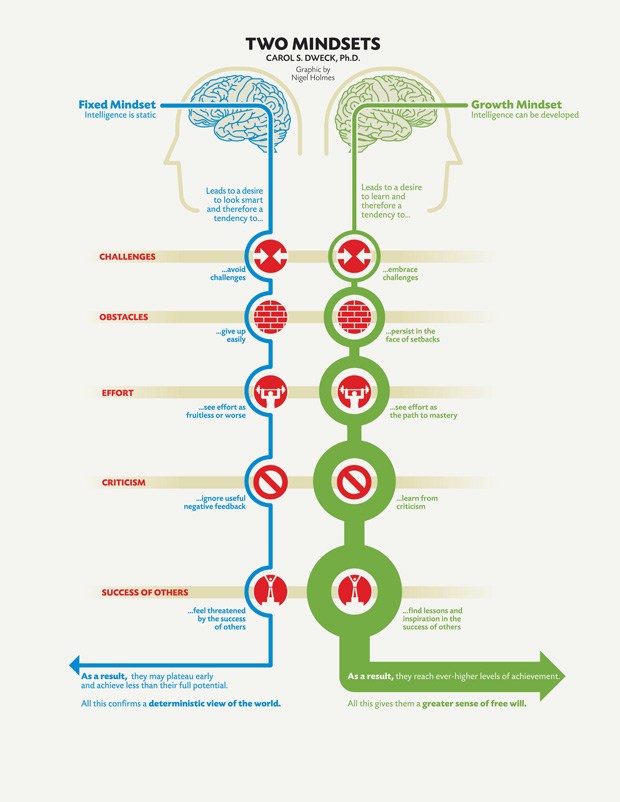
taschen_informationgraphics10

Have a great Journal Club tonight!

Warm regards,

Jacqueline
On Coaching

In 2011, Dr. Atul Gawande published a piece in The New Yorker on the idea of utilizing a coach to improve upon his surgical technique. His 2017 TED talk above summarizes his evolving thoughts on the concept of coaching and how it might be leveraged in our culture of medicine.

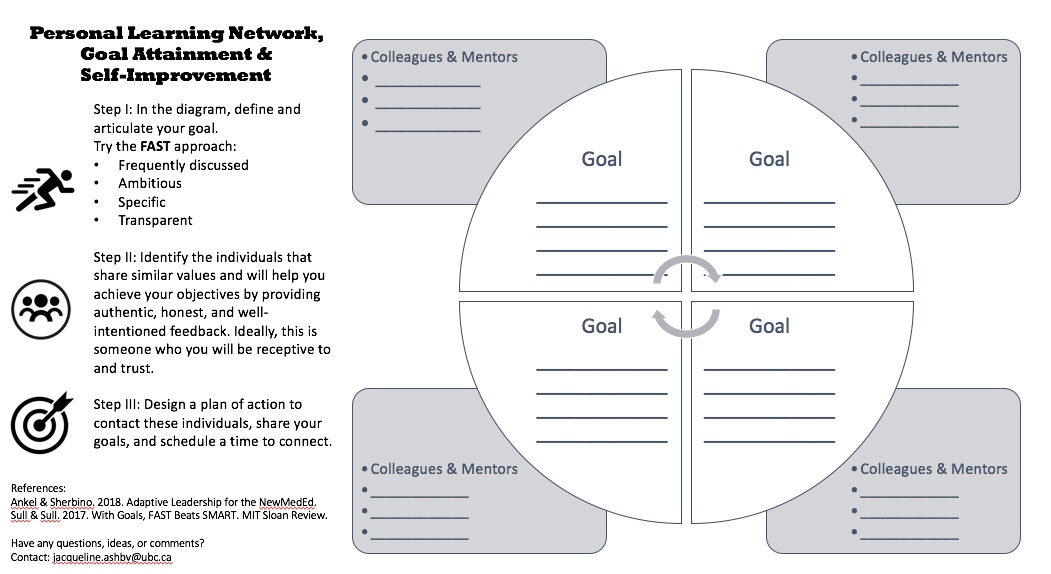
To encourage those interested in seeking out colleagues and mentors for feedback, I’ve created a “Personal Learning Network” exercise that may help you in both identifying the goal and those individuals supportive of your development in that area.

Personal Learning Network.jpeg

Step I: First, define and articulate your goal. Design a goal that is measurable and challenging. Be willing to share and discuss this objective with others to elicit feedback and provide positive reinforcement. The FAST approach to goals is one tool to encourage self-organization in complex systems.

Step II: Identify the individuals that share similar values and will help you achieve your objectives by providing authentic, honest, and well-intentioned feedback. Ideally, this is someone who you will be receptive to and trust.

Step III: Design a plan of action to contact these individuals, share your goals, and schedule a time to connect.

References
Ankel & Sherbino. 2018. Adaptive Leadership for the New MedEd.
Atul Gawande. 2011. Personal Best: Top athletes and singers have coaches. Should you? The New Yorker.
Sull & Sull. 2017. With Goals, FAST Beats SMART. MIT Sloan Review.

Have any questions, ideas, or comments? Please feel free to email me at jacqueline.ashby@ubc.ca

Scholar & PIP Project Deadlines 2018

Hello Residents!

Hope everyone is having a fantastic fall! As a friendly reminder, below are the following deadlines for Scholar Projects:
  • Draft abstract due to Site Faculty: November 15 (UBC deadline)
  • Final abstract due to Program Office: December 15  (UBC deadline)
  • Final manuscript due to Program Office: February 28 (UBC deadline)

The PIP project idea deadline was last week on October 31st.

Dr. Iris Liu
Scholar & Behavioural Medicine Faculty Lead

Do You Have a Bright Idea?

The BCCFP is offering a unique funding opportunity to enable members to create or modify tools/resources that will help BC family physicians address the social determinants of health (SDH).

The one-time SDH Grants Program will award up to eight grants of up to $5,000 each to the successful applicants. It’s easy to apply, and applications are due on December 17, 2018.

To learn more, review the SDH Grants Application Guide.

Clinical Educator Fellowship Program

The Centre for Health Education Scholarship (CHES) is offering funded fellowship opportunities for senior residents (R3-R5), residents in enhanced skills programs (PGY3 family medicine), or established clinicians interested in health education scholarship.

The two year fellowship is based at CHES and includes a master’s degree, completion of a research project, specialized academic half-days and teaching opportunities. An option for part time participation is available with the approval of the fellowship director.

If you’re interested in learning more and want to apply, click here.

Application Deadline – Friday December 14

ICRE 2018

20181018_152800_HDR_resized copy.jpg
Point Pleasant Park, Halifax, Nova Scotia

Greetings!

Hope you are well! I recently returned from the International Conference on Residency Education (ICRE). This year it was held in Halifax, Nova Scotia! I had the opportunity to connect with Residents and Faculty across Canada to celebrate the work and research in residency education as well as tackle some of the challenges that we’re confronting. I’ve gathered a series of resources and have posted them below for you to peruse.

  • Resident Doctors of Canada released the 2018 National Resident Survey in April. I encourage you to review the report’s findings. RDoC is also in the throes of creating an extensive toolkit offering strategies on topics including implementing technology, understanding allied healthcare roles, and the psychological safety in our learning and working environments.
  • Fatigue Risk Management Toolkit for Residents, Leaders, and Policy Makers in Canadian Postgraduate Medical Education. Located in the Appendix and References, are a series of assessment tools including the Karolinska Sleep Questionnaire, a Fatigue List Checklist, and Epworth Sleepiness Scale.
  • I attended an interesting session on the TGROW (Topic, Goal, Reality, Options, and Wrap-Up) model of coaching developed by Sir John Whitmore. You can learn more about this method in his book Coaching for Performance: Growing Human Potential and Purpose: The Principles and Practice of Coaching and Leadership.

Articles, Books, & Talks

I want to highly recommend attending ICRE 2020 as it will be held in Vancouver! Residents and Faculty may want to consider submitting abstracts to present.

Many of you have also shared resources with me over the past few weeks. Thank you for participating in the exchange!

Canada’s Digital Health Hub
Do Words Matter? Stigmatizing Language and the Transmission of Bias in the Medical Record.
Future Crunch
G18 General Practice Conference
Kids Brains Health
SFU’s Pain Studies Lab
The Virtues of Cold Blood: A Conversation with Paul Bloom

Warmly,

Jacqueline

Rural Global Health Partnership Initiative Grant

The Rural Coordination Centre of BC is launching another round of applications for the Rural Global Health Partnership Initiative Grant.

The Rural Global Health Partnership Initiative (RGHPI) is a new program providing funding to support partnerships between rural BC physicians or medical trainees committed to rural service, and lower resource communities in BC, Canada, and in developing countries. The goals of this initiative are to enhance capacity for generalism in rural BC; to foster reciprocal learning in diverse health systems and community contexts; and to demonstrate how global health (local and international) community partnerships can heighten awareness, create innovative solutions to address healthcare challenges, and lead to improved health outcomes, especially for underserved, marginalized, and indigenous populations.

The next deadline is October 31, 2018.

Application details can be found here.

Eligible applicants

  • BC physicians with experience practicing rural medicine, extensive connections to rural communities, and a demonstrated interest in global health.
  • BC medical trainees (resident or medical student) with a demonstrated interest in rural medicine and global health.

Happy, Healthy Neighbourhoods

Greetings Residents!

UBC’s Phase 3 of the Stadium Neighbourhood public consultation is launching soon!

I encourage you all to share your expertise and contribute to this dialogue as the communities we design, build, and nurture influence our health and wellbeing. Safety, walkability, mobility, accessibility, economic health, green space, and inclusiveness are just some of the needs and desires that people identify as important characteristics of their neighbourhoods. Implementing these features into the built environment is a challenge and requires intention and collaboration. So take part in this opportunity and lend your voice!

Warmly,

Jacqueline

More from UBC below:

Provide your feedback on the Plan Options for the new neighbourhood to be located near the Thunderbird Stadium. The consultation will be running from October 1-21.

You can provide your input online or in person from October 1 to 21.

Online survey:

Survey will open from October 1-21

Public Open Houses:

October 3, 10am – noon, Robert H. Lee Alumni Centre, 6163 University Blvd

October 10, 4pm-7pm, Wesbrook Community Centre, 3335 Webber Lane

Building Happier, Healthier Communities: We are hosting two events with Happy City around the theme Building Happier, Healthier Communities. You are invited to take part in this important discussion on how we can build happiness and wellbeing into UBC’s neighbourhoods.

Public Talk: Join Happy City author Charles Montgomery for an evening of fascinating science and stories of transformation from cities around the world. Register here.
October 4, 5:30pm to 8pm, Robert H. Lee Alumni Centre, 6163 University Blvd

Workshop: Roll up your sleeves for a half day workshop on how to design happiness into Stadium Neighbourhood. The workshop will be co-facilitated by Campus and Community Planning and the Happy City team. Register here.
October 13, 12pm to 4pm, BC Hydro Theatre, CIRS Building, 2260 West Mall

To register for both of these events or to learn more click here.

Design Thinking Lecture Series: Virtual Reality & Patient Education

IKONA Co-Founder & CEO Tim Fitzpatrick

Join us for our next Design Thinking session with IKONA Co-Founder & CEO Tim Fitzpatrick! Tim will be leading a conversation on improving patient education; provider training using immersive media; and why virtual and augmented reality have the power to transform the patient experience and improve outcomes.

Academic Half Day
ARHCC Baker 103 Conference Room
Thursday, October 11, 2018
10:00 a.m. – 11:00 a.m.


Cheers!
Jacqueline