Killam Teaching Prizes

UBC Killam Teaching Prizes are UBC’s most prestigious teaching awards. The Prizes are awarded annually, and are supported by the UBC Killam Endowment Fund. The Prizes recognize excellent teaching in the MD Undergraduate Program, undergraduate science programs, Occupational Therapy and Physical Therapy programs, B.M.L.Sc. program, residency programs, schools and graduate programs within the Faculty.

For the 2017-2018 academic year, the Faculty of Medicine will receive four UBC Killam Teaching Prizes of $5,000 each. The prizes will be presented at 2019 Spring Convocation, with award certificates presented at the 2019 Annual Awards Reception in the fall.

Deadline to submit nomination form: Friday February 15, 2019 at 4:30 pm
Nomination Overview & Form

For more information, please contact Ms. Sissi Wang, Executive Assistant, Office of the EADE, at 604-827-3574 or eade.assist@ubc.ca
Site Office Library: Resources

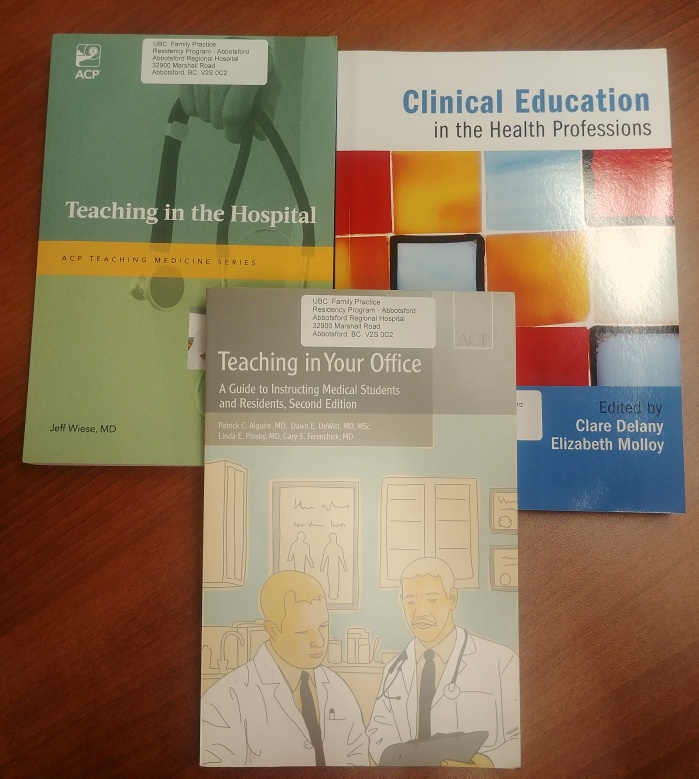
We’ve added a few more books to our Site Office Library! These educational resources include:

  • Teaching in the Hospital by Jeff Wiese, MD
  • Teaching in your Office: A Guide to Instructing Medical Students and Residents by Patrick Alguire, MD, Dawn DeWitt, MD, Linda Pinsky, MD, and Gary Ferenchick, MD
  • Clinical Education in the Health Professions by Clare Delany and Elizabeth Molloy

If you’d like to check them out, please let Ann or Susan know that you’re interested.

Thank you!

Jacqueline

Conferences: 2019/2020

sky.jpeg

Headed to Bozeman, Montana for the Wilderness Medicine Conference in February! Conferences are a great opportunity to network with others, showcase your research, gather new paradigms, share ideas, learn about the latest technology, and tinker with state-of-the-art tools. It’s always a bonus if you have a few extra days to connect with the host city and immerse yourself in a new culture. Events that may pique your interest this year:

Alberta College of Family Physicians: ACFP2019
American Academy for Family Physicians: AAFP2019
Asia Pacific Medical Education Conference: APMEC2019
BC College of Family Physicians: BCCFP2019
BC Rural Health Conference: RHC2019
Canadian Conference on Medical Education: CCME2019
Family Medicine Forum: FMF2019
Health Care Education Association: HCEA2019
Innovations in Medical Education Conference: IME2019
International Association for Medical Education: AMEE 2019
Manitoba College of Family Physicians: MCFP2019
Office Practice of Primary Care Medicine: HMS2019
Ottawa Conference: Ottawa2020
Royal Australian College of General Practitioners: GP19
Society for Public Health Education: SOPHE2019
Stanford Medicine X: CHANGE2019
TED Vancouver: TED2019
The International Conference on Residency Education: ICRE 2019

To learn more about what’s happening closer to home, check out UBC’s Faculty of Medicine Calendar of Events or UBC’s CPD Conferences.

Warm regards,

Jacqueline

Link Pack

Big news on the UBC front! CHIME telescope detects second-ever repeating fast radio burst! I think it’s Dave. He seems to pop up every 9 years right? 2001…2010…2019!

Here’s what else caught my eye this week:

Interpersonal medicine already exists. It’s called family medicine.

There is a danger that our growing exposure to beautifully presented images of food having detrimental consequences.” Eating with our eyes: From visual hunger to digital satiation.

Physical activity and sedentary behaviour in kids.

Amphetamine- and Opioid-Affected Births: Incidence, Outcomes, and Costs, United States, 2004–2015.

Why a medieval woman had lapis lazuli hidden in her teeth.

Doctors as patients.

UBC CHES Event! Lies, Damned Lies, and Surveys (Jan 16).

What do surgery and airline travel have in common?

Best medical apps (so far)

The International Performing Arts Vancouver PuSh Festival is back! (various venues, Jan 17–Feb 3).

Need to improve your leadership style? Two things you can do right now.

Have a great weekend and enjoy some time outdoors!

Jacqueline

High-Performance Medicine

“Perhaps the greatest long-term potential of AI in health systems is the development of a massive data infrastructure to support nearest-neighbor analysis, another application of AI used to identify ‘digital twins.’ If each person’s comprehensive biologic, anatomic, physiologic, environmental, socioeconomic, and behavioral data, including treatment and outcomes, were entered, an extraordinary learning system would be created.”

Eric J. Topol on High-Performance Medicine: The Convergence of Human and Artificial Intelligence. A 2019 must-read!

Communities of Commitment

“Building learning organizations requires basic changes in thinking and behaviour that overturn conventional and reactionary beliefs. Shifting from a fragmented, competitive and reactive organization to one that is systemic, cooperative and creative also requires a ‘Galilean shift’ toward building ‘communities of commitment.’ In this regard, commitment goes beyond personal loyalty to include a commitment to societal changes through one’s organization.”

Fred Kofman & Peter Senge on Communities of Commitment: The Heart of Learning Organizations.

UBC CPD: Pearls for Immunization Practice

Pearls for Immunization Practice is now CME accredited through UBC and Residents can accrue Mainpro-1 CME credits towards their first five years of practice.

Pearls for Immunization Practice is an online self-learning course for all interested immunization providers and takes approximately 90 minutes to complete. It is especially useful for those physicians new to immunization practice in BC.  This course is also suitable as a refresher course for physicians who already have a theoretical and clinical understanding of immunization practice and would like to update their knowledge.

Learn more and register for the free course here.

Conversational Competence


Journalist Celeste Headlee’s TEDx talk on 10 ways to have a better conversation made me think about how we teach and demonstrate the art of a good conversation as well as how we allocate time and space for learners to develop their “softer” skills such as listening, problem solving, time management, and the ability to receive and learn from constructive feedback. Although the presentation’s title says 10 ways, there are actually 11 (and I think it’s the best one).

Warm regards,

Jacqueline

Improving Healthcare

“Over the last half century, Systems Theory has spread across disciplines, from psychology to engineering. By the 1980s and ’90s management science began to apply Systems Theory broadly. Application of this theory rests on the assumption that most individuals strive to do good work, but that they are acted upon by diverse influences, and that functional and efficient systems not only account for, but also embrace, these influences. Causal Analysis based on Systems Theory asserts that when errors occur, one ought not focus solely on individual failings, but on the surroundings that allowed such events to transpire. It further asserts that outcomes can be influenced by smart interventions, developed after studying common patterns and behaviors across time.”

Dr. Brett Anderson on Improving Healthcare by Embracing Systems Theory.

Anderson, B. (2016). Improving healthcare by embracing systems theory. The Journal of Thoracic and Cardiovascular Surgery, 152(2). Retrieved from https://www.ncbi.nlm.nih.gov/pmc/articles/PMC4947551/