
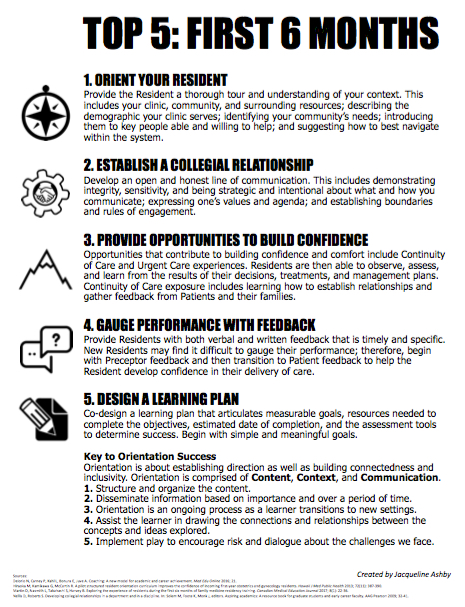
Hi All!
Sources:
Deiorio N, Carney P, Kahl L, Bonura E, Juve A. Coaching: A new model for academic and career achievement. Med Edu Online 2016; 21.
Hiraoka M, Kamikawa G, McCartin R. A pilot structured resident orientation curriculum improves the confidence of incoming first-year obstetrics and gynecology residents. Hawaii J Med Public Health 2013; 72(11): 387-390.
Martin D, Nasmith L, Takahashi S, Harvey B. Exploring the experience of residents during the first six months of family medicine residency training. Canadian Medical Education Journal 2017; 8(1): 22-36.
Nellis D, Roberts S. Developing collegial relationships in a department and in a discipline. In: Solem M, Foote K, Monk J, editors. Aspiring academics: A resource book for graduate students and early career faculty. AAG Pearson 2009; 32-41.
 Greetings All!
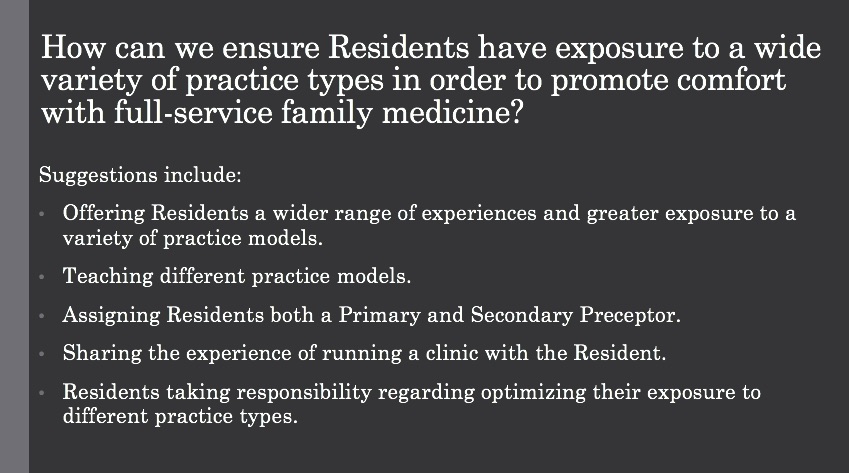 We also asked Preceptors to share their views on how to formally and informally address the delivery of content. This sparked a dialogue regarding whose responsibility it is to teach Practice Management. Based on our conversation, several Preceptors felt that Residents are responsible for their transition to practice and satisfying its corresponding curriculum objectives. Preceptors did recommend designing and developing a standardized curriculum; specifying the curriculum objectives and core competencies; partnering with business leaders on the topic; and a transition to practice game: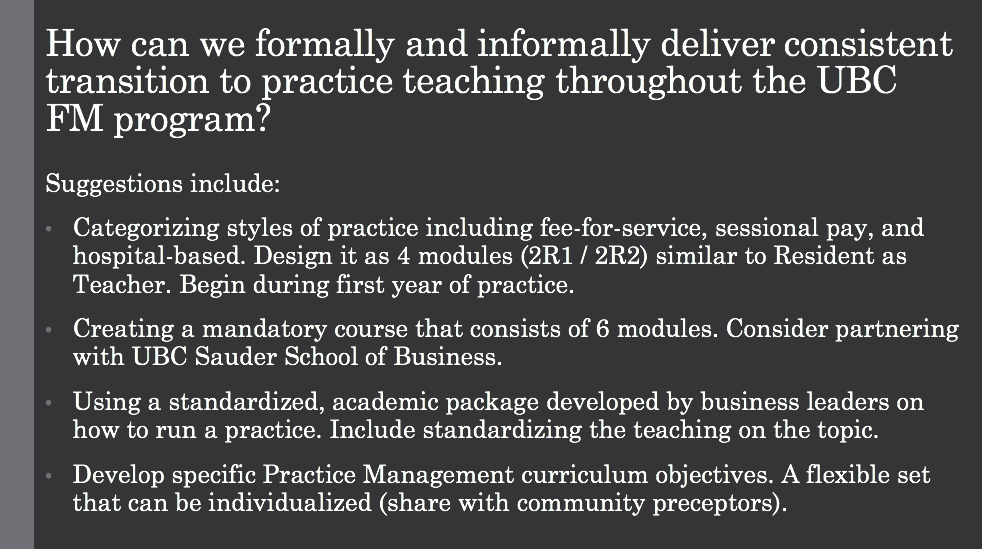
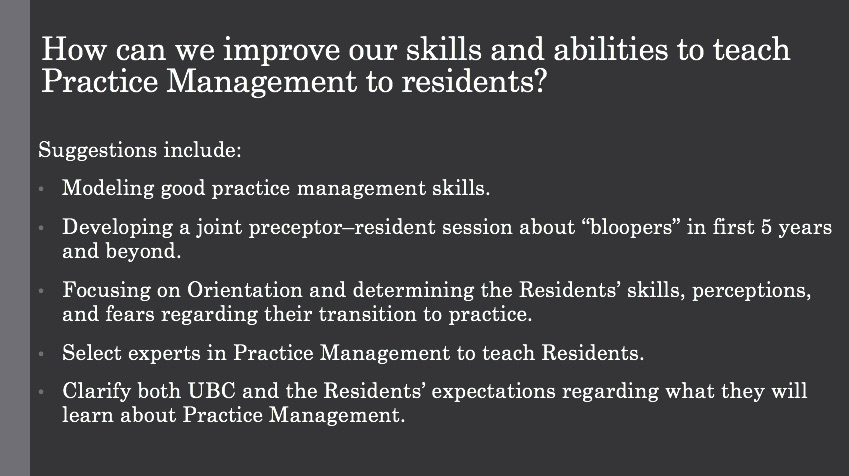
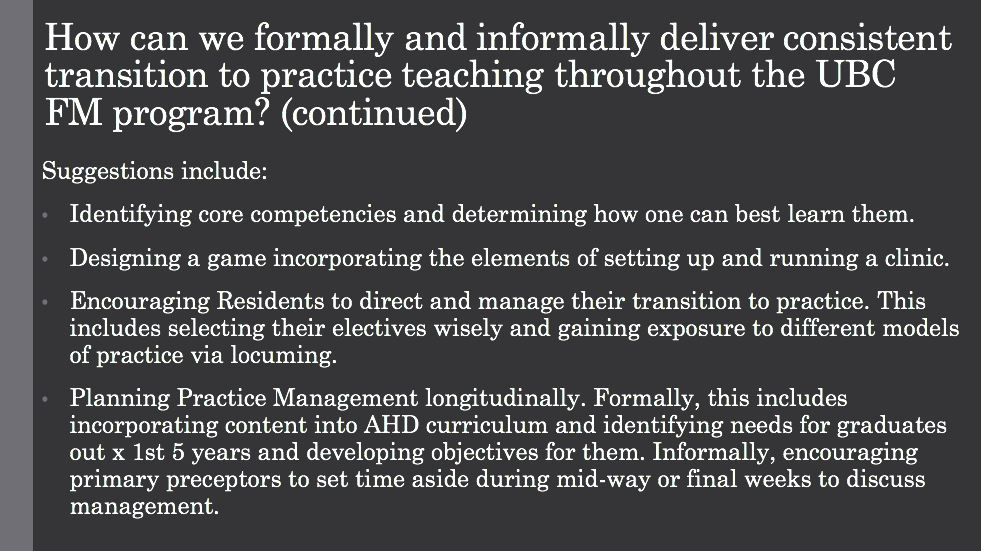 We completed the session eliciting Preceptors’ thoughts on teaching Practice Management. Participants expressed that modelling best practice is important and essential in educating Residents; however, they again encouraged their learners to take initiative and clarify their expectations about what they hope to achieve and experience during residency.
 Transitioning to practice is a stressful and anxious period for many Residents. Medicine’s body of knowledge continues to expand and evolve in its complexity. The shift from the cottage industry to the corporate model is limiting Residents’ access to mentorship. Generational differences in work-life balance are creating a tension between emerging and established practitioners. Implementing a mentorship program for Residents and offering learners the opportunity to manage a clinic are approaches to providing Residents greater exposure to the content while reinforcing an experiential education.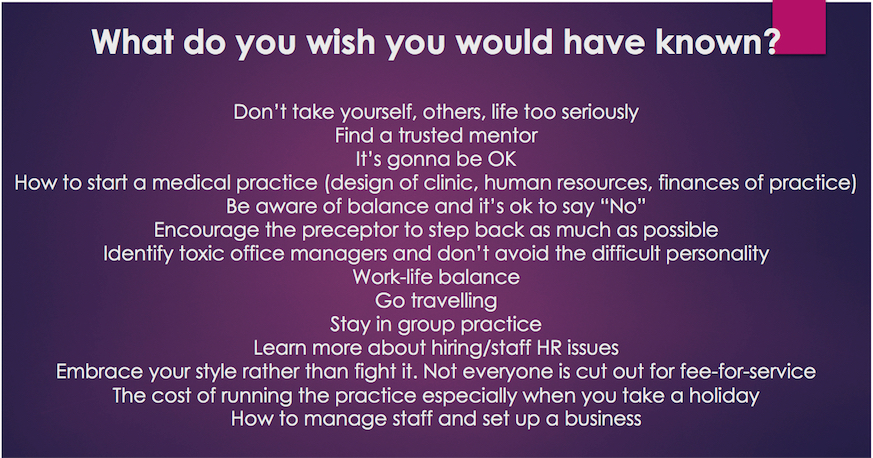




 Family Medicine Residency Site: Abbotsford-Mission