Health Innovation Funding Investment Awards: Call for Proposals

The call for proposals for the Health Innovation Funding Investment (HIFI) Awards is now open to faculty members at UBC Vancouver and UBC Okanagan. UBC Health is offering awards of $10,000 to $25,000 to faculty members who are collaborating across Faculties, disciplines, and campuses to develop new teams, pursue new ideas, or translate findings from innovative health-related research. 

Health is produced by a complex interplay of individual, social, political, and economic factors. Interdisciplinary and cross-Faculty collaborations have the potential to lead to more innovative solutions to improve health and address health inequities. The HIFI Awards are intended to catalyze these collaborations by supporting cross-Faculty and cross-campus research at UBC. 

For information on eligibility criteria, key dates, and how to apply, visit the HIFI page. Proposals are due October 31, 2021. Learn more here.

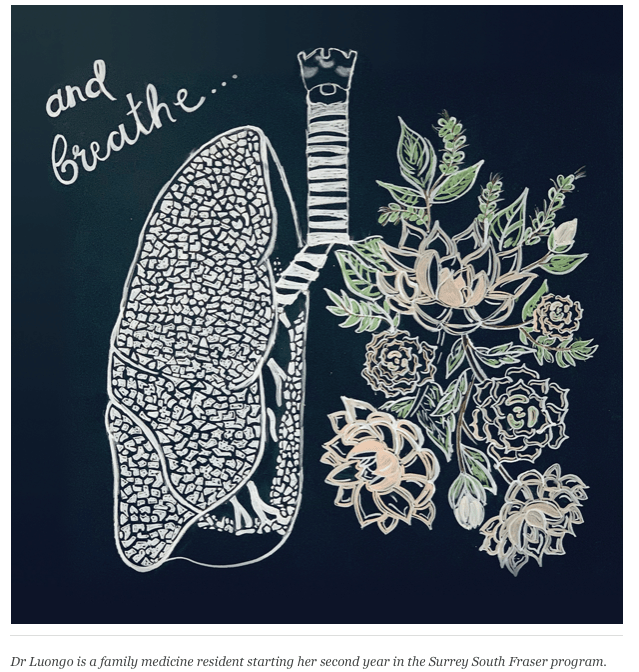
And Breathe…

“Dr Stephanie Luongo often uses art as a therapeutic outlet during her downtime in her residency. This chalk artwork is an integration of anatomy and nature, expressing, she says, “that life is beautiful and precious, and at times can feel delicate—much like nature itself.” When trying to alleviate the stresses of residency, COVID-19, and working as a physician, Dr Luongo finds that reminding herself to breathe can make all the difference.” via BCMJ

Exercise Prescriptions

The Grouse Grind!

“In the words of exercise medicine advocate Dr Robert Sallis, what if there was one prescription that could prevent and treat dozens of diseases? Regular physical activity is known to reduce the risk of premature death and at least 35 chronic diseases, from obesity to dementia to depression.[1] It has also been reported that nearly 20% of adult deaths can be attributed to physical inactivity and its associated low cardiorespiratory fitness, which is more than obesity (2% to 3%), smoking (8% to 9%), diabetes (2% to 4%), and high cholesterol (2% to 4%) combined.[2] The positive effects on patient health of a prescription to increase physical activity cannot be denied.

Physical activity is often more effective than prescription medications for preventing and managing chronic conditions, and it improves overall patient well-being. It is also less expensive, more accessible, and results in fewer medication interactions and side effects. Despite extensive evidence supporting the benefits of physical activity, Canadians as a whole are insufficiently active to achieve these health benefits.[3] With the recent publication of the groundbreaking Canadian 24-Hour Movement Guidelines for all ages (https://csepguidelines.ca),[4] there has never been a better time to discuss the importance of helping patients be more active.”

More on Incorporating Exercise Prescriptions into Medical Education via BCMJ.

Clean Water

“‘I had glasses engraved with Too bets`huna, which in our language means ‘We live by water’, says Thomas. ‘As the Elders took their first sips, I had to hold back tears as the reality hit me. We’d done it, after years of waiting, after hundreds of conference calls and numerous forest fires and despite being in the middle of a pandemic. We were resilient and persevered.’

After decades of relying on bottled water, the village of about 50 people, located 200 kilometres west of Quesnel on Kluskus Lake, now has a steady supply of clean drinking water straight out of the tap, thanks to a new water treatment plant crafted to their unique needs.

‘We had to do things differently. And now, what was just a dream many years ago is reality,’ says Chief Liliane Squinas.

The robust treatment system relies primarily on ultraviolet light, paired with chlorine disinfection, to ensure clean drinking water that is free of harmful microbes. The setup is simple enough that it can be operated, maintained and even repaired without relying heavily on specialist skills or pricey components.

In the past, water treatment solutions for other remote communities foundered for a variety of reasons. Sometimes the system was too complicated or too burdensome to keep running. Other times the solution was simply too big for local conditions.

This time, Lhoosk’uz Dené members were determined to get it right and to build a system that was scaled to their needs, produced good-tasting and safe drinking water, and was easy to maintain and repair.”

Read more on Lhoosk’uz Dené village taps into clean water after a 20-year wait via UBC News.

Research Privacy

For those residents interested in pursuing research that involves patients, I encourage you to watch WHRI’s public event focused on privacy and security in health research. Dr. Holly Longtaff, Research Privacy Director at the Provincial Health Services Authority, gave a presentation about why participation in research is necessary and public safety. Jessica Sutherland, member of the Patient Research Advisory Board for the Endometriosis and Pelvic Pain Laboratory at UBC, moderated the talk.

View the session here

SPPH helping to support pets and their people in the DTES

SPPH graduate Dr. Doris Leung is helping lead a UBC-community partnership that supports pets and their people in Vancouver’s DTES

“When the BC government declared the COVID-19 pandemic a public health emergency in March of 2020, Kelsi Jessamine and Dr. Doris Leung had to act quickly to continue supporting their clients—pet owners experiencing homelessness or who are vulnerably-housed in Vancouver’s Downtown Eastside (DTES). The pair, who jointly run Community Veterinary Outreach’s (CVO) Vancouver program, had received a UBC Community-University Engagement Support (CUES) grant to offer a series of free ‘One Health’ veterinary clinics. The first event in late February had been a huge success. When the health order to stay at home came out, the second clinic was just days away.

‘It was just one of those things where, one day before the event, we thought, ‘we can’t do it’,’ said Doris, Regional Director of CVO in Vancouver. ‘The thing is, we had 80 pet owners signed up for that event, so we knew that people wanted to come—whether it was for flea control or grooming or pet food or pet supplies, or for seeing a nurse or a mental health support worker or a pharmacist—we knew there were a lot of people in need.'”

Learn more on Supporting pets and their people in the DTES: UBC-community partnership addresses public health needs while preparing future grads via UBC Community Engagement.

Beyond the Classroom: Clinical Faculty Spotlight

Kirsten Miller, Clinical Assistant Professor, Pediatrics

Who inspires you and why?

While I am constantly inspired by women in leadership positions, I am most inspired by families who have faced profound challenges, including grief and loss. They demonstrate incredible strength and grace, and the privilege of providing support through such experiences is what makes the practice of medicine truly meaningful.

Tell us about a project or endeavour that you’ve participated in that makes you proud:

The development of the Sustaining Pediatrics in Rural and Underserved Communities (SPRUCe) network, which I undertook with my colleague Dr. Jenny Retallack. SPRUCe aims to provide education, mentorship, locum and recruitment support for rural pediatricians. These physicians do amazing work with limited resources and limited time off and we hope SPRUCe’s initiatives make their professional lives easier.

Best advice for students:

Gain strength from your friends and loved ones; believe the positive feedback you receive because it is true; find mentors (more than one) who inspire you; model your practice after those you admire; and in the words of authors Emily and Amelia Nagoski, remember that “the cure for burnout is not self-care but it is all of us caring for each other.

Excerpt from Beyond the Classroom: Clinical Faculty Spotlight: Dr. Kirsten Miller. Learn more about her here!