Sustainability Education Grant

The word “sustainability” doesn’t often come up in medical education and training and yet in order to have a robust healthcare system we need to think about areas where we can improve and innovate in order to advance our objectives. Here’s an opportunity below that I encourage those in medicine to consider applying to:

The Sustainability Education Grant program provides funding for faculty members at UBC Vancouver looking to advance and diversify sustainability education opportunities for students across campus in all disciplines.

The funding supports curriculum development centred on transformative learning that incorporates experiential, applied and/or interdisciplinary sustainability education principles.

Submit your application by May 16 here.

Warm regards,

Jacqueline

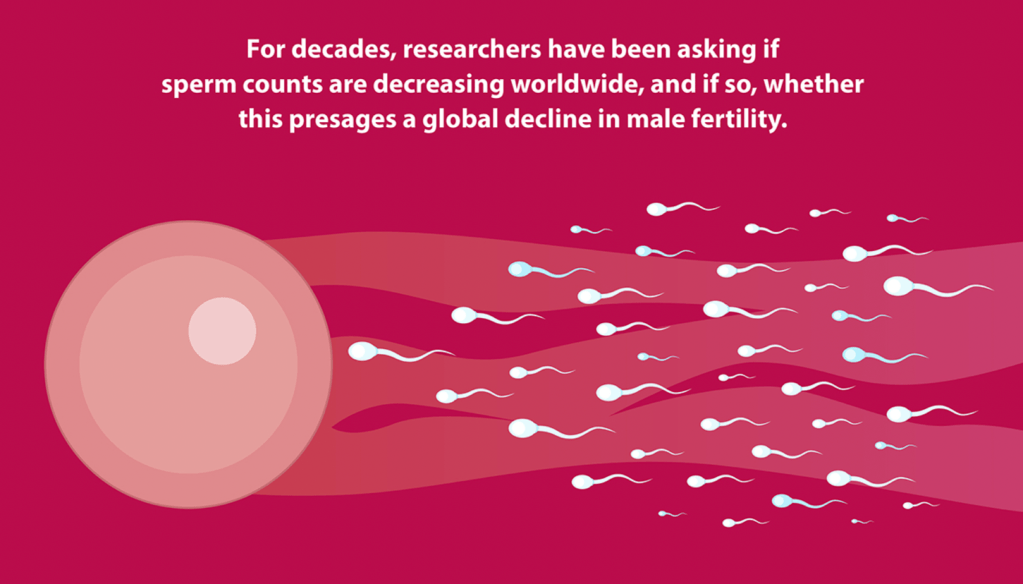
Global decline of male fertility: Fact or fiction?


“For decades, researchers have been asking if sperm counts are decreasing worldwide, and if so, whether this presages a global decline in male fertility. Most recently, a large systematic review and meta-regression analysis sought to identify trends in sperm counts between 1981 and 2013 and found that sperm counts appeared to be declining rather than stabilizing. One of the complicating features of relying on sperm count as a marker of fertility is that a low sperm count does not guarantee an inability to conceive. A large variety of factors, including tobacco, alcohol, and drug use; psychological stress; obesity; insufficient sleep; and environmental factors such as air pollutants and heavy metals, have been identified as potential risk factors affecting semen quality. Initial investigations recommended for a patient presenting with fertility concerns include a detailed history, physical examination, investigations based on the clinical context, and semen analysis for most patients. Although the evidence is conflicting, our review suggests that the potential decline in male sperm counts does not necessarily translate to a decline in male fertility.”

Global decline of male fertility: Fact or fiction? via BCMJ.

Innovations in early intervention for people with eating disorders

“Eating disorders are complex brain-based illnesses with both psychological and physical components. They affect almost 10% of the population and have become much more prevalent since the COVID-19 pandemic began.[1] They are characterized by significant disturbances in behaviors and attitudes that surround eating, body weight, and body shape[2] and include anorexia nervosa, bulimia nervosa, binge-eating disorder, night-eating syndrome, and other specified feeding and eating disorders. Eating disorders can lead to life-threatening medical complications and frequently co-occur with other debilitating mental illnesses such as bipolar, depressive, and anxiety disorders.[3] People with a family history of an eating disorder or any other significant mental illness are at increased risk of developing an eating disorder. Other factors affecting the onset of an eating disorder include the influence of media and diet culture, a history of trauma, and stressful life transitions and certain personality traits such as perfectionism.[4] Eating disorders occur across the gender spectrum, and people identifying as nonbinary or transgender are particularly at risk. Dieting for weight loss increases susceptibility to the development of these conditions. Since the COVID-19 pandemic began, the prevalence of eating disorders has increased dramatically as social isolation, job losses, financial insecurity, and uncertainty about the future have created a fertile environment where eating disorders can develop and thrive.

In Canada, wait times for treatment of eating disorders are unacceptably long—months or even years. Treatment programs are usually located in large urban centres, creating barriers for people living in remote and rural areas. Only when people become extremely ill are they eligible for inpatient treatment. People with serious eating disorders are at high risk for suicide, and difficulty in accessing services exacerbates this problem. Since the start of the pandemic, many hospital-based eating disorder treatment programs have cut back their services, deploying personnel to other areas of need. Many of these programs were slow to transition to a virtual format, leaving a critical gap in services.”

Learn more about what family physicians can do to help via BCMJ.

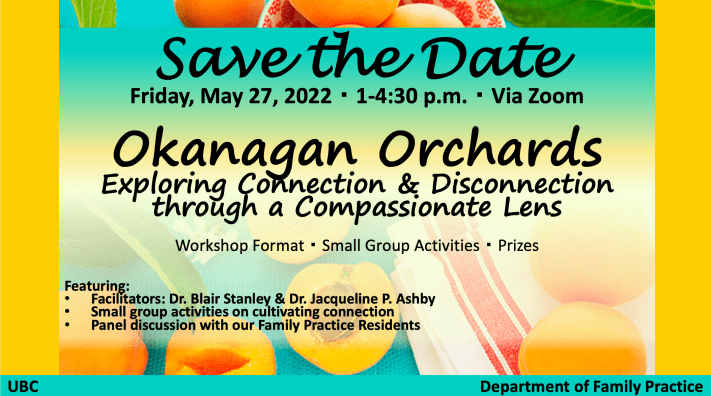
Okanagan Retreat 2022: Registration

Registration is now open for Okanagan Orchards, our annual faculty development and appreciation event, hosted by the UBC Family Practice Postgraduate Program.

This is a free virtual event on the afternoon of Friday, May 27th, 2022. Register here!

This event is open to all preceptors and faculty from across the province, as well as administration and resident leads.

We look forward to bringing our team together virtually for an interactive afternoon of intimate discussions, small workshops, and prizes!

Feel free to share this invitation with colleagues at your site. Please let me know if you have any questions. We look forward to seeing you in May! 

Larissa McLean, BA, MHA  
Manager, Rural Education & Initiatives
Faculty of Medicine | Department of Family Practice, Postgraduate Program 
The University of British Columbia
larissa.mclean@ubc.ca
http://postgrad.familymed.ubc.ca 

Climate Change: Understanding & Managing the Health Impacts of Wildfire Smoke

Climate change has had a huge impact on many aspects of human health. Please join us for this free online accredited educational session where highly experienced and knowledgeable medical experts will answer your questions, share their experiences and recommend best practices in understanding and managing the significant health impacts of wildfire smoke.

May 4 (Wed) | 1830–2000 PDT | Webinar: Register here
Audience: family physicians, specialists and other health care providers.
Meet our panel:

  • Dr. Courtney Howard, Emergency Physician, Clinical Associate Professor in the Cumming School of Medicine, University of Calgary
  • Dr. Dharma McBride, Emergency and Family Physician 
  • Dr. Emily Brigham, Respirologist, Legacy for Airway Health 
  • Dr. Michael Hadley, Cardiology Fellow, Mount Sinai Hospital (New York)
  • Dr. Sarah Henderson, Scientific Director in Environmental Health Services, BCCDC, Associate Professor, UBC School of Population & Public Health
  • Moderator: Dr. Christie Newton, Family Physician, Associate Professor, Associate Head Education and Engagement, Medical Director UBC Health Clinic, UBC

What Happened to Paxlovid?

Nirmatrelvir is an antiviral medication developed by Pfizer which acts as an orally active 3C-like protease inhibitor.[1][2][3][4][5] It is part of the nirmatrelvir/ritonavir combination used to treat COVID-19 and sold under the brand name Paxlovid via Wikipedia.

“The story of Paxlovid starts back in 2003, when the first SARS outbreak took place in Asia. Looking to develop a medication that could stop its spread, Pfizer started researching drugs that could block the action of a viral protein called a protease, which is necessary for the virus to replicate itself inside the host cell. One advantage of a medication like this, compared to a vaccine, is that it attacks a vulnerability of the virus that doesn’t mutate in the same way that the spike proteins targeted by vaccines do. That means it’s likely to be equally effective against all variants.

Pfizer’s preliminary research didn’t get too far before SARS petered out. But when SARS-CoV-2 popped up, they put the idea back on the fast track, ultimately trying out more than 600 candidate compounds in test tubes. The most promising were then tested in animals before being winnowed down once more for human trials.

Pfizer started testing Paxlovid in September 2021, enrolling patients who were suffering from mild to moderate symptoms — meaning they hadn’t been hospitalized yet — and were at high risk of their symptoms turning severe, either due to being over 65 or having comorbidities like obesity or diabetes. Pfizer expected the study to last into 2022, but was able to end the trial early because the results were so spectacular. It reduced hospitalizations in those who caught COVID by 90 percent and eliminated deaths entirely. Among the thousand or so trial participants who took the drug, none died, versus seven people in the control group.”

What Happened to Paxlovid? The COVID antiviral arrived too late for the Omicron wave, but it remains a powerful weapon via The Intelligencer.

Creativity as an Essential Aspect in Medical Education

Awakening, Artist: Ivan Marchuk

“Ukrainian teachers support the statement that creativity draws on both spontaneous
thought, originating from the default mode network, and on sustained cognitive control over those thoughts originating from a separate brain network (Beaty et al., 2015). Unfortunately, there is a lack of methods for systematic assessment of skills as critical thinking or creative thinking. In our opinion, integrating updated pedagogical methodology with creative techniques and interprofessionalism is a valuable approach for fostering students’ creativity and generating research skills. It is also compulsory to orient knowledge into the development of students’ systematic and logical viewpoint, scientific and theoretical beliefs, moral qualities, and active life position (Wiley & Jarosz, 2012).

It is necessary to mark that intensification of future doctor’s creative potential is performed through the formation of creative thinking, research skills, ability to interact with the information means, put and solve different tasks according to specific activities that may help in the formation and development of independence and cognitive research activities in the process of personal, specially organized student’s educational activities (Runco & Jaeger, 2012). Nevertheless, up-to-date training experience is not focused on the demands of contemporary society as: ‘we are currently preparing students for jobs that do not yet exist, to use technologies that have not yet been invented, and to solve problems that we don’t even know are problems yet’ (Darling-Hammond, 2008, p. 2).

Shaheen (2010) stated that for many developing countries, creativity remains neglected, whereas in developed countries, educational philosophy and goals rely on student’s enhancement of creativity and self-actualization. Consequently, we define creativity as both a talent and a skill that can be developed as an independent activity, which is closely connected with intellect, curiosity and analytical thinking.”

More on Creativity as an Essential Aspect in Medical Education via Creativity Studies.

Holding Artificial Intelligence to Account

“In this issue of The Lancet Digital Health, Xiaoxuan Liu and colleagues give their perspective on global auditing of medical artificial intelligence (AI). They call for the focus to shift from demonstrating the strengths of AI in health care to proactively discovering its weaknesses.

Machines make unpredictable mistakes in medicine, which differ significantly from those made by humans. Liu and colleagues state that errors made by AI tools can have far-reaching consequences because of the complex and opaque relationships between the analysis and the clinical output. Given that there is little human control over how an AI generates results and that clinical knowledge is not a prerequisite in AI development, there is a risk of an AI learning spurious correlations that seem valid during training but are unreliable when applied to real-world situations.”

Read more on Holding Artificial Intelligence to Account via The Lancet.

Nominations 2022 Faculty of Medicine Awards

To all faculty and staff,

Nominations are now open for the 2022 Faculty of Medicine Awards.

This suite of Faculty of Medicine awards was recently refreshed in 2021 and includes several new awards which were launched last year with much success. These awards provide an expanded opportunity to acknowledge outstanding faculty and staff members who demonstrate exceptional contributions to the Faculty, and who are also dedicated to advancing our values and our vision of transforming health for everyone.

Please review the awards and nominations guidelines carefully and submit your nominations by Friday, June 10th. Recipients will be announced this summer, and the awards will be presented at our annual reception in the fall.

Sincerely,

Dermot Kelleher, MB, MD, FRCP, FRCPI, FMedSci, FCAHS, FRCPC, AGAF
Professor, Department of Medicine
Dean, Faculty of Medicine
Vice-President, Health
The University of British Columbia

Award Categories

For information on each award category and to download a nomination form, click on the links listed below.

*New award launched in 2021

Skin Color Bias & Health Outcomes

“In this research note, we use data from the National Longitudinal Study of Adolescent to Adult Health (Add Health) to determine whether darker skin tone predicts hypertension among siblings using a family fixed-effects analytic strategy. We find that even after we account for common family background and home environment, body mass index, age, sex, and outdoor activity, darker skin color significantly predicts hypertension incidence among siblings. In a supplementary analysis using newly released genetic data from Add Health, we find no evidence that our results are biased by genetic pleiotropy, whereby differences in alleles among siblings relate to coloration and directly to cardiovascular health simultaneously. These results add to the extant evidence on color biases that are distinct from those based on race alone and that will likely only heighten in importance in an increasingly multiracial environment as categorization becomes more complex.”

More on New Evidence of Skin Color Bias and Health Outcomes Using Sibling Difference Models: A Research Note via Demography.