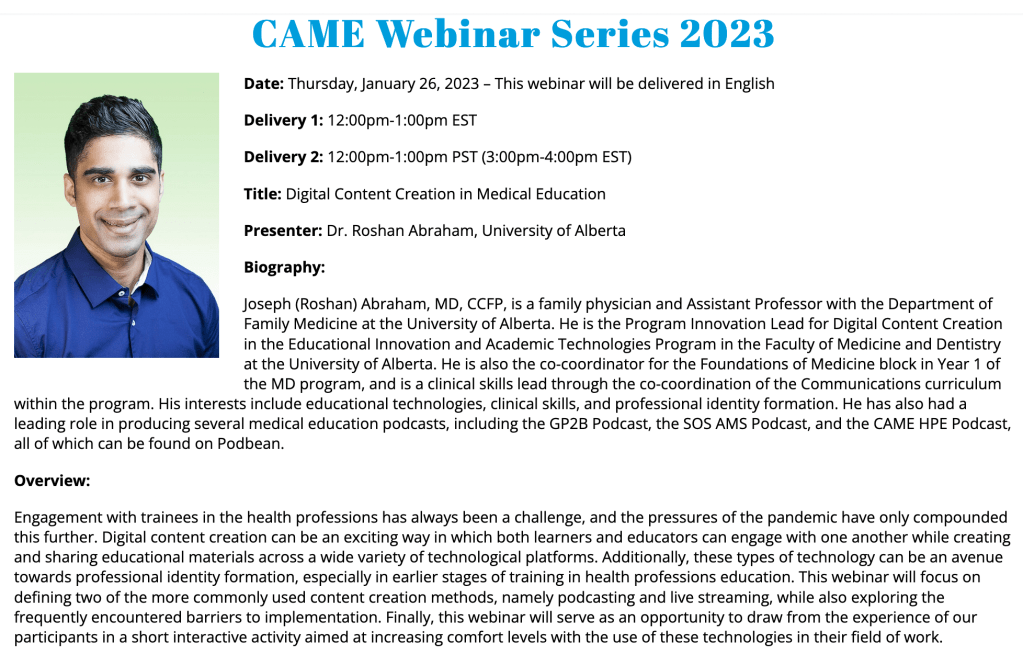
WHRI Events

Accelerating Access to Abortion Care Through Policy-partnered Research

In this talk, Dr. Sarah Munro will introduce attendees to the landscape of abortion access in Canada and the factors that facilitate uptake of stigmatized practices like abortion care. This presentation will also highlight the characteristics of integrated knowledge translation that lead to abortion policy and systems change, including how community partnerships shape and accelerate this work.

Dr. Sarah Munro is a qualitative health services researcher whose focus is knowledge translation and implementation science in women’s health. She is a Co-Director of the Contraception and Abortion Research Team (CART-GRAC), an Assistant Professor in the UBC Department of Obstetrics & Gynaecology and a Scientist with the Centre for Health Evaluation and Outcomes Sciences (CHÉOS). Her program of research is supported by a Michael Smith Health Research BC Scholar Award and the Canadian Institutes of Health Research.

When: January 18, 2023 @ 12:00–1:00 pm

Register here.

Ministry of Silly Walks

Abstract

Objective: To compare the rate of energy expenditure of low efficiency walking with high efficiency walking.

Design: Laboratory based experimental study.

Setting: United States.

Participants: 13 healthy adults (six women, seven men) with no known gait disorder, mean (±standard deviation) age 34.2±16.1 years, height 174.2±12.6 cm, weight 78.2±22.5 kg, and body mass index 25.6±6.0.

Intervention: Participants performed three, five minute walking trials around an indoor 30 m course. The first trial consisted of walking at a freely chosen walking speed in the participant’s usual style. The next two trials consisted of low efficiency walks in which participants were asked to duplicate the walks of Mr Teabag and Mr Putey (acted by John Cleese and Michael Palin, respectively) in the legendary Monty Python Ministry of Silly Walks (MoSW) skit that first aired in 1970. Distance covered during the five minute walks was used to calculate average speed. Ventilation and gas exchange were collected throughout to determine oxygen uptake (V̇O2; mL O2/kg/min) and energy expenditure (EE; kcal/kg/min; 1 kcal=4.18 kJ), reported as mean±standard deviation.

Main outcome measures: V̇O2 and EE.

Results: V̇O2 and EE were about 2.5 times higher (P<0.001) during the Teabag walk compared with participants’ usual walk (27.9±4.8 v 11.3±1.9 mL O2/kg/min; 0.14±0.03 v 0.06±0.01 kcal/kg/min), but were not different during the Putey walk (12.3±1.8 mL/kg/min; 0.06±0.01 kcal/kg/min). Each minute of Teabag walking increased EE over participants’ usual walking by an average of 8.0 kcal (range 5.5-12.0) in men and by 5.2 kcal (range 3.9-6.2) in women, and qualified as vigorous intensity physical activity (>6 resting metabolic equivalents).

Conclusions: For adults with no known gait disorder who average approximately 5000 steps/day, exchanging about 22%-34% of their daily steps with higher energy, low efficiency walking in Teabag style—requiring around 12-19 min—could increase daily EE by 100 kcal. Adults could achieve 75 minutes of vigorous intensity physical activity per week by walking inefficiently for about 11 min/day. Had an initiative to promote inefficient movement been adopted in the early 1970s, we might now be living among a healthier society. Efforts to promote higher energy—and perhaps more joyful—walking should ensure inclusivity and inefficiency for all.

Learn more on Quantifying the benefits of inefficient walking: Monty Python inspired laboratory based experimental study via BMJ.

Achievement of Treatment Targets Among Patients with Type 2 Diabetes

“Woman Shooting Cherry Blossoms” (2019) Yinka Shonibare CBE

“Background: An update on the degree to which patients with type 2 diabetes in Canada achieve treatment targets is needed to document progress and identify subgroups that need attention. We sought to estimate the frequency with which patients managed in primary care met treatment targets (i.e., HbA1c ≤ 7.0%, blood pressure < 130/80 mm Hg and low-density lipoprotein cholesterol [LDL-C] < 2.00 mmol/L), guideline-based use of statins and of angiotensin-convertingenzyme (ACE) inhibitors or angiotensin receptor blockers (ARBs), and the effects of patient age and sex.

Methods: We conducted a cross-sectional study of 32 503 and 44 930 adults with diabetes in Canada on June 30, 2015, and 2020, respectively, using electronic medical record data from primary care practices across 5 provinces. We grouped achievement of diabetes targets by age and sex, and compared between groups using logistic regression with adjustment for cardiovascular comorbidities.

Results: In 2020, target HbA1c levels were achieved for 63.8% of women and 58.9% of men. Blood pressure and LDL-C targets were achieved for 45.6% and 45.8% of women, and for 43.1% and 59.4% of men, respectively. All 3 treatment targets were achieved for 13.3% of women and 16.5% of men. Overall, 45.3% and 54.0% of women and men, respectively, used statins; 46.5% of women used ACE inhibitors or ARBs, compared with 51.9% of men. With the exception of blood pressure and HbA1c levels among women, target achievement was lower among younger patients. Achievement of the LDL-C target, statin use and ACE inhibitor or ARB use were lower among women at any age. From 2015 to 2020, target achievement increased for HbA1c, remained consistent for LDL-C and declined for blood pressure; use of statins and of ACE inhibitors or ARBs also declined.”

Achievement of treatment targets among patients with type 2 diabetes in 2015 and 2020 in Canadian primary care via CMAJ.

Globes and Astronaut Helmets Form Heads of Figurative Sculptures by Artist Yinka Shonibare CBE via Colossal.

Myocardial Infarction Following COVID-19 Vaccine Administration

“Vaccination against coronavirus disease 2019 (COVID-19) is the safest and most effective strategy for controlling the pandemic. However, some cases of acute cardiac events following vaccine administration have been reported, including myocarditis and myocardial infarction (MI). While post-vaccine myocarditis has been widely discussed, information about post-vaccine MI is scarce and heterogenous, often lacking in histopathological and pathophysiological details. We hereby present five cases (four men, mean age 64 years, range 50–76) of sudden death secondary to MI and tightly temporally related to COVID-19 vaccination. In each case, comprehensive macro- and microscopic pathological analyses were performed, including post-mortem cardiac magnetic resonance, to ascertain the cause of death. To investigate the pathophysiological determinants of MI, toxicological and tryptase analyses were performed, yielding negative results, while the absence of anti-platelet factor 4 antibodies ruled out vaccine-induced thrombotic thrombocytopenia. Finally, genetic testing disclosed that all subjects were carriers of at least one pro-thrombotic mutation. Although the presented cases do not allow us to establish any causative relation, they should foster further research to investigate the possible link between COVID-19 vaccination, pro-thrombotic genotypes, and acute cardiovascular events.”

Read more on Myocardial Infarction Following COVID-19 Vaccine Administration: Post Hoc, Ergo Propter Hoc? via Viruses.

FAQs: WorkSafeBC & your Patients

Q. How do I initiate a WorkSafeBC claim for a patient with an injury or disease I think might be related to the workplace?
A: Your initial examination and treatment start injured workers on the path to recovery. As the patient’s physician, you are an important partner in that process. When your patient comes to you for initial treatment of a work-related injury or disease, fill out a Form 8. Please complete and submit the form as soon as possible after treating an injured worker for the first time; the sooner the claim is registered, the sooner your patient can receive applicable health care and wage loss benefits.

Physicians are reimbursed on a scale for Form 8/11 submission, which reflects the importance of your patient’s ability to access benefits in a timely way. Reimbursement is highest if the form is submitted on the first day the injured worker is seen, with decreases each day after that. Physicians will not be reimbursed if the form is received by WorkSafeBC 6 business days or more after the injured worker is seen.

Please ask your patient if they have reported their injury to WorkSafeBC. If they haven’t, remind them to call WorkSafeBC Teleclaim (604 231-8888 or 1 888 967-5377 toll-free).”

Read more on WorkSafeBC and your patients with workplace injuries: Frequently asked questions via BCMJ.

Health and Safety Threats to Ukraine From Nonconventional Weapons

“Although a focus on trauma response and humanitarian care is essential for the ongoing Russia-Ukraine war, recent posturing by Russian leadership indicates that radiological or nuclear weapons could be used to defend illegally annexed territories in Ukraine. This situation necessitates readiness for nonconventional warfare threats, which include chemical, biological, radiological, nuclear, and explosives (CBRNE) attacks. CBRNE preparedness has been variable among Ukrainian and European Union member states, which may be called on to detect and respond to potential attacks. Russia or its proxies have used CBRNE weapons in several recent conflicts, and awareness of these risks and mitigation strategies are prudent measures now. Based on these historical ingressions, prioritizing education and equipment for health care professionals to recognize and respond to potential CBRNE threats within Ukraine and bordering countries is essential.

Despite regulations against the use of chemical weapons by the Organisation for the Prohibition of Chemical Weapons (OPCW), Russian chemical weapons research has focused on developing highly potent weaponized organophosphates, or nerve agents. The past decade has seen Russia use these agents in assassination attempts of the Skripals and Alexei Navalny through the introduction of nerve agents in food and clothing. These fourth-generation agents (eg, Novichok, a group of nerve agents) are characterized by their lethality, unconventional routes of poisoning, and long-term environmental persistence. Russia’s connections to Syria also provide insight. The majority of the more than 55 chemical weapon attacks in Syria between 2013 and 2018 involved chlorine gas or the deadly nerve agent sarin in cannisters or combined with bombs dropped from aircraft. Although these events have been attributed to the Syrian government, the close relationship between Syria’s Assad regime and Russia suggests that these indiscriminate strategies could be used in the current conflict.

Weaponized opioids have also been used during the Putin regime. In 2002, Chechen terrorists attacked the Dubrovka Theater in Moscow, resulting in a hostage standoff. In response, Russian special forces instilled a chemical aerosol into the theater’s vents, incapacitating occupants and resulting in 125 deaths. Analysis of clothing from 2 victims demonstrated the presence of remifentanil and carfentanyl, 2 potent opioids, with death likely from poisoning. Although less practical on the battlefield, it is plausible that the Russian military could use similar compounds to cause serious casualties among opposing soldiers, political protestors, or civilians trapped in buildings, hospitals, subways, or bomb shelters.”

Read more on Health and Safety Threats to Ukraine From Nonconventional Weapons: A Clear and Present Danger via JAMA.


Smartphones, Social Media Use, & Youth Mental Health

  • ARTICLES KEY POINTS:
  • “Evidence from a variety of cross-sectional, longitudinal and empirical studies implicate smartphone and social media use in the increase in mental distress, self-injurious behaviour and suicidality among youth; there is a dose–response relationship, and the effects appear to be greatest among girls.
  • Social media can affect adolescents’ self-view and interpersonal relationships through social comparison and negative interactions, including cyberbullying; moreover, social media content often involves normalization and even promotion of self-harm and suicidality among youth.
  • High proportions of youth engage in heavy smartphone use and media multitasking, with resultant chronic sleep deprivation, and negative effects on cognitive control, academic performance and socioemotional functioning.
  • Clinicians can work collaboratively with youth and their families, using open, nonjudgmental and developmentally appropriate approaches to reduce potential harms from social media and smartphone use, including education and practical problem-solving.
  • There is a need for public awareness campaigns and social policy initiatives that promote nurturing home and school environments that foster resilience as youth navigate the challenges of adolescence in today’s world.”

Learn more about Smartphones, Social Media Use & Youth Mental Health via CMAJ.

Cannabis Vaping: Acute & Long-Term Risks

“The rapid emergence of youth vaping has completely changed the landscape of adolescent substance use in Canada and has become a pressing public health issue of our time. While nicotine remains the most common substance encountered in vaping devices, cannabis vaping is now reported by one-third of youth who vape. Though cannabis vaping is thought to generate fewer toxic emissions than cannabis smoking, it has been associated with several cases of acute lung injury and often involves high-potency forms of cannabis, exposing youth to several acute and long-term health risks. The low perceived riskiness of cannabis as a substance and of vaping as a mode of consumption may bring a false sense of security and be particularly appealing for youth who may be looking for a ‘healthier way’ to use substances. While research is still lacking on how best to support youth who may have already initiated cannabis vaping, concerted efforts among paediatric providers, public health experts, schools, communities, and families are urgently needed to limit the spread of cannabis vaping among Canadian youth.”

Learn more on Cannabis vaping: Understanding the health risks of a rapidly emerging trend via Paediatr Child Health.

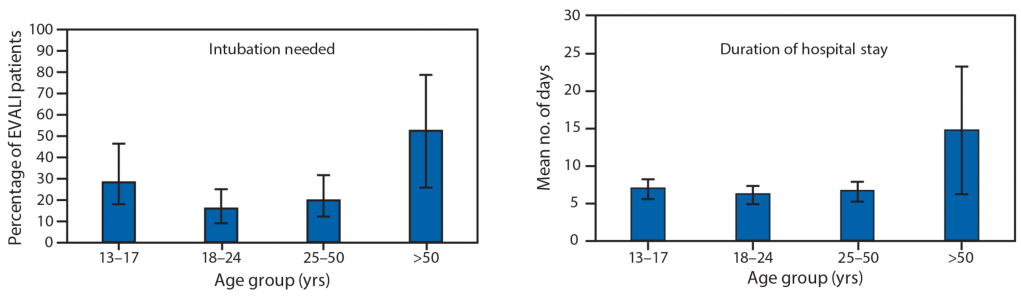
Percentage of persons needing intubation and hospitalization among persons with vaping-associated lung injury.

Read more on the 2019-2020 Vaping Lung Illness Outbreak in Canada here.