
 Register for the event here!
Women Collaborating Globally

“It takes a global effort. In a visionary and bold initiative, women leaders from different countries are coming together to identify priorities and opportunities for international collaboration. ‘Women in Science, Health and Innovation: Leadership Looking To The Future‘ will be held in Vancouver on March 7. In this event that ties to International Women’s Day — and foreshadows the 2019 Women Deliver conference in Vancouver on gender equality — researchers and speakers from Canada, France, the Netherlands, the United Kingdom, Switzerland, Germany and the United States will come together to address important questions:
1. What have been the greatest changes in North America and Europe and over time for women in health, science and innovation?
2. What have been some of the historical and incentives barriers to women entering engineering and physical sciences?
3. What is on the agenda for coming years in gender, medical research and innovation?
4. How have women in the past set the path for women in academic medicine and entrepreneurship of the future?”
More on Women in health, science and innovation are collaborating globally by Dr. Judy Illes, Professor of Neurology and Canada Research Chair in Neuroethics at the University of British Columbia. She is Director of the National Core for Neuroethics at UBC, and faculty in the Brain Research Centre at UBC and at the Vancouver Coastal Health Research Institute.
Scholar Public Lecture

Ms. Dion Stout was born and raised on the Kehewin First Nation in Alberta, and adopts a Cree lens in her research, writing and lectures on First Nations health and health care. She is a past President of the Canadian Indigenous Nurses Association and appointee to the National Forum on Health. She is the recipient of the Assiniwikamik Award from the Aboriginal Nurses Association of Canada; a Distinguished Alumnus Award from the University of Lethbridge; and Honorary Doctor of Laws from the University of British Columbia, the University of Ottawa and Carleton University. In November 2008, the Canadian Nurses Association of Canada selected Madeleine for the Centennial Award that was given to 100 outstanding Canadian nurses. In March 2010 she won the National Aboriginal Achievement Award (Indspire Award) in the health category. Madeleine was appointed as a Member of the Order of Canada on July 1, 2015 and has been featured in recent editions of the Canadian WHO’S WHO. See full bio and event details by clicking here.

Upcoming Webinars
Greetings! There are a couple of free webinars coming up that I wanted to share:
The next webinar in The International Association for Medical Education (AMEE) Spring Webinar series will be hosted by the AMEE Faculty Development Committee on:
Using a peer support strategy to strengthen workplace supervision
Presented by Drs. Helen Wozniak & Narelle Campbell
Wednesday, March 6, 2019 at 12:00 (noon) GMT/UK.
You can access the webinars by joining here when the webinar begins.
&
The Association for Talent Development (ATD) will be hosting a webinar on:
The brain science of healthcare patient and provider satisfaction and why VR provides an ideal solution
Presented by learning scientist Todd Maddox, PhD, and IKONA CEO Tim Fitzpatrick
Friday, March 15, 2019 from 10-11 PDT
Find more information and register here.
Resident Policies & Procedures 2018-2019
The UBC Faculty of Medicine Postgraduate Office recently updated our Resident Policies and Procedures Manual for 2018-2019. This includes your academic year rotation schedule, resident wellness, payroll and benefits contact information, resident management system (RMS), and more! Please download a copy.
(Thank you Dr. Brenda Hardie for the forward!)
AHD Guest Speaker Series: Expanding Patient Partnerships: Better Experiences For All
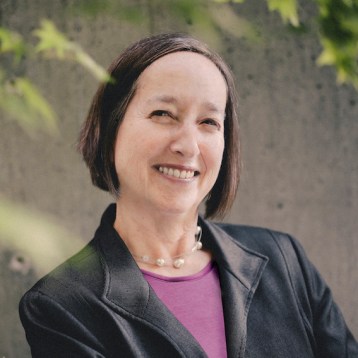 Join Carolyn to explore “relationship-based care” for better patient experiences and outcomes, and to provide a more rewarding professional life. Understanding your patient’s care goals, expectations, fears, values and social landscape can build greater patient self-efficacy and initiative, and also daily opportunities to see how you are making a difference in lives. She will draw on her own experiences in uncovering new dimensions to patient harm, strategies for greater patient safety and developing systems resilience from an ecosystem perspective of care. Co-design and co-delivery with patients and family members as your improvement partners offers refreshing innovation and collaboration as a regular part of the workday. We’ll describe small practices that can deliver big rewards for everyone.
Academic Half Day
Thursday, April 25, 2019
ARHCC Baker 103 Conference Room
9:30 a.m. – 11:30 a.m.
Preceptors and Clinical Educators are welcome to attend!
Carolyn Canfield works as a citizen-patient across Canada and internationally to expand opportunities for patients, carers and communities to partner with healthcare professionals. Following personal tragedy in 2008, her full-time volunteering has earned her recognition as Canada’s first Patient Safety Champion in 2014, appointment at UBC as Adjunct Professor in the Department of Family Practice, and membership on UBC’s MD Admissions Subcommittee member. She co-founded BC’s Patients in Education (PIE) and the national Patient Advisors Network (PAN) to develop capacity and leadership in citizen-patients.
The recent “patient engagement” issue of Longwoods’ Healthcare Quarterly, featured Carolyn’s commentary: “The Capacity for Patient Engagement: What Patient Experiences Tell Us About What’s Ahead.”
AHD: Practice Management
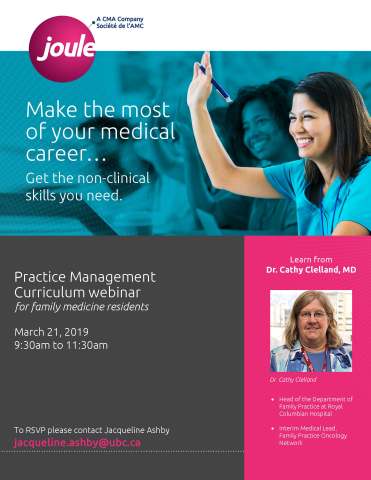
Greetings Residents! A few months ago I sent out a poll asking what Practice Management sessions you wanted in 2019. You responded and so I’ve scheduled the following for Thursday, March 21 from 9:30-11:30:
- So you’re finishing residency: What you wish someone had told you (fees, licences, memberships)
- Evaluating payment and practice options in British Columbia
If you’re unable to join us due to rural or electives, please email me at jacqueline.ashby@ubc.ca and I’ll forward out a link to the session.
Warm regards,
Jacqueline
Laughter & Medicine

“In the new study, published in The Journal of Clinical Investigation, Jon T. Willie, Kelly Bijanki, and their colleagues at Emory University School of Medicine, Atlanta, looked at a 23-year-old undergoing iEEG for 8 weeks in preparation for surgery to treat her uncontrolled epilepsy [1]. One of the electrodes implanted in her brain was located within the cingulum bundle and, when that area was stimulated for research purposes, the woman experienced an uncontrollable urge to laugh. Not only was the woman given to smiles and giggles, she also reported feeling relaxed and calm.”
More on Discovering a Source of Laughter in the Brain (2019) by Dr. Francis Collins.
Coaching Communication
“Dr. Pollak taught two skills that are core to patient-centered communication and also identified by clinicians as areas in which they needed help: recognizing patient emotion and responding to negative emotion. The coach instructed clinicians how to identify negative emotions even when patients were not expressing them directly. For example, anxiety often prompts patients or caregivers to rapidly ‘pepper’ clinicians with questions,12 and many questions that initially appear as medical actually represent negative emotions. ‘Are the tumors getting bigger?’ represents fear or anxiety, and needs a response that addresses that fear, rather than a factual response about how many millimeters the tumors are currently.”
From Coach, Don’t Just Teach (2019) by Kathryn I. Pollak, PhD, Xiaomei Gao, MA & Laura P. Svetkey, MD, MHS
(Thank you Dr. Chow for sharing!)
 Family Medicine Residency Site: Abbotsford-Mission