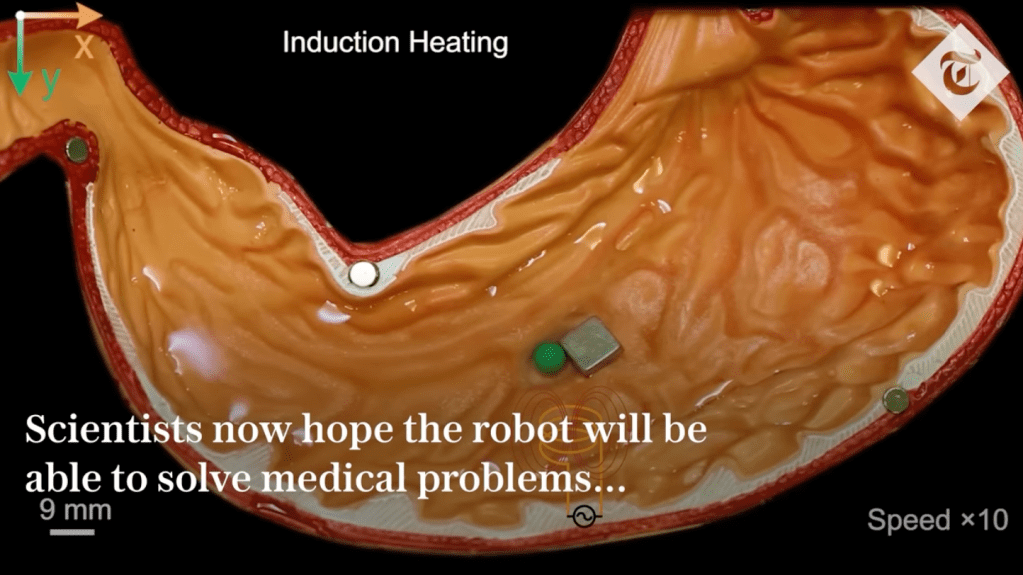
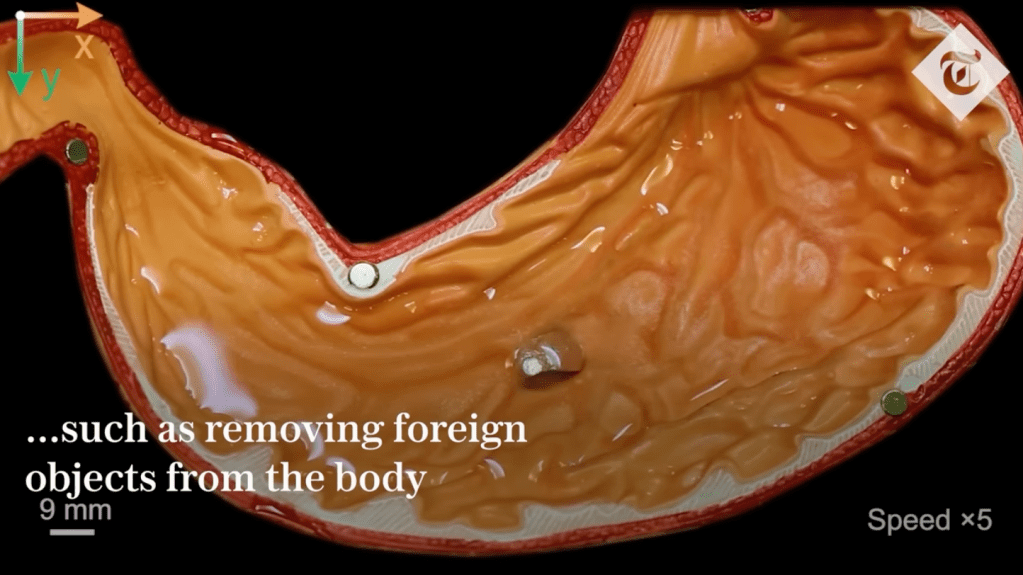
“Scientists have been developing magnetically controlled soft robots for years. Most existing materials for these bots are made of either stretchy but solid materials, which can’t pass through the narrowest of spaces, or magnetic liquids, which are fluid but unable to carry heavy objects (SN: 7/18/19).
In the new study, researchers blended both approaches after finding inspiration from nature (SN: 3/3/21). Sea cucumbers, for instance, ‘can very rapidly and reversibly change their stiffness,’ says mechanical engineer Carmel Majidi of Carnegie Mellon University in Pittsburgh. ‘The challenge for us as engineers is to mimic that in the soft materials systems.’
So the team turned to gallium, a metal that melts at about 30° Celsius — slightly above room temperature. Rather than connecting a heater to a chunk of the metal to change its state, the researchers expose it to a rapidly changing magnetic field to liquefy it. The alternating magnetic field generates electricity within the gallium, causing it to heat up and melt. The material resolidifies when left to cool to room temperature.”
Learn more on “These shape-shifting devices melt and re-form thanks to magnetic fields” via ScienceNews.
“Army nurse preparing to enter a COVID-19 positive room to treat patients”. Artist: Sgt. 1st Class Curt Loter via Bayne-Jones Army Community Hospital.
“Diagnostic errors are especially prone to raise concern among clinicians because they are associated with physicians’ self-identity and are often viewed as personal failings resulting in feelings of shame rather than as a signal to investigate the systems issues behind the problem. Because the underlying data are often imperfect, physicians often challenge their accuracy rather than interpret them as a call for improvement. … The health care profession needs to accept that physicians, being human, are fallible—systems of care to reduce diagnostic errors to a minimum must be designed. ED overcrowding is not an emergency medicine problem. It is a system problem and requires a system-level solution. Specific diagnosis-focused solutions might include checklists or cognitive aids that are pushed real time to clinicians, capturing, correcting, and preventing diagnostic errors in a timely and blame-free way. Machine learning, better access to advanced imaging and specialist consultation, development of reliable diagnostic biomarkers, improvements in health information technology, and clinical decision support need to be studied and employed as parts of the solution. Training modules that target the big 3 disease entities need to be developed at the medical school, residency, and practicing physician levels for all specialties involved in diagnosing those patients.”
Misdiagnosis in the Emergency DepartmentTime for a System Solution via JAMA.
“Mohs micrographic surgery is often used to remove basal cell cancers. During Mohs surgery the tumor is shaved away in thin layers, one layer at a time. Each layer is checked immediately under a microscope.
This allows the surgeon to preserve as much healthy skin as possible while removing all of the cancer and a thin margin of healthy skin. This surgery is a highly effective treatment for basal cell cancer and often has very good cosmetic results.
Basal cell cancers form in the epidermis, the protective, outermost layer of our skin. The cancerous cells invade surrounding tissues, usually forming a painless pearly bump.”
More on An effective treatment for basal cell cancers via Reviewed by Howard E. LeWine, MD, Chief Medical Editor, via Harvard Health Publishing.
Accelerating Access to Abortion Care Through Policy-partnered Research
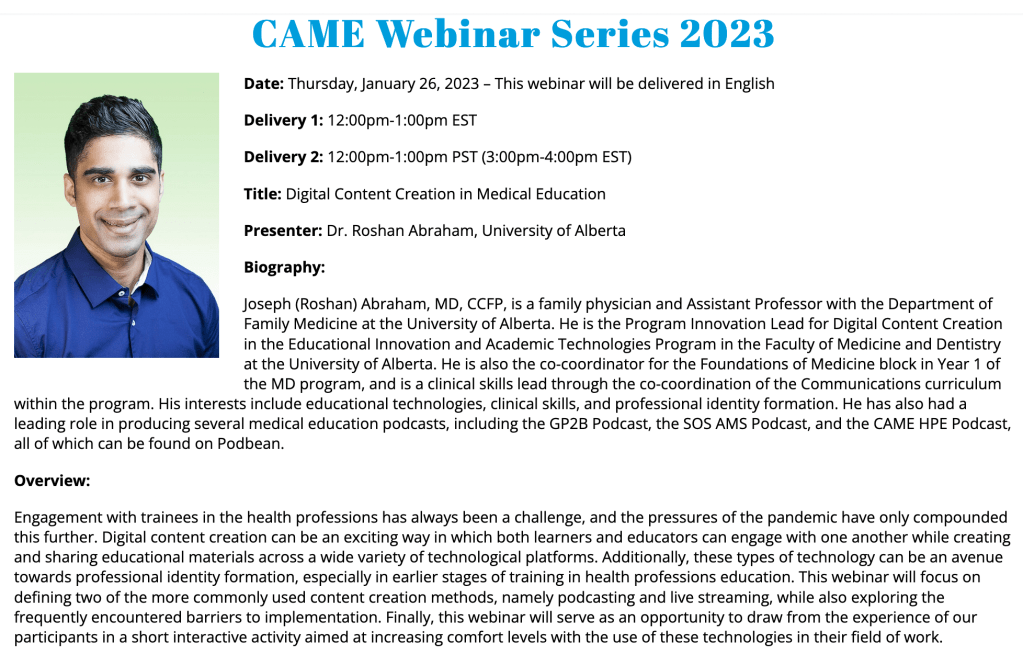
In this talk, Dr. Sarah Munro will introduce attendees to the landscape of abortion access in Canada and the factors that facilitate uptake of stigmatized practices like abortion care. This presentation will also highlight the characteristics of integrated knowledge translation that lead to abortion policy and systems change, including how community partnerships shape and accelerate this work.
Dr. Sarah Munro is a qualitative health services researcher whose focus is knowledge translation and implementation science in women’s health. She is a Co-Director of the Contraception and Abortion Research Team (CART-GRAC), an Assistant Professor in the UBC Department of Obstetrics & Gynaecology and a Scientist with the Centre for Health Evaluation and Outcomes Sciences (CHÉOS). Her program of research is supported by a Michael Smith Health Research BC Scholar Award and the Canadian Institutes of Health Research.
Objective: To compare the rate of energy expenditure of low efficiency walking with high efficiency walking.
Design: Laboratory based experimental study.
Setting: United States.
Participants: 13 healthy adults (six women, seven men) with no known gait disorder, mean (±standard deviation) age 34.2±16.1 years, height 174.2±12.6 cm, weight 78.2±22.5 kg, and body mass index 25.6±6.0.
Intervention: Participants performed three, five minute walking trials around an indoor 30 m course. The first trial consisted of walking at a freely chosen walking speed in the participant’s usual style. The next two trials consisted of low efficiency walks in which participants were asked to duplicate the walks of Mr Teabag and Mr Putey (acted by John Cleese and Michael Palin, respectively) in the legendary Monty Python Ministry of Silly Walks (MoSW) skit that first aired in 1970. Distance covered during the five minute walks was used to calculate average speed. Ventilation and gas exchange were collected throughout to determine oxygen uptake (V̇O2; mL O2/kg/min) and energy expenditure (EE; kcal/kg/min; 1 kcal=4.18 kJ), reported as mean±standard deviation.
Main outcome measures: V̇O2 and EE.
Results: V̇O2 and EE were about 2.5 times higher (P<0.001) during the Teabag walk compared with participants’ usual walk (27.9±4.8 v 11.3±1.9 mL O2/kg/min; 0.14±0.03 v 0.06±0.01 kcal/kg/min), but were not different during the Putey walk (12.3±1.8 mL/kg/min; 0.06±0.01 kcal/kg/min). Each minute of Teabag walking increased EE over participants’ usual walking by an average of 8.0 kcal (range 5.5-12.0) in men and by 5.2 kcal (range 3.9-6.2) in women, and qualified as vigorous intensity physical activity (>6 resting metabolic equivalents).
Conclusions: For adults with no known gait disorder who average approximately 5000 steps/day, exchanging about 22%-34% of their daily steps with higher energy, low efficiency walking in Teabag style—requiring around 12-19 min—could increase daily EE by 100 kcal. Adults could achieve 75 minutes of vigorous intensity physical activity per week by walking inefficiently for about 11 min/day. Had an initiative to promote inefficient movement been adopted in the early 1970s, we might now be living among a healthier society. Efforts to promote higher energy—and perhaps more joyful—walking should ensure inclusivity and inefficiency for all.
Learn more on Quantifying the benefits of inefficient walking: Monty Python inspired laboratory based experimental study via BMJ.
“Background: An update on the degree to which patients with type 2 diabetes in Canada achieve treatment targets is needed to document progress and identify subgroups that need attention. We sought to estimate the frequency with which patients managed in primary care met treatment targets (i.e., HbA1c ≤ 7.0%, blood pressure < 130/80 mm Hg and low-density lipoprotein cholesterol [LDL-C] < 2.00 mmol/L), guideline-based use of statins and of angiotensin-convertingenzyme (ACE) inhibitors or angiotensin receptor blockers (ARBs), and the effects of patient age and sex.
Methods: We conducted a cross-sectional study of 32 503 and 44 930 adults with diabetes in Canada on June 30, 2015, and 2020, respectively, using electronic medical record data from primary care practices across 5 provinces. We grouped achievement of diabetes targets by age and sex, and compared between groups using logistic regression with adjustment for cardiovascular comorbidities.
Results: In 2020, target HbA1c levels were achieved for 63.8% of women and 58.9% of men. Blood pressure and LDL-C targets were achieved for 45.6% and 45.8% of women, and for 43.1% and 59.4% of men, respectively. All 3 treatment targets were achieved for 13.3% of women and 16.5% of men. Overall, 45.3% and 54.0% of women and men, respectively, used statins; 46.5% of women used ACE inhibitors or ARBs, compared with 51.9% of men. With the exception of blood pressure and HbA1c levels among women, target achievement was lower among younger patients. Achievement of the LDL-C target, statin use and ACE inhibitor or ARB use were lower among women at any age. From 2015 to 2020, target achievement increased for HbA1c, remained consistent for LDL-C and declined for blood pressure; use of statins and of ACE inhibitors or ARBs also declined.”
Achievement of treatment targets among patients with type 2 diabetes in 2015 and 2020 in Canadian primary care via CMAJ.
Globes and Astronaut Helmets Form Heads of Figurative Sculptures by Artist Yinka Shonibare CBE via Colossal.
You need to be affiliated with UBC to register. Click here to register. If you have any questions, please contact Faculty Development at fac.dev@ubc.ca.
“Vaccination against coronavirus disease 2019 (COVID-19) is the safest and most effective strategy for controlling the pandemic. However, some cases of acute cardiac events following vaccine administration have been reported, including myocarditis and myocardial infarction (MI). While post-vaccine myocarditis has been widely discussed, information about post-vaccine MI is scarce and heterogenous, often lacking in histopathological and pathophysiological details. We hereby present five cases (four men, mean age 64 years, range 50–76) of sudden death secondary to MI and tightly temporally related to COVID-19 vaccination. In each case, comprehensive macro- and microscopic pathological analyses were performed, including post-mortem cardiac magnetic resonance, to ascertain the cause of death. To investigate the pathophysiological determinants of MI, toxicological and tryptase analyses were performed, yielding negative results, while the absence of anti-platelet factor 4 antibodies ruled out vaccine-induced thrombotic thrombocytopenia. Finally, genetic testing disclosed that all subjects were carriers of at least one pro-thrombotic mutation. Although the presented cases do not allow us to establish any causative relation, they should foster further research to investigate the possible link between COVID-19 vaccination, pro-thrombotic genotypes, and acute cardiovascular events.”
Read more on Myocardial Infarction Following COVID-19 Vaccine Administration: Post Hoc, Ergo Propter Hoc? via Viruses.
“Q. How do I initiate a WorkSafeBC claim for a patient with an injury or disease I think might be related to the workplace? A: Your initial examination and treatment start injured workers on the path to recovery. As the patient’s physician, you are an important partner in that process. When your patient comes to you for initial treatment of a work-related injury or disease, fill out a Form 8. Please complete and submit the form as soon as possible after treating an injured worker for the first time; the sooner the claim is registered, the sooner your patient can receive applicable health care and wage loss benefits.
Physicians are reimbursed on a scale for Form 8/11 submission, which reflects the importance of your patient’s ability to access benefits in a timely way. Reimbursement is highest if the form is submitted on the first day the injured worker is seen, with decreases each day after that. Physicians will not be reimbursed if the form is received by WorkSafeBC 6 business days or more after the injured worker is seen.
Please ask your patient if they have reported their injury to WorkSafeBC. If they haven’t, remind them to call WorkSafeBC Teleclaim (604 231-8888 or 1 888 967-5377 toll-free).”
Read more on WorkSafeBC and your patients with workplace injuries: Frequently asked questions via BCMJ.
from the Abbotsford-Mission Family Practice Residency Program! Learn more about our Abbotsford Foundry where youth and families can learn, grow, and thrive amid life’s challenges here.







 Family Medicine Residency Site: Abbotsford-Mission