Translational Simulation

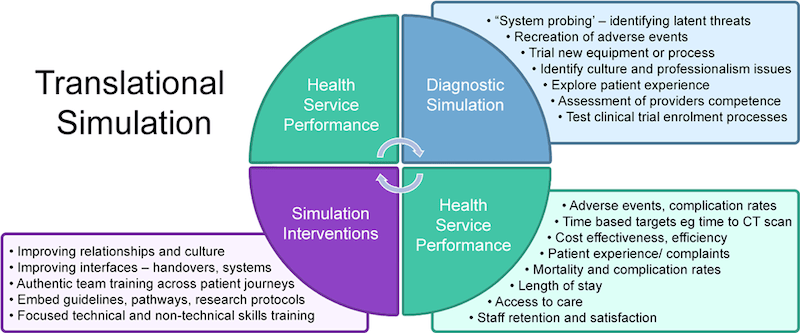
Translational-Sim-3.png

“Dr. Victoria Brazil from Bond University and Gold Coast Health Australia, suggests that translational simulation can be used to link educational activities to patient level outcomes even though measurement outcomes may be harder to measure. Brazil suggests that medical simulation should focus on ‘not where but why.’ ‘Descriptions of simulation type often use the device (e.g. high fidelity mannequin simulation) or place, e.g. in situ simulation (ISS), but these descriptors underplay the critical importance of outcomes from simulation, e.g. individual competence, team behaviors or patient level outcomes'” (Brazil Advances in Simulation (2017) 2:20. DOI 10.1186/s41077-017-0052-3).

Translational simulation encompasses the concept of Systems Integration defined by the Society for Simulation in Healthcare (SSH) as ‘those simulation programs which demonstrate consistent, planned collaborative, integrated and iterative application of simulation-based assessment and teaching activities with systems engineering and risk management principles to achieve excellent bedside clinical care, enhanced patient safety, and improved metrics across the healthcare system'”.

More on Using Translational Simulation in Healthcare to Improve Patient Outcomes via HealthySimulation.com.
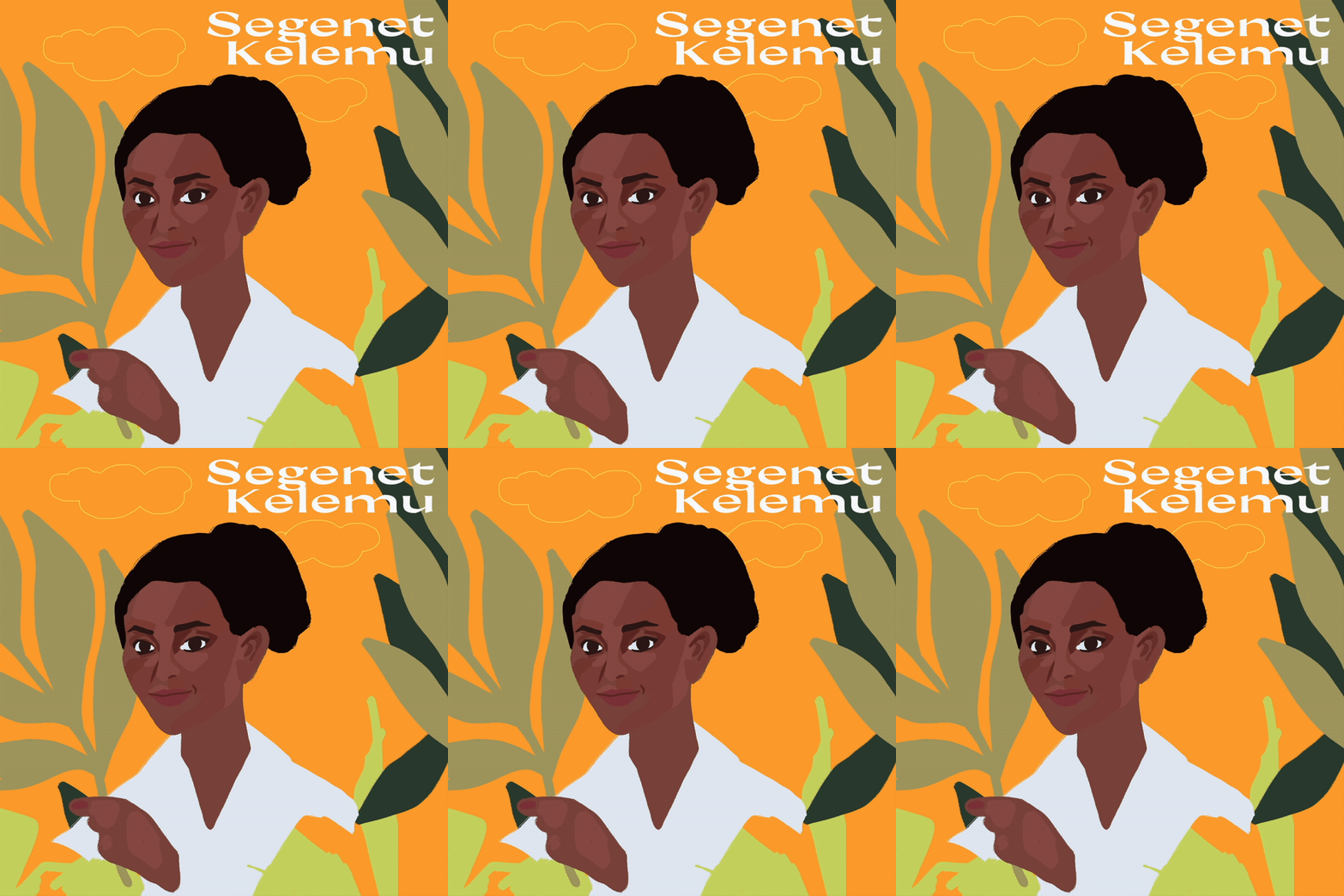
Honouring Women in Science

Credit: Daria Koshkina

“Segenet Kelemu is a molecular plant pathologist whose cutting-edge research is dedicated to helping the world’s smallholder farmers grow more food and rise out of poverty. ‘The drive of my life is to make a difference in people’s lives and to improve agriculture in Africa,’ she shares. Kelemu grew up in a poor farming family in Ethiopia and was the first woman from her region to get a college degree. ‘In my village, girls were married off at a very young age, but luckily I was too rebellious for anyone to arrange a marriage for me,’ she laughs. ‘I was really determined to go to university.’

More on Devoted to discovery: Seven women scientists who have shaped our world via Medium.

#WomenInScience #DevotedToDiscovery

Scholar Projects Final Manuscripts

Greetings Residents!

Your scholar projects final manuscripts are due to the Program Office February 28.

  • Remediation work, if necessary: March 2 – May 31
  • Deadline to apply for Lloyd Jones Collins Award: March 31
  • Presentations due to Program Office: June 12, 2020
  • Central Lloyd Jones Collins Scholarship Day: June 19, 2020

I encourage you all to apply for the Lloyd Jones Collins Award. If you want a final read through prior to submission forward it to me.

Warmly,

Jacqueline

Online Training to Fight Spread of Coronavirus

WHO_nCoV_Introductory Video from openWHO on Vimeo.

“Coronaviruses are a large family of viruses that are known to cause illness ranging from the common cold to more severe diseases such as Middle East Respiratory Syndrome (MERS) and Severe Acute Respiratory Syndrome (SARS).

A novel coronavirus (CoV) was identified in 2019 in Wuhan, China. This is a new coronavirus that has not been previously identified in humans.

This course provides a general introduction to nCoV and emerging respiratory viruses and is intended for public health professionals, incident managers and personnel working for the United Nations, international organizations and NGOs.”

Take the course here. More on Emerging respiratory viruses, including nCoV: methods for detection, prevention, response and control and Online training as a weapon to fight the new coronavirus via World Health Organization.

AMEE Webinar: Medical Humanities: A Way to Transform Society

The next presentation in the AMEE Webinar series will be presented by, Jonathan McFarland, Sechenov First Moscow State Medical University -“Medical Humanities: a way to transform society” on Tuesday the 11th of February 2020 at 14:00 (2pm) GMT.

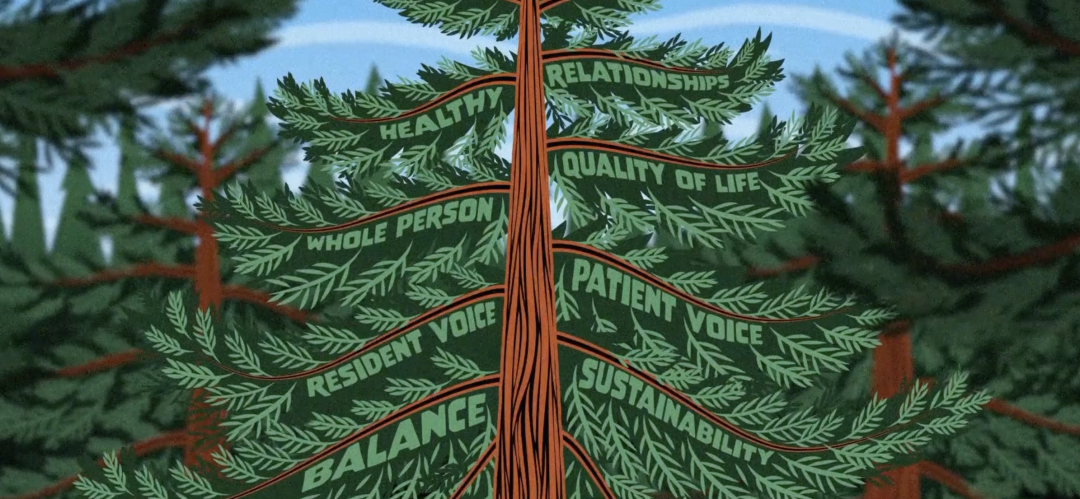
The humanities are now very topical in medical education; for instance, in the last AMEE conference, there was a whole theme dedicated to them. More and more understand that the humanities are needed to restore balance to an increasingly scientific and technologically orientated curricula. The practice of medicine is, however, to do with people, and the humanities are necessary to help health professionals deal with people’s preoccupations, worries and concerns.

Taking this as a starting point the main concern of this webinar will be how the (re)introduction of the humanities into medical education and practice can help not only on an individual and personal level (i.e. the Doctor-patient relationship) but also on a wider societal and global level. How the humanities are needed to help change and transform society at this critical and complicated moment.

As of 2019, the AMEE webinar series will be entirely free. Please register here
Due to limited space, it is advisable to join on time as AMEE cannot guarantee entry to the webinars.

Salt-Coated Mask

“Researchers at the University of Alberta have developed a virus-killing salt coating that’s designed to improve the effectiveness of the common surgical masks often used to prevent the spread of pathogens like influenza or the new coronavirus.

The sodium chloride coating applied to the surface of the surgical mask is designed to kill any virus particles which can otherwise survive for up to a week — a risk researchers say the average person isn’t aware of.

The salt coating, which has been under development since 2015, essentially works to kill any particles of the virus it comes into contact with.

‘When virus-carrying water droplets sit on the surface, the salt dissolves and water begins to evaporate,’ he explained. ‘During the evaporation process the salt crystals begins to grow and a very sharp edge of the crystal basically destroys the virus.'”

More on A salt-coated mask that kills viruses? Alberta researchers working on it via CTVNews.

Fifth Annual Women’s Health Research Symposium

Fifth Annual Women’s Health Research Symposium
Wednesday, March 4, 2020
Robert H. Lee Alumni Centre
www.whri.org

The Fifth Annual Women’s Health Research Symposium is to be held on Wednesday, March 4, 2020 at the Robert H. Lee Alumni Centre at the University of British Columbia.

The Symposium is being hosted by the Women’s Health Research Institute and will be an opportunity to showcase some of the amazing women’s health research taking place in BC and beyond. The theme of this year’s event focuses on digital and virtual health and how this emerging field is catalyzing women’s health research.

More information on the program and speakers can be found here: https://ubccpd.ca/course/WHRI2020

To register for the symposium, please click the following link: https://events.eply.com/WHRI2020

We very much look forward to seeing you at the Symposium!