
Join us for this 6th annual conference, brought to you by Fraser Health, UBC, Surrey Memorial Hospital, and Vancouver Fraser Medical Program. Learn more here.
Dates: April 30, 2021 – May 1, 2021
April 30, 2021
Topics include: H. pylori: Who We Should Treat and Who We Shouldn’t; Pitfalls in Ordering Microbiology Tests; Updates in the Management of Community-Acquired Pneumonia in the Time of COVID; Updates on COVID-19; Update on HIV and Prep and PEP; Non-Pulmonary Tuberculosis; COVID-19 in Children.
May 1, 2021
Topic: In-depth case discussions of topics discussed on Day 1.
CHES: Cutting Edge Speaker Series
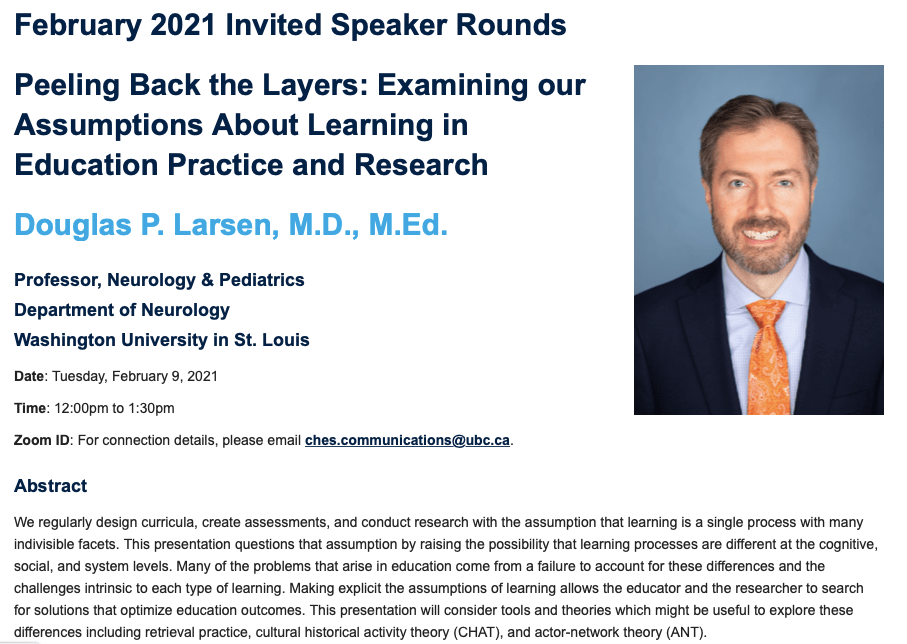
For connection details, please email ches.communications@ubc.ca.
More here on the talk.
Quiz!

Knowing the natural environment that surrounds you and your patients is important in understanding how our environment influences our health and wellbeing.
For example, in 2016, a three-year-old Victoria boy died after ingesting this type of mushroom. Name the world’s most poisonous mushroom now growing in BC?
Spider bites are often misdiagnosed. There are 5 species of black widow spiders in North America, north of Mexico. Name the species found in BC.
If your employment includes working in our BC mountains, you may come across 3 plants that are defined as “hazardous” by Worksafe BC. Name these 3 plants.
Leave your answers in the comment section below!
Have a great weekend,
Jacqueline
Environments by Design: Health, Wellbeing, & Place
“On January 1st, 2020, the world woke to news that a pneumonia outbreak in Wuhan, China, had been identified as a strain of coronavirus. By March, the World Health Organization would define it as a pandemic and the most serious global health threat on the planet. Under lockdown conditions the relationship between health and the spaces we inhabit became central.
The response from professionals and academics was immediate. Public health officials became consultants on ‘healthy buildings’, infectious disease specialists advised on planning codes, mental health experts became advisors on design strategy. Environmental psychologists collaborated on adapting homes for lockdown, sociologists re-examined behaviour in public space; teachers critiqued new spatial uses of the classrooms and, by extension, interior work environments of every type.
It is tempting to see this recent global concern about health and environments as new. The reality is, it has a long history. The public health profession was born from the housing conditions of the 19th century urban poor. ‘Sick building syndrome’ has been a concern for years. Demands for walkable neighbourhoods are long standing. Housing for the elderly, accessible design, and the broader healthy cities agenda globally, all pre-date COVID-19.
Seen in this light, this conference seeks to bring recent experiences and responses into dialogue with these longer standing areas of research into health, wellbeing and environments.”
Environments by Design: Health, Wellbeing, & Place
Place: Virtual
Dates: 01-03 December, 2021
Learn more here.
Abstracts: June 25, 2021 (Round One) | November 5, 2021 (Round Two)
Sixth Annual Women’s Health Research Symposium
This event is being hosted by the Women’s Health Research Institute, one of only a few research institutes worldwide to focus exclusively on women’s health. With this event, we aim to celebrate the work of local women’s health researchers and offer a unique forum for networking and knowledge exchange. This event will engage researchers and relevant stakeholders from a wide range of disciplines in order to provide a forum where provincial leaders in women-focused health research can connect and collaborate. Because we will be holding the symposium virtually this year, we want to use this opportunity to showcase the amazing research taking place across British Columbia with representation from all corners of the province.
Wednesday, March 3, 2021
Virtual Conference
www.whri.org
More information on the program and speakers can be found here.
To register for the symposium, please click the following link.
We very much look forward to seeing you at the Symposium!
UBC Care of the Elderly Virtual Conference
We have condensed our popular 3-days intensive course into 1-day virtual conference for you to participate in the safety and comfort of your own home or office. Each presentation will last 20 minutes, followed by 10 minutes of Q&A. Topics are tailored for primary care providers who work with elderly patients. Participants will also have the opportunity to express their learning needs on each topic prior to the event. Check out the agenda here!
Testing New Ways to Put Equity Into Action
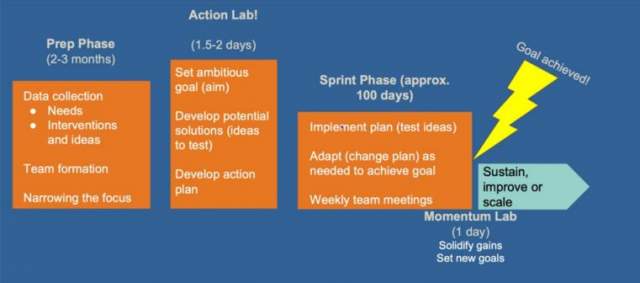
“According to the Equity Action Lab Implementation Guide, an Equity Action Lab is ‘a flexible and adaptable model that uses a set of activities to bring together a diverse group of community stakeholders to take action in pursuit of equity and community improvement.’ The model helps stakeholders act on a complex (adaptive) health topic that does not yet have a known fix or remedy. It requires multiple groups or sectors to work together to test and learn their way into solutions.
IHI based the model on an approach employed by IHI’s Strategic Partner, Community Solutions, that used design thinking and ‘switch thinking’ to quickly get to action and results. As part of our efforts as 100 Million Healthier Lives convener, IHI incorporated improvement science, the psychology of change, systems thinking, co-designing with people with lived experience, and effective approaches for tackling adaptive challenges to create the Equity Action Lab. Most importantly, we tested and refined methods for co-designing solutions with context experts.”
Testing New Ways to Put Equity Into Action via Institute for Healthcare Improvement.
EdX: Global Health Informatics to Improve Quality of Care
There’s a new tuition-free course with EdX on Global Health Information to Improve Quality of Care offered by MIT. Learn how to design health information and communication technology (ICT) solutions for the developing world.
About the course: Disease has no respect for country borders and increased global travel has fuelled the spread of infectious disease, as evidenced by the Ebola virus epidemic. Chronic diseases such as diabetes and heart disease, initially confined to the developed world, now exist side by side with malnutrition in low- and middle-income countries (LMIC). Global warming is widening the endemicity of vector-borne diseases.
In this course, we will explore ways to leverage information technology to combat disease and promote health, especially in resource-constrained settings. Technology is a driving force that sweeps across nations even faster than disease and with the spread of mobile phones, which bring computational power and data to our fingertips, new paradigms in tracking and battling disease have been discovered.
The course begins February 16th! Register here.
EdX: AnatomyX: Musculoskeletal Cases
There’s a new tuition-free course with EdX on AnatomyX: Musculoskeletal Cases. Learn the anatomy basic to understanding five musculoskeletal injuries commonly seen in primary care medicine and orthopedic clinical specialty practice. Follow hypothetical patients from injury to operating room.
About this course: Musculoskeletal AnatomyX invites students to join medical and basic science faculty at Harvard Medical School (HMS) to learn about musculoskeletal injuries commonly seen in clinical practice.
For each case, students visit the HMS Clinical Skills Center to observe the initial patient encounter and physical examination by an orthopedic surgeon. Following the patient encounter, students complete the interactive gross anatomy, histology and radiology learning sessions essential for understanding the case. The anatomy learning sessions include observing actual dissections in the Harvard Medical School anatomy laboratories revealing and explaining the human anatomy relevant for each clinical case.
The course began today but I’m sure you can grab a seat now! Register here.
Quality Improvement & Patient Safety (QIPS)

Providing training in quality improvement and patient safety (QIPS) is an important consideration for all of our residency programs. This has been fortified by its specific inclusion in the new accreditation standards. PGME’s aim is to provide a foundational QIPS curriculum to supplement what already exists and for the curriculum to be integrated into each residency program as needed.
Learn more here.

