“What a living whale is worth — and why the economy should protect nature How much is one living blue whale worth in the fight against climate change? A lot more than you may think, says financial economist Ralph Chami. He explains the value of bringing the language of dollars and cents to conservation — and offers his vision of a new economy that would profit off regenerating nature, not extracting from it.”
Learn more: ‘They teach us’: how whales can help dispel the myth of green capitalism via The Guardian. Several humpback whales found dead on B.C.’s coast in a matter of weeks via CBC.
“Join us and Race & Health as we launch a new Lancet Series assessing the pervasive impacts of racism, xenophobia, and discrimination on health inequities globally—and what we can do to improve the lives of minoritised people.
The Series will be published in The Lancet’s special issue: Advancing racial and ethnic equity in science, medicine, and global health.
This is a hybrid event, kindly supported by Wellcome Trust. Register to attend in person or online.”
“Surges in respiratory illnesses are overwhelming children’s hospitals across Canada, prompting calls to reintroduce masking in schools.
‘It’s a pediatric healthcare crisis of a proportion that I don’t think anybody has seen in their careers at this point,’ said Lennox Huang, chief medical officer and vice-president of medical and academic affairs at Toronto’s Hospital for Sick Children.
Across Ontario, all pediatric intensive care units are operating at more than 100% capacity. The situation is impacting adult services, too, as hospitals are diverting pediatric patients to adult ICUs.
The province has instructed all hospitals to work at up to 150% of their usual operating capacity, up from 120% under normal surge plans.
SickKids is redeploying staff and cancelling scheduled surgeries to prioritize emergency procedures, Huang told CMAJ. ‘It’s all hands on deck.’
‘We’re seeing nurses, physicians, and respiratory therapists working in areas they wouldn’t have otherwise,’ he said. ‘Physicians are, in many cases, doubling up on the number of shifts, clinical work, and calls that they’re doing to meet the clinical demand.’
Calls for masking in schools as respiratory infections overwhelm children’s hospitals via CMAJ.
Alternatively, you can join the virtual health visit by entering the following info in Zoom:
Meeting ID: 693 8412 1933 Password: 581699
If you can’t connect by computer or by mobile device, or if your microphone or speakers don’t work properly, you can join the virtual health visit by phone:
Dial 1-833-955-1088 (Toll-free) followed by the Meeting ID and Passcode Meeting ID: 693 8412 1933 / Password: 581699
This annual conference in primary care medicine provides an opportunity to refresh your knowledge about, and enthusiasm for, primary care medicine. This conference will focus on an evidence-based review of practical information, new trends and discuss controversial topics useful for primary care physicians practicing in urban or rural areas. Educational activities include a Main Lecture Series which will provide a comprehensive review on Cardiology, Sports Medicine / Rheumatology, Internal Medicine, Dermatology, Therapeutics, Brain & Aging, Women & Children’s Health, and Surgery. Exemplary guest speakers have been chosen for their ability to communicate information and skills relevant to daily clinical practice. The speakers will also provide ample time for questions.
Main Lecture Series (In-Person/Virtual) Tuesday, Nov. 22 – Friday, Nov. 25, 2022
Participants will be able to:
Analyze current issues in primary care medicine and review new guidelines for the treatment of a number of diseases and disorders commonly encountered in family practice.
Discuss cases regarding new treatment options and technological advances.
Identify new evidence based treatments using the most up to date clinical and scientific information.
The Office of Faculty Development and the Centre for Health Education Scholarship are pleased to co-facilitate the CAME Webinar Series at UBC. Designed to bring practical, evidence and experience-based advice to Canadian health educators, the webinars offer the opportunity to engage online with an expert and with colleagues in a live discussion on a key topic in health professions education.
*Please note that while these sessions are free to attend, registration is required. See registration link below.
Presenter: Dr. Mariam Abdurrahman, McMaster University Date: Tuesday, November 22, 2022 Time: 12:00 to 1:00pm PDT You need to be affiliated with UBC to register. Click hereto register.
“Ghost gear can consist of all lost, abandoned or deteriorating fishing nets and commercial fishing gear, as well as plastic waste from aquaculture. Recent studies indicate that ghost fishing gear may make up 46-70% of all macro-plastics in the ocean by weight, and pose threats to marine animals like whales and turtles.
Now, the Department of Fisheries and Oceans (DFO) is investing $8.3 million into what will be known as the Ghost Gear Fund. It will support 22 projects in Canada and four internationally over the next two years, targeting categories such as gear retrieval, eco-disposal, acquisition and the piloting of new gear technology.”
Canada invests $8.3M in fishing gear removal to fight marine plastic pollution via Environmental Science & Engineering
A Detailed Review Study on Potential Effects of Microplastics and Additives of Concern on Human Health via PubMed.
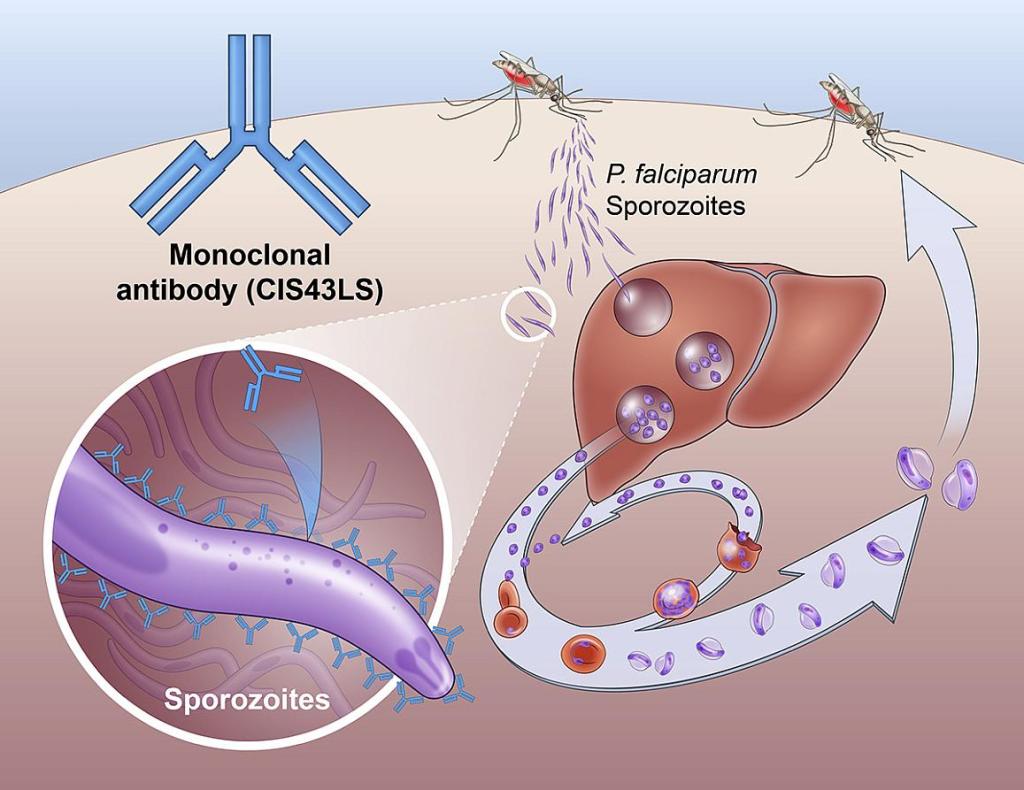
An antibody drug called CIS43LS prevents malaria infection by interrupting the lifecycle of the Plasmodium falciparum parasite. The antibody binds to and neutralizes sporozoites, the stage of the parasite transmitted from mosquitos to humans. NIH
“One dose of an antibody drug safely protected healthy, non-pregnant adults from malaria infection during an intense six-month malaria season in Mali, Africa, a National Institutes of Health clinical trial has found. The antibody was up to 88.2% effective at preventing infection over a 24-week period, demonstrating for the first time that a monoclonal antibody can prevent malaria infection in an endemic region. These findings were published today in The New England Journal of Medicine and presented at the American Society of Tropical Medicine & Hygiene 2022 Annual Meeting in Seattle.
‘We need to expand the arsenal of available interventions to prevent malaria infection and accelerate efforts to eliminate the disease,’ said Anthony S. Fauci, M.D., director of the National Institute of Allergy and Infectious Diseases (NIAID), part of NIH. ‘These study results suggest that a monoclonal antibody could potentially complement other measures to protect travelers and vulnerable groups such as infants, children, and pregnant women from seasonal malaria and help eliminate malaria from defined geographical areas.'”
More on Monoclonal antibody prevents malaria infection in African adults Antibody protected NIH clinical trial participants during six-month malaria season via NIH.
You also might be interested in mosquitoes that can’t spread malaria engineered by scientists via Science Daily.
Join our one hour special roundtable conversation starring 3 pediatric patients and their families who have experienced long-term stays at the leading pediatric hospitals of Sant Joan de Déu (Barcelona), Great Ormond Street (London), and SickKids (Toronto)!
This will be a conversation between 3 families and 3 professional representatives (one from each hospital) to discuss what is it to experience a long-stay in a hospital room? And how important are user experience, psychology, innovation and the spatial considerations when designing in a pediatric healthcare environment.
We’d like the roundtable participants to think about: How did a long stay the hospital room make them feel? How could hospital rooms be improved to make the children and family stay a much better experience?
This roundtable sets the context of HACK THE HOSPITAL 2, a hackathon designed to enable discussion and development of ideas to improve the experience of children, young people and families who need to stay in-hospital.
This year’s edition sets out to explore the design of the hospital room of the future and welcomes participants specialized in the areas of #healthcare, #tech, #business and #creativity.
“Positive thinking, we’re told endlessly, is absolutely essential at every minute if we hope to lead happy, successful lives: only through positive thinking will we achieve our ambitions and be winners instead of losers. Cartloads of self-help books, well-paid motivational speakers and lifestyle gurus all emphatically promote this drive to focus always on positive thinking. ‘It’s necessary to get losers out of your life if you ever want to live your dream,’ says self-help guru Les Brown, presumably eschewing all losers and living his.’ Positive thinking, we’re told endlessly, is absolutely essential at every minute if we hope to lead happy, successful lives: only through positive thinking will we achieve our ambitions and be winners instead of losers. Cartloads of self-help books, well-paid motivational speakers and lifestyle gurus all emphatically promote this drive to focus always on positive thinking. ‘It’s necessary to get losers out of your life if you ever want to live your dream,’ says self-help guru Les Brown, presumably eschewing all losers and living his.
We’re likewise endlessly told that negative thinking, is a definite no-no, only for wet blanket losers. But is this true? Is it true that positive thinking is always the best approach, or could it be, in fact, that some good old negative thinking might actually enable us to live our lives more effectively, efficiently and happily than optimism will? Well, apparently, it does! It turns out this full-tilt drive for constant positivity is being somewhat mis-sold us. So cheer up, wet blanket negative thinkers, if you dare! You may actually have got it right!
Negativity, this radio series explains, is a better spur to suitable action than unwarranted, blind hope, and can prove enormously constructive. Instinctive emotions like fear, anxiety and self-doubt serve an important, positive purpose, just as long as self-doubt is tempered by self-compassion. Self-doubt brings greater flexibility and consideration to plans and actions with a willingness to change tack instead of a moving in a headlong, inflexible rush, while pessimism can actually spell success. The very best, most successful lawyers and surgeons are, the presenter tells us, pessimists – those who examine a job from every possible angle, suspicious that any little thing could go wrong at any moment and get ready for it.”







 Family Medicine Residency Site: Abbotsford-Mission