
Remembering Dr. Connie Eaves

“It is with heavy hearts that we announce the passing of Dr. Connie Eaves, professor in UBC’s Department of Medical Genetics and the School of Biomedical Engineering, and a distinguished scientist at BC Cancer’s Terry Fox Laboratory.

A world authority on stem cells, Connie was an exceptional scientist, but she was also a leader, beloved mentor, and deeply-respected colleague and friend.

Her research career — spanning more than five decades — was driven by curiosity and an unwavering devotion to improving the lives of people with cancer.

Her discoveries advanced knowledge on the origin of leukemia and breast cancer, and her pioneering research methodologies — including developing a technique to separate cancerous from normal stem cells — have become gold standard approaches used by laboratories around the world.”

Read more on Remembering Dr. Connie Eaves, a pioneer in leukemia and breast cancer research via UBC Faculty of Medicine
Homeostasis & Ultrasound

“A new device tested in pigs enables monitoring and early detection of pH changes in deep tissues due to post-operative leaks following gastrointestinal surgery. Such leaks – which occur at high rates 3-7 days following surgery – can be fatal if overlooked, and as such, require constant monitoring. Yet, early detection of these leaks remains a challenge.

To address this need, Jaiqi Liu and colleagues developed a novel class of pH-responsive materials for real-time ultrasound measurement of pH changes indicative of leaks from healing surgical joins following gastrointestinal surgery. They dubbed their bioresorbable, shape-adaptive, ultrasound-readable materials structure, ‘BioSUM.’ The thin and implantable device is comprised of small metal discs within a pH-responsive hydrogel. During recovery, the distance between the metal discs can be measured using ultrasound. Should a leak occur, the hydrogel reacts to the change in pH and swells, pushing the metal discs further apart, signaling a complication.”

Learn more: Liu, J., et al. (2024) Bioresorbable shape-adaptive structures for ultrasonic monitoring of deep-tissue homeostasis. Science. doi.org/10.1126/science.adk9880.

Loneliness & the Power of Connection

“If you are lonely, if you’ve ever been lonely, you are not alone. Loneliness is extraordinarily common. It is a universal part of the human experience – a natural signal like hunger or thirst that our body sends us when we lack something that we need for our survival, which is social connection. In the latest RSA Short, US Surgeon General Vivek Murthy explains how we can get better at spotting the signs of loneliness in people around us, and the simple steps we can all take to build a more connected society, and a more connected life.”

Speaker: Dr Vivek Murthy, 21st Surgeon General of the United States via US Department of Health and Human Services

Family Physician Shortages

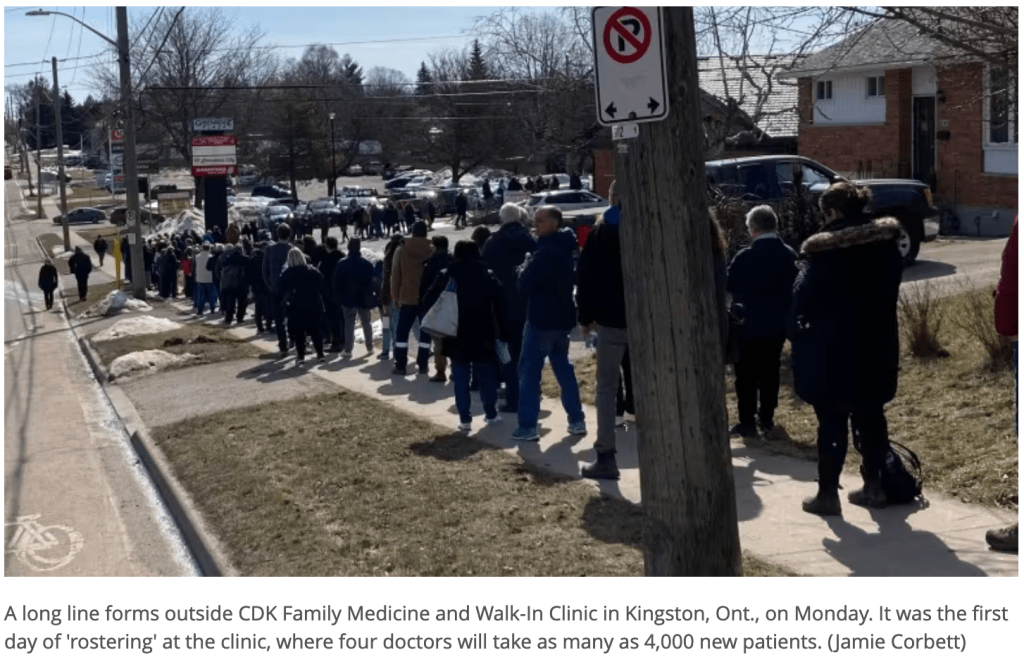
“Hundreds of people desperate to find a family physician lined up overnight outside a Kingston, Ont., medical clinic this week, in what many are calling a clear sign of the serious doctor shortage in the region.

On Feb. 22, the CDK Family Medicine and Walk-In Clinic announced four physicians would start taking on as many as 4,000 new patients at the clinic. Some 30,000 residents are currently without a family doctor in Kingston.

During ‘rostering’ days held last week, prospective patients were asked to line up outside the clinic to be seen on a first-come, first-served basis. On Wednesday, the line was cut off after the first 100 people.”

Read more on Hundreds line up outside Kingston clinic in desperate bid for family doctor via CBC News.

Excessive Social Media Use & Mental Health

“How does time spent online, and especially social media, affect the brains and behaviours of children and youth?

Social media platforms are seemingly designed to capture the attention of users and produce habitual checking of apps and notifications. In recent years, our lives have become increasingly dominated by social media, either as a source of information, entertainment, or just a way to connect with others.

In Canada alone, more than 30 million social media accounts are currently registered, with teenagers one of the highest user groups.

During the COVID-19 pandemic, young people were drastically affected by the sudden shift to a digital world and the explosion of a reliance on screens. School closures, coupled with social isolation, led to dramatic increases in daily screen time use and exacerbated mental health challenges for many young people.

Research shows strong links between screen time and mental health concerns, including anxiety and depression, although few longitudinal studies have been conducted in the pandemic or post-pandemic eras to determine causal relationships. The stress of lockdowns and the absence of typical support networks left adolescents more vulnerable than ever to the negative effects of social media.

Now, in the years following the pandemic lockdowns, it’s imperative that we study and address the impact excessive screen time can have on brain development.”

Read more on Expert insight: Excessive social media use worsened adolescent mental health during COVID-19 via Western University News.

Anorexia Nervosa in Adolescent Males

Anorexia nervosa is a potentially life-threatening eating disorder

Up to 0.3% of males will receive a diagnosis of anorexia nervosa in their lifetime. Affected males have a 6-times higher mortality rate than those in the general population. Stigma, poor mental health literacy and gendered stereotypes reduce help-seeking behaviours and lead to delayed treatment and worse outcomes. Early identification and prompt treatment are essential.

Specific adolescent male populations are at elevated risk

Athletes involved in body-and strength-focused sports (e.g., cycling, running, wrestling); racially and ethnically diverse males; and gay, bisexual, trangender, and queer people are more susceptible to developing anorexia nervosa.

Evaluation of adolescent males with possible anorexia nervosa should include screening for muscle-enhancing goals and behaviours

Muscle-enhancing behaviours are driven by body ideals that emphasize muscularity and leanness, and can include diet changes (intermittent fasting, and bulking and cutting diets), purging (vomiting, excessive exercise), supplement use, and anabolic steroid use. The Muscularity Oriented Eating Test is an assessment instrument validated to assess for muscularity-oriented disordered eating behaviours.

Learn more on Anorexia nervosa in adolescent males via CMAJ.

Health Chatbots

“Imagine that you are on the waiting list for a non-urgent operation. You were seen in the clinic some months ago, but still don’t have a date for the procedure. It is extremely frustrating, but it seems that you will just have to wait.

However, the hospital surgical team has just got in contact via a chatbot. The chatbot asks some screening questions about whether your symptoms have worsened since you were last seen, and whether they are stopping you from sleeping, working, or doing your everyday activities.

Your symptoms are much the same, but part of you wonders if you should answer yes. After all, perhaps that will get you bumped up the list, or at least able to speak to someone. And anyway, it’s not as if this is a real person.

The above situation is based on chatbots already being used in the NHS to identify patients who no longer need to be on a waiting list, or who need to be prioritised.”

Read more on “You could lie to a health chatbot – but it might change how you perceive yourself” via The Conversation.

Celebrating Resident Doctors Appreciation Week

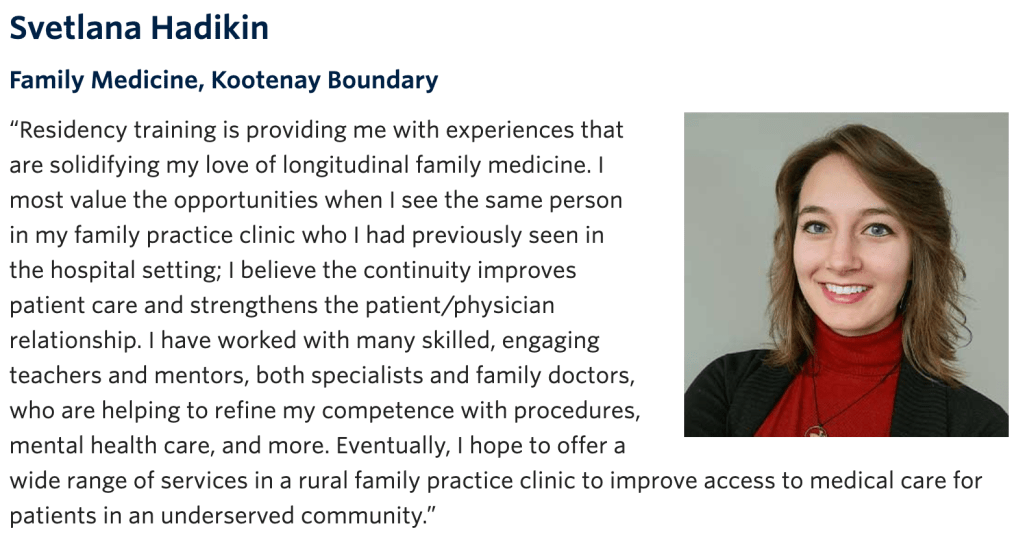
“From family medicine clinics to specialist units around British Columbia, there are more than 1300 UBC resident doctors training in regional, rural and remote communities.

Guided by UBC clinical faculty, resident doctors provide compassionate care to families and patients, and play a crucial role in our healthcare system. They also contribute their skills and knowledge beyond the clinic.

‘Resident doctors support the education of medical students, conduct research and strengthen health care as they train to become expert practitioners in numerous specialties,’ says Dr. Ravi Sidhu, Associate Dean of Postgraduate Medical Education. ‘I am grateful for their dedication to serving and enhancing health of communities across B.C.’

Thank you to all UBC resident doctors for the care you provide communities across B.C.

As part of Resident Doctors Appreciation Week, we caught up with a few UBC resident doctors to learn more about their experience by asking the following question: ‘How has residency training informed your future practice?’”

Read their responses here.