“30 Under 30” in Healthcare

“When I saw that I had been named as a Forbes 30 Under 30, I was shocked,” he says. I’m just a kid from Vancouver trying to do some good in the world, so this will take a while to fully sink in. All I can say is that it is truly an honor to represent Vancouver and UBC on the international stage. Hopefully I can help pave the way and inspire the Forbes 30 under 30 recipients of the future.”

Mohit Sodhi, a UBC medical student, has been named one of Forbes’ top “30 Under 30” in Healthcare. Launched in 2011, the Forbes “30 Under 30” recognizes people under the age of 30 from a wide range of industries who are making a notable impact in their field. For the Healthcare category, the recipients include entrepreneurs and researchers who are taking on some of healthcare’s biggest challenges.

As a graduate from UBC’s Experimental Medicine Program, and under the supervision of Dr. Mahyar Etminan, Sodhi collaborates on research that examines rare adverse events of some of the most commonly prescribed medications. In one such study, he and his colleagues identified cardiac issues from fluoroquinolone that led to regulatory agencies revising their recommendations for its use. Other studies uncovered eye damage from erectile dysfunction drugs and serious gastrointestinal side effects from GLP-1 drugs like Ozempic.

Learn more about UBC medical student Mohit Sodhi named one of Forbes “30 Under 30” in Healthcare via UBC Faculty of Medicine.
Nurse Practitioners & Autonomy

“A heated debate is brewing in Alberta that has implications for the future of primary care in the province.

This week, the provincial government announced nurse practitioners will be allowed to set up their own publicly funded independent practices as early as January.

During Wednesday’s news conference, Premier Danielle Smith touted the plan as a ‘key part’ of the solution to a shortage of family physicians that has left an estimated 600,000 — or more — Albertans without care.

‘Help is on the way,’ she said.

‘We will stop at nothing to ensure that Albertans have access to the care they need, when and where they need it.'”

More on Nurse practitioner announcement leaves family physicians feeling devalued, disrespected: Alberta doctors are pushing back against a plan to give nurse practitioners more autonomy via CBC News.

CHES Event: Unravelling the Complexities of Teacher Motivation

Abstract

“The recruitment and retention of teachers in health professions education is challenging and creates a significant amount of stress and pressure on programs to mitigate. Implementing incentives and strategies that ought to support those who teach can backfire if not delivered carefully, often unintentionally worsening the problem. For example, teaching awards, financial stipends, and feedback from learners can create perceptions of undervalue when they are impersonal, inequitable, inefficient, or poorly framed. In this presentation, I will highlight the perspectives of teachers themselves, the learners they teach, and those in educational leadership roles who supervise teachers in order to offer a holistic view of the complexities, unintended consequences, and nuanced perspectives in an attempt to elucidate helpful insight into how teachers may be better supported. The goal of this presentation is to further our understanding around how HPE teachers’ motivations can be optimized to recruit, support and retain teachers while reinforcing their engagement with, and dedication to, teaching.”

Katherine Wisener, PhD Candidate, Health Professions Education, Maastricht University, Associate Director, Faculty Development,
Faculty of Medicine, University of British Columbia

Date: Tuesday, December 12, 2023
Time: 12:00pm to 1:30pm
Hybrid: Life Sciences Centre 1312 CMR & Zoom*
Zoom Details: For connection details, please email ches.communications@ubc.ca.

Heart Attack Risk & New Mothers

Question  Does use of remote self-monitoring and physician-guided titration of antihypertensive medications using a Bluetooth-enabled app provide better long-term blood pressure control than usual outpatient care during the first 9 months postpartum?

Findings  In this randomized clinical trial involving 220 participants, physician-guided self-management of outpatient postnatal blood pressure, following hypertensive pregnancy, was associated with a 6/5-mm Hg lower ambulatory blood pressure at 9 months postpartum.

Meaning  A physician-guided remote telemonitoring program was used to guide self-management of blood pressure and was associated with improved blood pressure control during the postnatal period after a hypertensive pregnancy compared with usual antihypertensive management.

Learn more on Long-Term Blood Pressure Control After Hypertensive Pregnancy Following Physician-Optimized Self-ManagementThe POP-HT Randomized Clinical Trial via JAMA.

Brain Implant & Communication

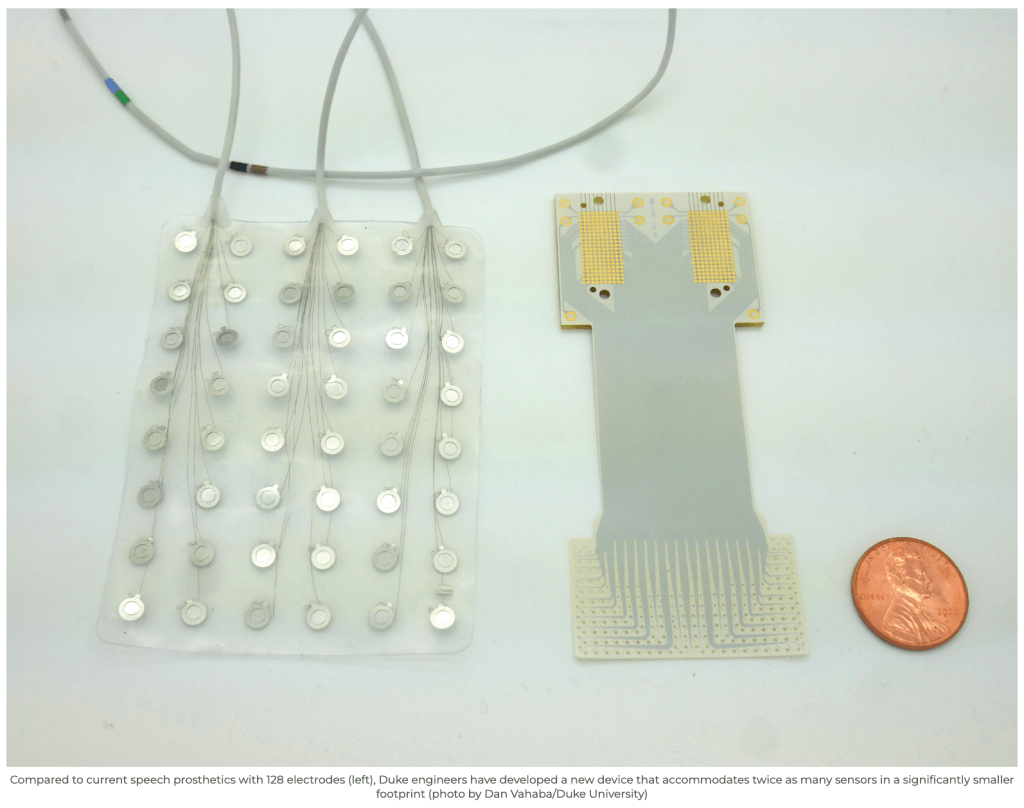
“Appearing Nov. 6 in the journal Nature Communications, the new technology might one day help people unable to talk due to neurological disorders regain the ability to communicate through a brain-computer interface.

‘There are many patients who suffer from debilitating motor disorders, like ALS (amyotrophic lateral sclerosis) or locked-in syndrome, that can impair their ability to speak,’ said Gregory Cogan, Ph.D., a professor of neurology at Duke University’s School of Medicine and one of the lead researchers involved in the project. ‘But the current tools available to allow them to communicate are generally very slow and cumbersome. There are many patients who suffer from debilitating motor disorders, like ALS (amyotrophic lateral sclerosis) or locked-in syndrome, that can impair their ability to speak,’ said Gregory Cogan, Ph.D., a professor of neurology at Duke University’s School of Medicine and one of the lead researchers involved in the project. ‘But the current tools available to allow them to communicate are generally very slow and cumbersome.'”

Learn more about Duke Scientists Create Brain Implant That May Enable Communication From Thoughts Alone via Duke Today.

Maternal Microbiota & Fetal Development

“In a Finnish study, significant differences in the gene activity of the fetal intestine, brain and placenta were identified, depending on the microbes in the mother’s body and the compounds produced by them. The findings indicate that maternal microbes are important to her offspring’s development and health.

The microbiota of the mother or dam is thought to be important for the development and health of her offspring. However, so far little is known about how interactions with the microbiota begin and what the mechanisms of action are.

A collaborative study carried out at the Universities of Helsinki, Eastern Finland and Turku investigated how the maternal microbiota affects fetal development by comparing the foetuses of normal and germ-free mouse dams living in a sterile environment. The researchers measured gene expression and the concentrations of small-molecular compounds, or metabolites, in the fetal intestine, brain and placenta.

‘The effects of the dam microbiota and the metabolites it produces on fetal development have not been previously investigated in such a comprehensive manner. Our study sheds light on the significance of the microbiota and the mechanisms by which the microbiota affects individual development and pregnancy. We identified previously unknown compounds in the fetus, which are likely to be microbial and which can be important for individual development,’ says Mikael Niku, the principal investigator of the study from the Faculty of Veterinary Medicine, University of Helsinki.”

Learn more on Maternal Microbiota Can Affect Fetal Development via Science Daily.

Aleksi Husso, Tiina Pessa-Morikawa, Ville Mikael Koistinen, Olli Kärkkäinen, Hyuk Nam Kwon, Leo Lahti, Antti Iivanainen, Kati Hanhineva, Mikael Niku. Impacts of maternal microbiota and microbial metabolites on fetal intestine, brain, and placentaBMC Biology, 2023; 21 (1) DOI: 10.1186/s12915-023-01709-9

The Future: Medical Education & Coaching?

“Sal Khan, the founder and CEO of Khan Academy, thinks artificial intelligence could spark the greatest positive transformation education has ever seen. He shares the opportunities he sees for students and educators to collaborate with AI tools — including the potential of a personal AI tutor for every student and an AI teaching assistant for every teacher — and demos some exciting new features for their educational chatbot, Khanmigo.”

These are the kind of tools and the type of out-of-the-box thinking that will help us in how we train, educate, and assess our future family physicians.

Learn more here on How AI Could Save (Not Destroy) Education via TED.

Advancements in Nanotechnology

“Advances in treatment and earlier detection have significantly improved cancer survival rates in recent decades. But some cancers remain devastatingly lethal. For patients with glioblastoma (GBM), the most common and aggressive form of brain cancer, the average life expectancy is just 12 to 18 months after diagnosis. Only a quarter will survive more than a year, and just 5% more than five years.

At the University of Toronto, Prof Yu Sun and his team at the Robotics Institute are harnessing the potential of nanorobotics – the field of technology developing microscopically small robots – to build what could be a game changing new treatment option: ‘nano-scalpels‘ that seek out cancer cells and destroy them by spinning when activated by a magnetic field.”

Learn more on Tiny robots, giant steps: how nanotechnology could improve cancer and fertility treatment via The Guardian.

The Brain Atlas Project

Brain Atlas Project at Oxford University

“A team of over 200 researchers around the world, involving multiple health and scientific institutions, led by the University of Oxford, has today published, in the journal Nature, the first digital atlas showing the dynamics of normative maturation of each hemisphere of the fetal brain between 14 and 31 weeks’ gestation – a critical period of human development.

The atlas was produced using over 2,500 3-dimensional ultrasound (3D US) brain scans that were acquired serially during pregnancy from 2,194 fetuses in the INTERGROWTH-21st Project, which is a large population-based study of healthy pregnant women living in eight diverse geographical regions of the world (including five in the Global South), whose children had satisfactory growth and neurodevelopment at 2 years of age.

The study is unique because, for the first time, an international dataset of 3D US scans, collected using standardised methods and equipment, has been analysed with advanced artificial intelligence (AI) and image processing tools to construct a map showing how the fetal brain matures as pregnancy advances.”

Read more on the First digital atlas of human fetal brain development published via Oxford University News & Events.

CHES: Clinical Educator Fellowship

We are excited to announce that applications are now open for CHES’ Master of Health Professions Education (MHPE-Canada) and Clinical Educator Fellowship Program (CEFP). This includes our inaugural call for applicants to the Indigenous Stream of our Fellowship.

We are holding an in-person Open House on Wednesday, November 8th from 5.30-7:30pm and a Virtual Open House on 16th November from 5.30-7:30pm.Attendees will meet Dr. Rose Hatala, Director of MHPE-Canada and CEFP; Chief CEFP Fellows Lucas Streith and Brian Kim, and MHPE-Canada students. Register now!

In-person Open House
Date: Wednesday, November 8th
Time: 5:30 – 7:30pm
Location: CHES, P. A. Woodward Instructional Resources Centre (IRC), 429 – 2194 Health Sciences Mall, Vancouver, BC Canada V6T 1Z3

Virtual Open House
Date: Thursday, November 16th
Time: 5:30 – 7:30
Zoom Linkhttps://ubc.zoom.us/j/66360226047
Passcode: 087679

Master of Health Professions Education (MHPE) Canada:
The MHPE is a two-year, part-time, internationally recognized, research degree program that is primarily distance-based with annual, three-week courses that are delivered on-site. The program focuses on the acquisition of knowledge and skills relevant for a career in the field of education and education research for the health professions, with thesis supervision and mentorship offered by local experts in the field. MHPE-Canada is open to physicians, nurses, physical therapists, occupational therapists, dentists, pharmacists, and others. For more information on the program, eligibility, and the application process, please head to the CHES MHPE-Canada website.

Clinical Educator Fellowship Program:
CHES is offering opportunities for senior residents (R3-R5), residents in enhanced skills programs (PGY3 Family Medicine), or established clinicians interested in health education scholarship, to develop their skills in health education. This 2-year fellowship is designed for those interested in developing an academic career as a Clinical Educator and boasts many education leaders as active alumni.

Indigenous Stream: This Stream is for any Indigenous physician and Indigenous ally physician interested in developing knowledge and skills as a Clinical Educator. Fellows within the Indigenous stream, with the support of an advisory group, will help create a vision of an Indigenous approach to educational leadership.

For more information on the program, eligibility, and the application process, please head to the CHES Clinical Educator Fellowship Program website.

Application Deadlines: This year’s application deadline for both programs is Friday, December 15, 2023. Please send all applications and inquiries to ches.applications@ubc.ca.

Many thanks,

Sara Harb, on behalf of Dr. Rose Hatala, Director of MHPE-Canada and CEFP.