
We are entering a rather interesting and challenging period in medical education. Never before have clinicians had such immediate access to enormous volumes of medical information. Yet, with the growing integration of artificial intelligence into research, publication, and clinical practice, distinguishing credible evidence from misleading or even fabricated information is becoming increasingly difficult.
For medical residents, the ability to locate, critically appraise, and apply evidence is no longer simply an academic exercise. It is fundamental to developing sound clinical judgment and providing safe, effective patient care.
Consider the growing concerns about AI-generated research, fabricated references, the misuse of respected researchers’ identities in scientific publications, and automation bias. These developments raise important questions about how we prepare future physicians to evaluate the information they encounter and, perhaps more importantly, recognize when something is wrong.
The challenge is no longer simply finding evidence. It is determining what constitutes trustworthy evidence in the first place.
Fortunately, the University of British Columbia offers an excellent educational resource to help residents develop these essential competencies.
The Evidence-Informed Health Care (EIHC) Modules
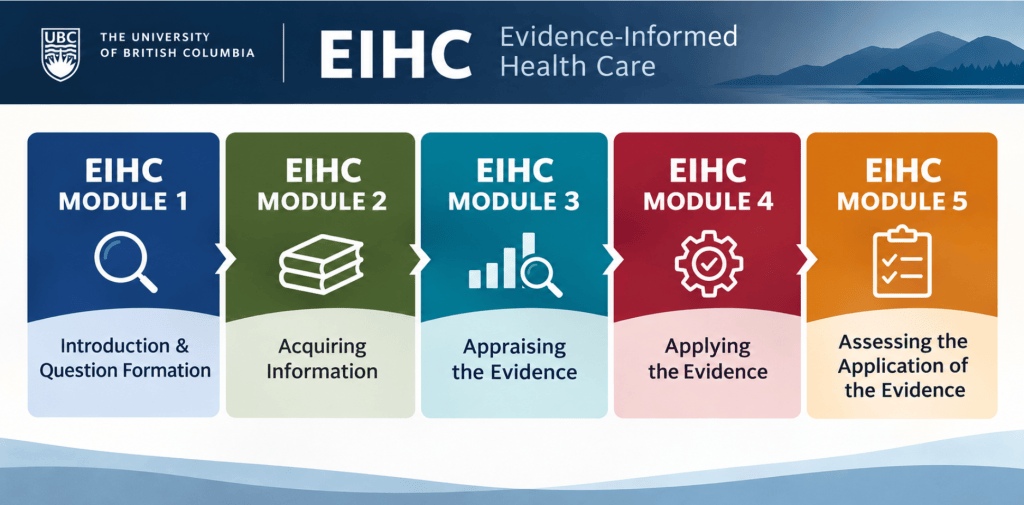
Developed by an interdisciplinary team of UBC educators, clinicians, and librarians, the Evidence-Informed Health Care (EIHC) program offers five free, self-paced online modules designed to strengthen learners’ abilities to work with evidence and translate it into clinical practice.
The modules guide learners through five fundamental areas:
- Introduction to Evidence-Informed Health Care and Question Formation: Learning to formulate meaningful, answerable clinical questions.
- Acquiring Information: Identifying credible sources and developing effective strategies for locating relevant research.
- Appraising the Evidence: Critically examining the quality, validity, and relevance of published research.
- Applying the Evidence: Integrating research findings with clinical expertise, patient values, and the circumstances of care.
- Assessing the Application of Evidence: Evaluating how evidence-informed decisions translate into clinical practice and patient care.
The modules use virtual patient cases and clinical examples to connect these skills to real-world decision-making.
Why these modules are important in practice and in scholarship
In an era where AI systems can generate convincing clinical explanations, research summaries, and references, residents must be prepared to question what they read rather than accept information simply because it appears authoritative.
An AI-generated response may be articulate, confident, and entirely wrong. Similarly, a published article may appear credible while containing errors, methodological weaknesses, or misrepresented findings.
Learning to critically appraise evidence provides an important foundation for recognizing these limitations. Although the EIHC modules were not designed specifically to address AI-generated misinformation, the competencies they teach are directly relevant to navigating these emerging challenges.
There is another important consideration. Evidence-informed practice is not simply about following what the literature says. It requires the ability to interpret findings in the context of individual patients, exercise professional judgment, and recognize when the available evidence is insufficient.
These are competencies that residents will carry throughout their professional lives.
Explore the five EIHC modules: https://courses.cpe.ubc.ca/browse/ubcv/medicine/dept-of-medicine/eihc


