Atlas of Cells

“The Human Cell Atlas will impact almost every aspect of biology and medicine, ultimately leading to a richer understanding of life’s most fundamental units and principles.”

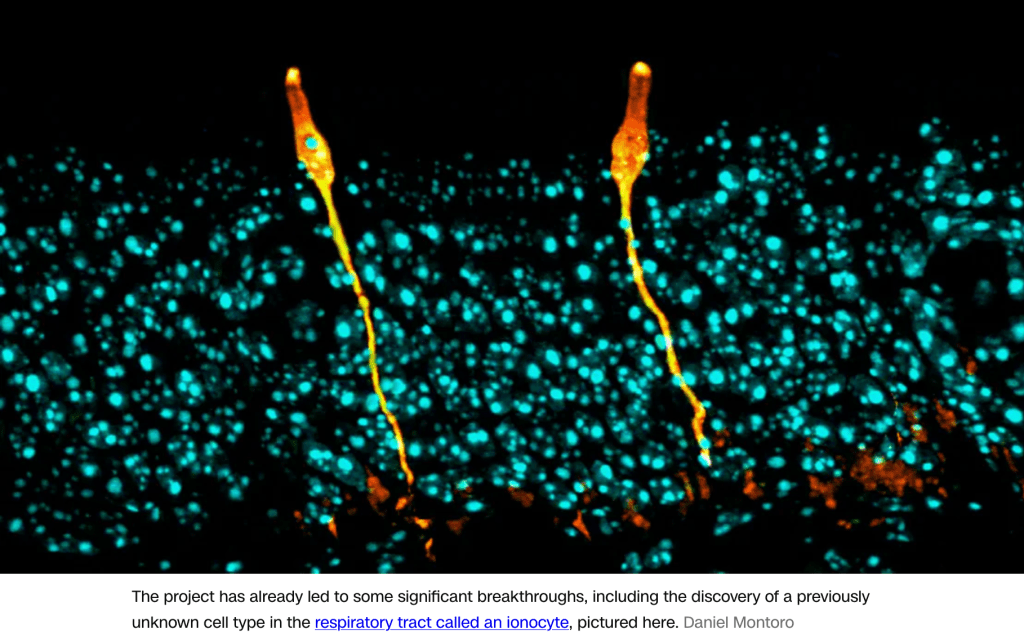
“The Human Cell Atlas is a global consortium that is mapping every cell type in the human body, creating a 3-dimensional Atlas of human cells to transform our understanding of biology and disease. The Atlas is likely to lead to major advances in the way illnesses are diagnosed and treated.

There are about 37 trillion cells in the human body and each has its own specialized role. To identify, understand and map each cellular role, HCA researchers use and develop innovative technologies such as single cell transcriptomics, spatial genomics, and computational and AI techniques. These can reveal the active genes and other characteristics in an individual cell to help classify what the cell does, and where exactly it lives and works in the body.”

Learn more about the Human Cell Atlas.

Human Tissues, Aging, & the Space Station

“Researchers from the SIL flew to the Kennedy Space Centre (Florida, USA) to integrate the samples into the payload in preparation for the launch, which took place early in the early hours of Tuesday 5th November (UK time).

The samples are housed inside a Science Cube, which will be accommodated inside the ICE Cubes Facility once onboard the ISS; the platform provides power and data to the payload, as well as real-time connectivity with ground, enabling researchers back in Oxford to monitor and interact with the experiment in real-time.

Dr Ghada Alsaleh, who leads the Space Innovation Lab at Oxford, said: ‘This is an exciting moment— not just because we’re embarking on a journey to space, but because we’re bringing along a ground-breaking project that could help people live healthier lives, both on Earth and in Space.

‘Our project seeks to uncover how ageing progresses under microgravity conditions, and to test if these conditions could speed up the study of ageing processes that take much longer to observe on Earth. By conducting this research on the International Space Station (ISS), we hope to gain insights that could lead to breakthroughs in understanding and treating age-related diseases. These discoveries could significantly improve the quality of life for people on Earth, reducing the burden of ageing not only for individuals but also for their loved ones and society as a whole.

‘Using cutting-edge tools like organoids, 3D printing, and mechanical stress testing, we’re trying to understand how ageing works at the cellular level. The goal is to find ways to slow down age-related health issues, whether you’re on Earth or up in Space.'”

More on Oxford space lab experiment heads to International Space Station via University of Oxford news.