Scholar Day 2021: Jackpot June!

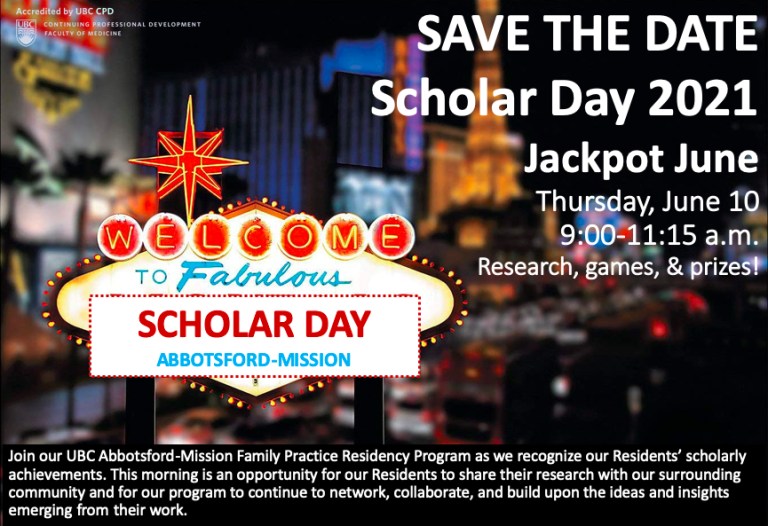
Scholar Day: Jackpot June 2021
Thursday, June 10
0900 – 1115 

Join our UBC Abbotsford-Mission Family Practice Residency Program as we recognize our Residents’ scholarly achievements.

This engagement is an opportunity for our Residents to share their research with our surrounding community and for our program to continue to network, collaborate, and build upon the ideas and insights emerging from their work.

Scholar Day 2021 is CPD accredited. Certification statement: The University of British Columbia Division of Continuing Professional Development (UBC CPD) is fully accredited by the Committee on Accreditation of Continuing Medical Education (CACME) to provide study credits for continuing medical education for physicians.  This program meets the certification criteria of the College of Family Physicians of Canada and has been certified by UBC CPD for up to 1.75 Mainpro+ Group Learning credits. Each physician should claim only those credits accrued through participation in the activity. CFPC Session ID#: 194630-002
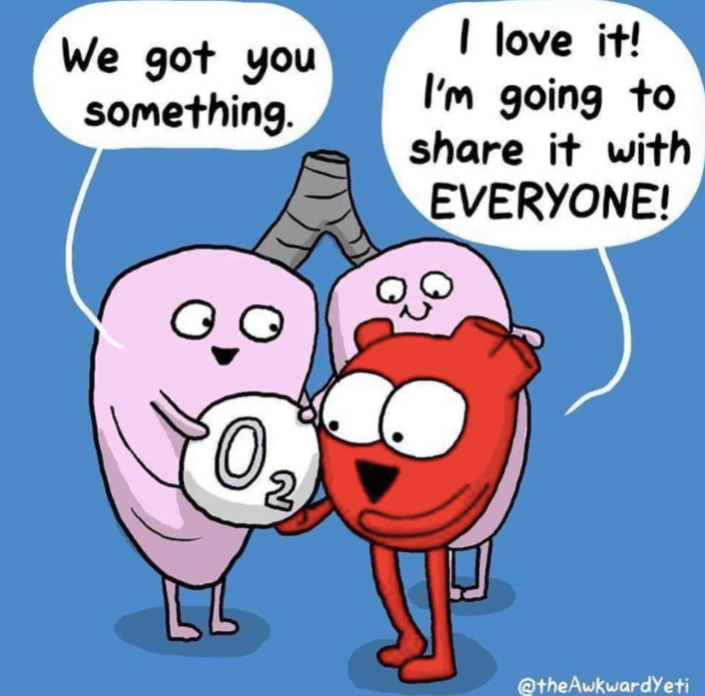
Oxygen

“The oxyhemoglobin dissociation curve is a vital tool for comprehending how blood transports and releases oxygen. Oxygen is carried throughout the body primarily by a protein molecule, hemoglobin, which is present inside red blood cells. Oxygen can also be carried throughout the body by dissolving in blood plasma, but this dissolved portion only constitutes a small portion of the total amount of oxygen transported in the bloodstream. Only 2% of oxygen in the bloodstream is dissolved directly in the plasma component of blood compared to 98% of oxygen in the protein-bound state to hemoglobin.[1]

It is important to note the difference between oxygen saturation (SaO2)which is the percentage of hemoglobin bound to oxygen and partial pressure of oxygen in the blood (PaO2) which is the amount of oxygen dissolved in the blood. The oxyhemoglobin dissociation curve helps describe the relationship between these two important concepts.”

More on the Physiology, Oxygen Transport And Carbon Dioxide Dissociation Curve (2020) via StatPearls.

Virtual Reality & Emotional Response

“The opportunity to develop empathy through engagement and presence in a VR/IVR simulation offers interest and relevance across all healthcare disciplines. Indeed, studies by Ogle et al. (2013) demonstrated that medical students with higher levels of empathy show greater clinical competence. Moyers et. al (2016) concluded that clients have better outcomes when treated by therapists with greater empathy. Parsons and Mitchell (2002) explored the potential of creating virtual environments to support those with autism-spectrum disorders. The review concluded that this ability to immerse individuals within these environments offers opportunities for individuals to practice behaviors within role-playing situations, and provides a safe environment to practice rule learning and repetition of tasks. They acknowledge that this flexible approach allowed for encouragement of problem-solving skills, and a greater understanding and increased awareness of the participants’ thoughts and feelings by the practitioners.

Regarding the reaction of participants to challenging situations, a significant question is whether negative emotional responses and actions to real-world situations can be reduced through IVR simulation training. While there has not been any work of this kind within healthcare, there has been work undertaken in the military that explores this area. Pallavicini et al. (2016) concluded that IVR could provide possibilities to assess individuals’ resilience to stress, as well as identifying the impact that stress may have on psychological reactions including empathy. They argue that the response to stressors makes it possible to train practitioners and to identify those that have resilient behaviors. The ability to create and recreate stressful scenarios using IVR has also been used successfully in disaster and emergency training (Feng et al. 2018). While these works focused on areas outside of healthcare, the possibility of exploring and applying these tools to healthcare education offers a significant opportunity.”

More here on Virtual Reality Application Used to Assess Emotional Response via Healthy Simulation.

Educational Research Grants for Residents

Each year UBC CPD awards two research grants to UBC residents: one (1) for Family Practice residents and one (1) for residents in a specialty area.

Grant recipients receive an honorarium of $500.00 to support educational research projects. UBC residents conducting and presenting research as part of graduation requirements are eligible and invited to apply.  

For more information click here.

The MCC suspends the delivery of the MCCQE Part II

The Medical Council of Canada (MCC) is announcing that, effective immediately, we will discontinue the delivery of the virtual Medical Council of Canada Qualifying Examination (MCCQE) Part II for candidates currently registered.

The decision was taken this morning by the MCC Council who approved the following motion:

“Whereas the MCC is committed to providing a standardized and valid exam experience to candidates, be it resolved that due to the impact of the pandemic on the MCC’s ability to deliver the exam and, as an exceptional circumstance, the administration of the MCCQE Part II is suspended effective immediately. All registered candidates will receive an apology and a full refund of exam fees.”

Read the full statement here via MCC.

UBC Medicine Invitation

Dear colleagues,

Please join Dermot Kelleher, Dean of the Faculty of Medicine and Vice-President of Health, and the Office of Respectful Environments, Equity, Diversity & Inclusion, for the next It Starts with Us virtual event.

This two-part event starting tomorrow, June 1 and next week, June 8 will use an active and engaging approach to discuss and learn about conflict engagement. You are invited to attend one or both of the events.

Topic: Conflict Engagement

  • Part 1: Audience members will watch “Department Discipline”—a community-created play developed by UBC’s Conflict Theatre team—while having the opportunity to actively participate and try out different conflict engagement strategies to see how the outcome of the interaction can be changed. No acting experience required and no pressureeveryone is welcome to attend and participate in a way that’s most comfortable for themRegistration for Part 1 is limited on a first-come first-served basis
  • Part 2: Fundamentals of conflict engagement. 

When:

  • Part 1: June 1, 2021, 12:00-1:30 pm 
  • Part 2: June 8, 2021, 12:00-1:30 pm 

What will I learn? The essentials of conflict engagement – an important tool in standing up to injustice and supporting our commitments and values.

What will I learn? The essentials of conflict engagement – an important tool in standing up to injustice and supporting our commitments and values.

PART 1: REGISTER NOW

PART 2: REGISTER NOW

Registration closes at 11:00 am tomorrow, June 1, 2021.

This event is hosted in partnership with UBC’s Equity & Inclusion Office and Conflict Theatre team. Please note both events will be recorded.

Sincerely,

Roslyn Goldner
Executive Director 
Office of Respectful Environments, Equity, Diversity & Inclusion
Faculty of Medicine | The University of British Columbia

Join the National Forum on Anti-Asian Racism

I am pleased to invite all our students, faculty and staff to participate in UBC’s National Forum on Anti-Asian Racism — a two-day virtual event on June 10 and 11, 2021, to address the ongoing crisis of escalating anti-Asian racism in Canada.

We are convening a diverse group of people to support a robust national conversation about this ongoing crisis, including community organizers, scholars, and public intellectuals, along with key figures in government, health care, media, journalism, the private and not-for-profit sectors.

This national forum will include open discussions about anti-Asian racism in our country with the aim of articulating bold and concrete recommendations for action. We will also discuss anti-Asian racism within the broader context of racism against Indigenous, Black and other racialized communities.

The first day of the Forum will be open to the public, with sessions focusing on issues impacting Asian Canadians, coalition building across Asian Canadian communities, and advocating for systemic change.

The second day will be a closed working session to start, with sector leaders, informed by the outcomes of day one. The Forum will culminate in a public session; this will be an opportunity to share bold actions and key priorities as next steps.

RSVP before June 7https://ubc.ca/antiasianracism

We all have a role to play in the fight against pervasive and enduring anti-Asian racism. I hope you will join me for these crucial discussions.

Santa J. Ono
President and Vice-Chancellor

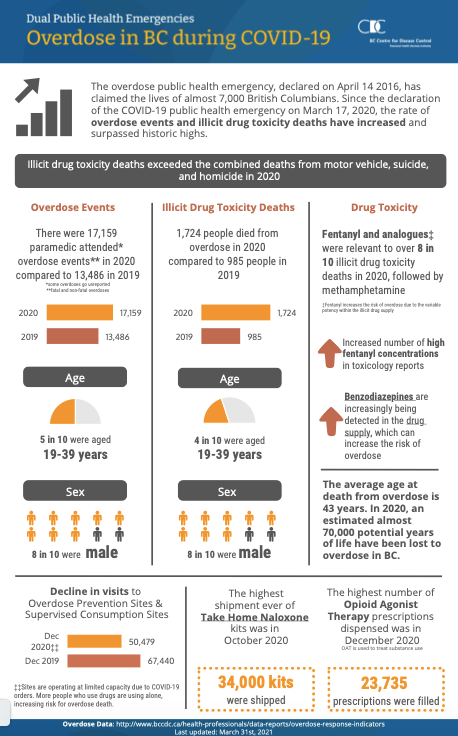
COVID-19 & The Overdose Crisis in BC

A snapshot of the overdose crisis since COVID-19 via BCCDC.

“The overdose crisis in BC has been exacerbated by the COVID-19 pandemic. Despite BC reporting over 1300 overdose deaths since the onset of the pandemic, progress in managing the overdose crisis has been ineffectual. To save the lives of people who use drugs affected by these dual public health emergencies, policy makers must work toward developing pandemic guidelines that are both conducive to the needs of people who use drugs, and reflective of COVID-19 control strategies in BC.”

At the Crossroads: The intersecting Public Health Emergencies of COVID-19 and the Overdose Crisit in BC via BCMJ.

Tackling Youth Substance Abuse

COVID-19 Impacts: Tackling Youth Substance Use Challenges During the Pandemic

In this session, our panel will answer your questions and share their experiences, resources, and recommendations to support and manage youth with substance use issues during the COVID-19 pandemic.

June 16 (Wed) | 1830–2000 PDT +Add to Calendar
Target Audience: Physicians and other health care providers.
Up to 1.5 Mainpro+/MOC Section 1 credits
Course Webpage | Registration Form

Meet our panel: Dr. Hayley Broker, Family Physician at Foundry Northshore, Mountainside Alternative School, Dr. Steve Mathias, Child and Adolescent Psychiatrist and Addiction Specialist, Executive Director of Foundry, Dr. Carol-Ann Saari, Medical Lead and Division Head, Child and Adolescent Psychiatry, VIHA, Dr. Tom Warshawski, Pediatrician, Medical Director for Child and Youth Health, IHA.
Moderator: Dr. David Smith, Child & Adolescent Psychiatrist & Addiction Specialist and Medical Director for C&A Psychiatry, IHA.

How to Ask Questions:

  1. Go to https://www.sli.do/
  2. Enter the event ID #COVID-16June or go directly to https://app.sli.do/event/rz230emz
  3. Type out your question in the ‘type your question’ field and click ‘SEND’
  4. Up-voting: we encourage you to click the “thumbs up” icon beside the questions you like. It will move those questions to the top of the queue and increase the chances of a response

Ovarian Cancer Screening & Mortality

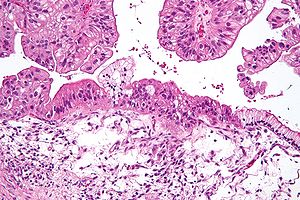
Micrograph of a mucinous ovarian carcinoma stained by H&E.


A decades-long study on ovarian cancer has produced disappointing results, says a British researcher. Following more than 200,000 women for an average of 16 years, the randomized trial found that annual screening for the cancer did not ultimately reduce the number of deaths from the disease. The results were published this week in the journal The Lancet. “Our aim was to try and establish a screening programme for ovarian cancer like we have for cervical and breast cancer,” said Usha Menon, lead investigator of the UK Collaborative Trial of Ovarian Cancer Screening (UKCTOCS) and a professor of gynecological cancer at University College London. 

More on Ovarian cancer researchers disappointed after trial finds regular screenings fail to reduce deaths via CBC News.