Pornography, Adolescents, & the Role of Primary Care

“The internet has become an integral part of the modern lives of adolescents. This allows youth to easily access information and topics of interest online, including sexually explicit material or pornography. Pornography is commonly defined as professionally produced or user-generated sexually explicit pictures or videos intended to sexually arouse the viewer. Increased access to the internet and other online platforms has resulted in a rapid increase in the number of adolescents who encounter and consume pornographic content. As a result, adolescents’ exposure to pornography has been a great concern for parents, teachers and the general public.

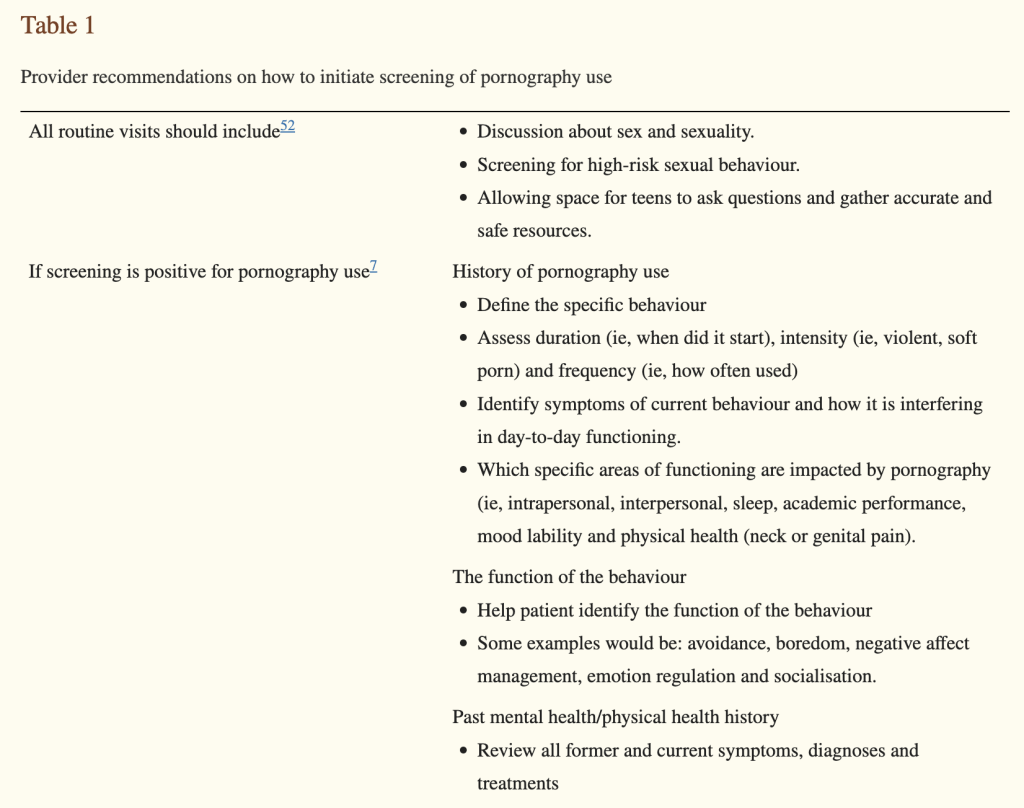
Pornography has the potential to impact adolescent development both negatively and positively. It is a greatly complex media, making it a particular concern for primary care providers (PCPs) and parents as they are often the first point of contact when adolescents experience any issues with well-being, including physical or mental health concerns. Having an unbiased understanding of the impact of pornography use on adolescent development lays the groundwork for healthcare providers to support adolescents in their sexual development and health. In this special communication, we seek to provide guidelines for medical providers to integrate routine screening and counselling of pornography use as a part of adolescent primary care and offer recommendations for how to facilitate conversations that may arise between youth and parents regarding the use.”

Read more on “Pornography use among adolescents and the role of primary care” via NIH.

Private Seniors Homes Underspent on Patients

“British Columbia’s advocate for seniors is calling for ‘fundamental reform’ in how the province funds contracted long-term care providers, after a study found for-profit facilities routinely under-delivered care for the funding they received.

Isobel Mackenzie said a review of financial records from 2021 and 2022 shows that long-term care facilities operated by for-profit companies delivered 500,000 fewer care hours than they were funded for by the province.

In comparison, facilities run by non-profit societies delivered 93,000 more care hours than what they were funded to provide.

‘The funding formula that’s supplied is the same,’ Mackenzie said. ‘And this is the result from that funding formula, where we are rewarding — if you view profit as your reward — not spending on the care.’

The province transfers about $2 billion a year to contracted operators to provide long-term care beds, which Mackenzie says is one of the largest annual fund transfers on the provincial budget.”

Read more on “Private seniors homes underspent on patients compared to public facilities, B.C. seniors advocate says: contracted long-term care facilities’ profits are rising much faster than what they spend on patients” via CBC News.

Podcast: Train Your Brain Faster

Karen Hopkin: This is Scientific American‘s 60-Second Science. I’m Karen Hopkin.

They say that practice makes perfect. But sometimes the best practice is not on a keyboard …[CLIP: Piano sounds]

It’s all in your head. Because a new study shows that the brain takes advantage of the rest periods during practice to review new skills, a mechanism that facilitates learning. The work appears in the journal Cell Reports. [Ethan R. Buch et al., Consolidation of human skill linked to waking hippocampo-neocortical replay]

Cohen: We know from previous research that interspersing rest with practice during training is advantageous for learning a new skill. In fact, we recently showed that virtually all early skill learning is evidenced during rest rather than during the actual practice.

Read more or listen here on Trying to Train Your Brain Faster? Knowing This Might Help with That via Scientific American.

Call of the Wild: Creating a Formal Wilderness Medicine Elective


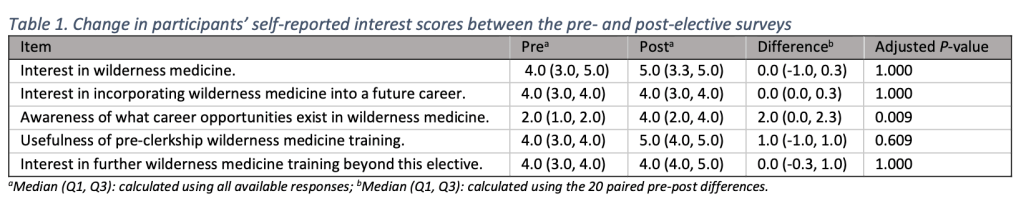
“Wilderness medicine education is interesting to medical students, yet not widely implemented in Canadian medical curricula. We describe a curriculum for a pre-clerkship wilderness medicine elective at a Canadian medical school. Our study reports increased student awareness of career opportunities in wilderness medicine after elective completion, and interest in hands-on learning for wilderness medicine topics. Medical schools may benefit from incorporating feedback from our elective towards a successful wilderness medicine curriculum in their own programs.”

Call of the wild: creating a formal wilderness medicine elective for Canadian pre-clerkship medical students via CMEJ.

B.C. Sets New Record

“Another 198 British Columbians died from toxic drugs in July, according to data released Tuesday by the B.C. Coroners Service, bringing the death toll in the first seven months of the year to 1,455.

The coroners service said the 1,455 deaths from January to July are the most ever reported in the first seven months of the year since a public health emergency over drug poisoning deaths in the province was declared in 2016.

‘I am saddened to once again report that British Columbia’s toxic drug crisis shows no signs of abating,’ said Chief Coroner Lisa Lapointe in a statement.

It puts the province on pace to potentially exceed the 2,383 deaths recorded last year. A total of 12,739 people in the province have died from drug overdoses in those seven years.”

Read more on B.C. sets new record with 1,455 drug deaths in 1st 7 months of 2023 via CBC News.

Origin Behind Major Childhood Allergies

“Several major childhood allergies may all stem from the community of bacteria living in our gut, according to a new study led by researchers at the University of British Columbia and BC Children’s Hospital.

The research, published in Nature Communications, identifies gut microbiome features and early life influences that are associated with children developing any of four common allergies — eczema, asthma, food allergy and/or hay fever. The findings could lead to methods of predicting whether a child will develop allergies, and ways to prevent them from developing at all.

‘We’re seeing more and more children and families seeking help at the emergency department due to allergies,’ said Dr. Stuart Turvey, professor in the department of pediatrics at UBC and an investigator at BC Children’s Hospital Research Institute, and co-senior author on the study. ‘Hundreds of millions of children worldwide suffer from allergies, including one in three children in Canada, and it’s important to understand why this is happening and how it can be prevented.'”

Read more on Researchers discover common origin behind major childhood allergies via UBC News.

Synthroid (Hypothyroidism)

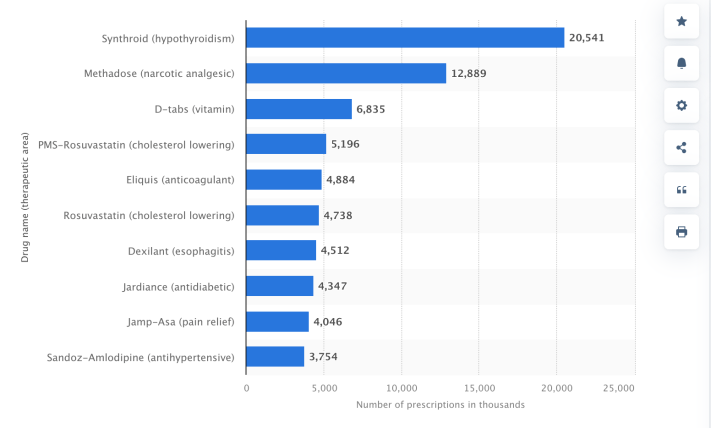
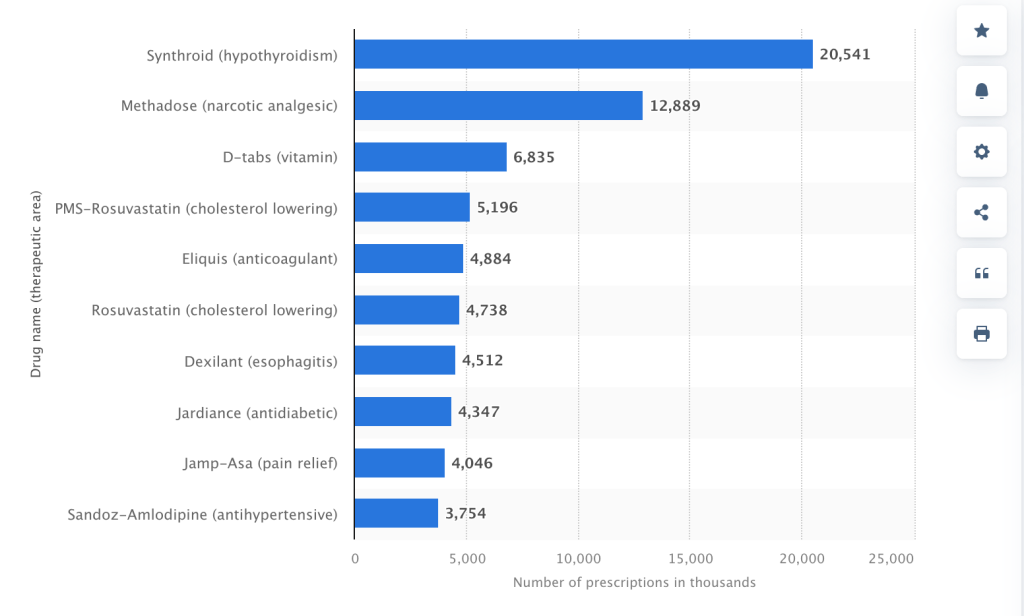
Leading dispensed drugs in Canada based on prescriptions in 2022 via Statista.

For those who noted that the man-made drug Synthroid was in the number one spot on the graph, Statista reports that, “In 2022, prescription drug synthroid – used for the treatment of hypothyroidism – was the most dispensed drug in Canada, coming to a total of more than 20.5 million prescriptions.”

Upon further investigation, Synthroid is the brand name for levothyroxine. “Levothyroxine, also known as L-thyroxine, is a synthetic form of the thyroid hormone thyroxine (T4).[4][7] It is used to treat thyroid hormone deficiency (hypothyroidism), including a severe form known as myxedema coma.[4] It may also be used to treat and prevent certain types of thyroid tumors.[4] It is not indicated for weight loss.[4]

More on Levothyroxine/Liothyronine Combination Therapy and Quality of Life: Is It All about Weight Loss? via European Thyroid Journal.

More on Understanding unapproved use of the approved drugs “off label” via FDA.

Take-Home Naloxone Distribution

Leading dispensed drugs in Canada based on prescriptions in 2022 via Statista.

Background: The increasing toxicity of opioids in the unregulated drug market has led to escalating numbers of overdoses in Canada and worldwide; takehome naloxone (THN) is an evidence-based intervention that distributes kits containing naloxone to people in the community who may witness an overdose. The purpose of this guidance is to provide policy recommendations for territorial, provincial and federal THN programs, using evidence from scientific and grey literature and community evidence that reflects 11 years of THN distribution in Canada.

Read more on the Guidance on take-home naloxone distribution and use by community overdose responders in Canada via CMAJ.

Prescription of Opioids

“A new study led by a McGill University scientist suggests opioid painkillers are not always beneficial — and sometimes harmful — as patients recover from minor surgery.

The research, published in The Lancet, examined the results of 47 randomized clinical trials in patients discharged after undergoing a minor or moderate procedure, ranging from molar extraction to foot surgery. 

Dr. Julio Fiore, an assistant professor at McGill who researches post-operative recovery, said his team found that prescribed opioids had no more of an impact on the pain experienced after minor surgery than over-the-counter painkillers. 

At the same time, the study found a significant increase in side effects, including nausea, vomiting and constipation.” 

Read more on “Are doctors still prescribing too many opioids?” via CBC News.

“In 2007 Purdue Pharma pleaded guilty to federal felony charges that the company misled regulators, doctors and patients about OxyContin’s risk of addiction and abuse. Sackler family members were not charged.” via the Guardian.

Read more on Canadians can now claim under $20 million OxyContin class actions settlement via OxyContin® and OxyNEO® Class Action Settlement. “To obtain compensation under the Settlement, you must first determine if you are eligible, then file a Claim Form and submit the required supporting evidence to the Claims Administrator on or before the Claims Deadline of February 27, 2024.”