Department of Family Practice: Special Educational Symposium

Join the Department of Family Practice for a Special Educational Symposium

Title: Building Community and Connection in Clinical Learning During COVID: Collectively Rethinking the Paradigm

Date: Wednesday, April 29, 8-9am (PST) via Zoom (virtual connection details to follow)

During this first meeting, we will engage participants in dialogue around the following questions related to the community-based clinical learning environment:

  • What is the current state of clinical learning in the virtual environment?
  • How might the clinical learning environment change in the future? (eg see the four curves figure)
  • What is needed to support clinical learning now and in the near future?
  • What resources can we draw on (human and other) and how do we collaborate on  various topics and ideas?

Please contact Dr. Maria Michelle Hubinette at maria.hubinette@ubc.ca to learn more and participate.

Maria Michelle Hubinette  MD CCFP MMEd FCFP (she/her/hers)
Clinical Professor
Scholar, Centre for Health Education Scholarship
UBC Faculty of Medicine | Department of Family Practice
maria.hubinette@ubc.ca
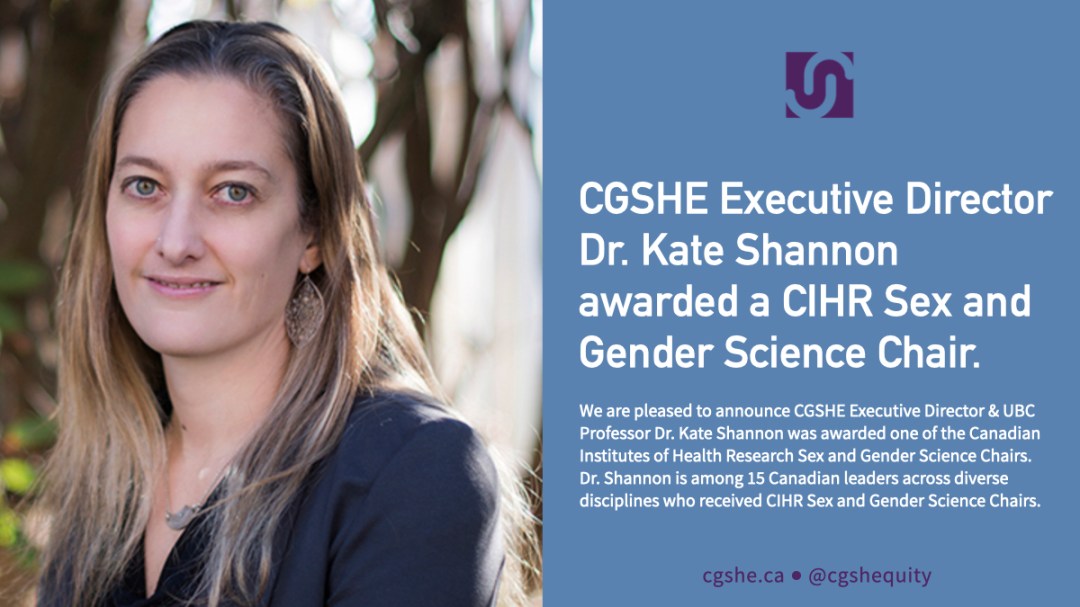
CIHR Sex & Gender Science Chair

EV0lTSuUcAAPEJt.jpg“We are pleased to announce Dr. Kate Shannon was awarded one of the Canadian Institutes of Health Research Sex and Gender Science Chairs. Dr. Shannon is among 15 Canadian leaders across diverse disciplines who received CIHR Sex and Gender Science Chairs. 

Dr. Kate Shannon, PhD, MPH (Global Health) is the Executive Director of the Centre for Gender and Sexual Health Equity, a Professor of Medicine and a Canada Research Chair in Gender Equity, Sexual Health and Global Policy at the University of British Columbia where she helps lead the university’s efforts on gender equity and sexual health care among underserviced and marginalized communities.”

Learn more about her work here.

NEW: Indigenous Patient-Led CPD

NEW: Indigenous Patient-Led CPD

We are an Elder-led group from Indigenous and non-Indigenous backgrounds working together to increase cultural safety and humility in rural BC by building relationships with First Nation communities and physician communities.
To learn more, visit Indigenous Patient-Led CPD.
To access the Cultural Safety Mindfulness During a Pandemic document, click here

Quality Improvement Projects: Award Winners

Unknown.jpg

Fantastic Quality of Improvement Project presentations this morning! Thank you to all who brought their a-game to the session. A special congratulations to:

Project Most Likely to Influence Practice Awards
Dr. Ashandeep Sandhu
: Dyslipidemia in Diabetes
A chart review and discussion about meeting LDL targets in diabetic patients.

Dr. Senan Fernandes: HbA1c in the diabetic elderly: Are we too strict with our glycemic control?

Faculty Choice Award
Dr. Monika Wojtera: Penicillin Allergy Testing in the Family Medicine Clinic
Determining how many patients with a history of mild penicillin allergy could potentially benefit from an in-office graded oral provocation challenge with amoxicillin.

AMEE Webinar: ‘COVID-19 Students’ & teachers wellbeing journey: Struggling, embracing, empowering’

AMEE is hosting a special webinar, ‘COVID-19 Students’ and teachers wellbeing journey: Struggling, embracing, empowering‘ will be presented by Janusz Janczukowicz, Jo Bishop & Ewa Pawlowicz on Thursday the 16th of April 2020 at 1000 hrs UK (GMT+1).

As of 2019, the AMEE webinar series will be entirely free. Please register here.

Due to limited space, it is advisable to join on time as AMEE cannot guarantee entry to the webinars. More information and resources can be found on our special webpage here.

AMEE also has a Special Interest Group (SIG) if you wish to carry on the conversation with any of the presenters.

To access the SIG please log onto AMEE’s sister site MedEdWorld and register your details, once logged in you can access the group by clicking on ‘Special Interest Groups’ located on the left-hand side of your screen.

COVID-19: A Gender Lens

“The need for access to skilled birth attendants, protection from gender-based violence, contraception, and safe abortion often becomes more acute during outbreaks. COVID-19 is no different in the respect. Domestic violence reportedly rose in Wuhan, China, during the city’s two-month lockdown. And people still have sex, experience puberty, menstruate, become pregnant, and give birth during public-health emergencies, so meeting these needs must remain a high priority.

That requires promoting women to leadership roles. Women are skilled service providers, epidemiologists, caregivers, community leaders, and more. Above all, they are the best experts on their own lives and must be meaningfully engaged in all preparedness and response efforts. That means ensuring the participation of girls and women in all local, national, regional, and global task forces on COVID-19. Women must serve on local community councils and in legislative bodies where important decisions are made. At the international level, gender imbalances in global health leadership, where men hold 72% of the top positions, must urgently be addressed.”

More on “A Gender Lens for COVID-19” via Project Syndicate here.

Snagit & Camtasia Platforms Available

Via our UBC Information Technology: UBC has secured a license for the popular software Snagit and Camtasia now available UBC-wide at no cost. Both software packages are available for download through the Convas Learning Management System.

Snagit is a powerful screen capture tool that allows you to easily capture, modify and share screenshots and basic video captures of your computer screen. This tool is invaluable for instructional and support purposes.

Camtasia complements the functionality of Snagit and includes comprehensive video and audio recording of your screen. This software has all the editing tools to create great video content and allows for easy sharing of your videos to anyone, anywhere.

Learn more on “Snagit and Camtasia Now Available for all UBC Staff, Faculty and Students” here.

*Image courtesy of TechSmith.