UFV-UBC Interprofessional Virtual Simulation

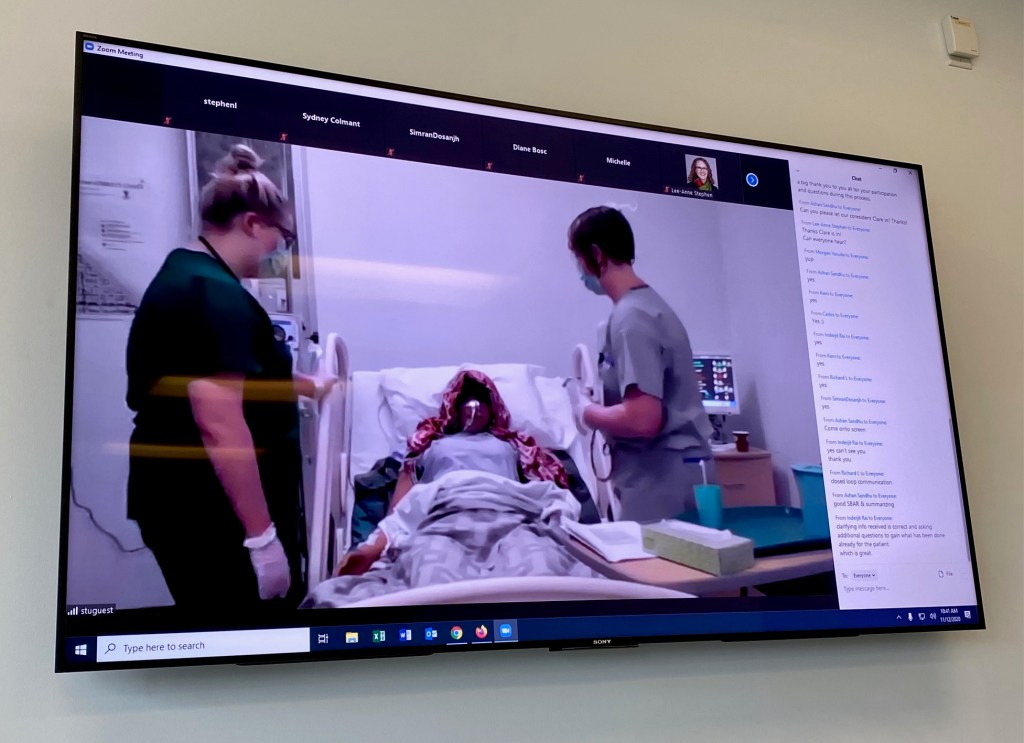
This past week we conducted our first University of the Fraser Valley (UFV) and University of British Columbia (UBC) interprofessional virtual simulation. Our UFV-UBC faculty have worked over the past year to design this unique opportunity that bridges Nursing and Family Practice programs in order to support team-based communication and patient-centred care. During the course of three hours, we facilitated four simulations that involved two teams comprised of one nursing student and one resident. Each team participated in two simulations that addressed caring for a critically ill patient followed by breaking bad news to the patient’s caregiver. Our learning objectives focused on:

  1. Demonstrating effective, collaborative, and respectful interprofessional communication
  2. Developing knowledge of health care team members roles
  3. Demonstrating collaborative leadership skills when caring for a critically ill patient
  4. Managing the care of a deteriorating/changing patient

We want to thank our simulation participants including Claire Wilcox, Megan Schmidt, Dr. Sophia Park, and Dr. Casey Hicks, in addition to our learners that joined us from home. We would also like to acknowledge the UFV-UBC faculty that were instrumental in developing and facilitating the simulation including Lee-Anne Stephen, Sarah Johanson, Janelle Baerg, Dr. Thanh Luu, and Dr. Jacqueline Ashby. Lastly, we thank UFV for allowing our team to use their facilities.

I want to conclude by saying that COVID-19 has challenged our program’s ability to both protect our learners’ health and offer them the experiences that are instrumental in their growth and development as healthcare practitioners. As a community, it’s imperative that we all do our part in taking the necessary measures to stop the spread of this virus. Please review the new regional orders that pertain to social gatherings, travel, indoor group physical activities, and workplace safety.

We are in this together.

Thank you,

Jacqueline
The CFPC underscores the unique considerations for Indigenous health in medical education

The College of Family Physicians of Canada (CFPC) is pleased to release the CanMEDS–Family Medicine Indigenous Health Supplement. It outlines Indigenous-specific considerations relevant to all areas of physicians’ professional activity, from medical expertise to advocacy and academic pursuits. This important resource, developed by the CFPC’s Indigenous Health Committee, complements CanMEDS–Family Medicine 2017—a competency framework that outlines the skills and abilities required for Canadian family physicians—and aims to optimize positive Indigenous health outcomes through a commitment to lifelong learning.

The document elaborates on the seven key CanMEDS-FM roles—the Family Medicine Expert, Communicator, Collaborator, Leader, Health Advocate, Scholar, and Professional—and defines each role in the context of Indigenous tradition. It focuses on supporting therapeutic relationships and creating a culturally safe patient experience that considers the unique needs, circumstances, and strengths of First Nations, Inuit, and Métis patients and their communities.

“This resource provides medical educators and academic leaders with a framework to prepare learners on how to engage in care that authentically respects the cultural, historical, political, and social contexts of Indigenous peoples,” says Dr. Sarah Funnell, CFPC Board Director and Co-chair of the CFPC’s Indigenous Health Committee. “Family doctors are often the first point of care and it is imperative that they have the critical knowledge and skills needed to support effective therapeutic interactions that are culturally safe, informed, and free of racism and discrimination.”

Learn more here.

Online supports for COVID-19 stress are there—but Canadians aren’t accessing them

“Sixty-five per cent of the 3,000 survey participants reported adverse mental health impacts related to COVID-19 in May, yet only two per cent reported accessing online mental health resources such as apps, websites, digital tools or other supports not involving direct contact with a mental health care provider.

‘Even among people who were experiencing mental distress of various types, and in groups who would likely benefit from these resources, the uptake was quite low,’ said lead researcher Emily Jenkins, a professor of nursing at UBC. ‘These programs are ideally positioned for the types of difficult experiences and emotions that we’re seeing during the pandemic. They are well suited for people who are having trouble coping and need some support to manage their mental health. They’re also easily accessed, and many are available in different languages.’

Among the online mental health resources available free to Canadians are:

  • CMHA’s BounceBack, currently available in B.C., Manitoba and Ontario and expanding to the rest of the country soon through a gift from Bell Let’s Talk
  • Wellness Together Canada, a federally funded program
  • WellCan, a resource developed and funded by corporate, community and public sector partners
  • Ontarians also have free access to the for-profit cognitive behavioural therapy program MindBeacon during the COVID-19 pandemic

Jenkins and Richardson are conducting further research to understand why use of these resources is so low, but early indications are that a lack of awareness is a major contributing factor. ‘We see a lot of messaging out there about physical distancing, face masks and hand washing. We really need to get more messages out to people about how they can support their mental health in a positive way as well,’ said Richardson.”

Learn more here on Online supports for COVID-19 stress are there—but Canadians aren’t accessing them via UBC Faculty of Medicine.

COVID-19: New Regional Orders

Due to a rapid increase in COVID-19 cases in our region, the Provincial Health Officer has issued new regional orders for all individuals, places of work, and businesses in communities in Fraser Health. The orders focus on four areas: social gatherings, travel, indoor group physical activities and workplace safety. These orders are in effect until November 23, 2020.

Specifics on these restrictions may be found here.
#WearAMask

Meaningful Community Collaboration in Research

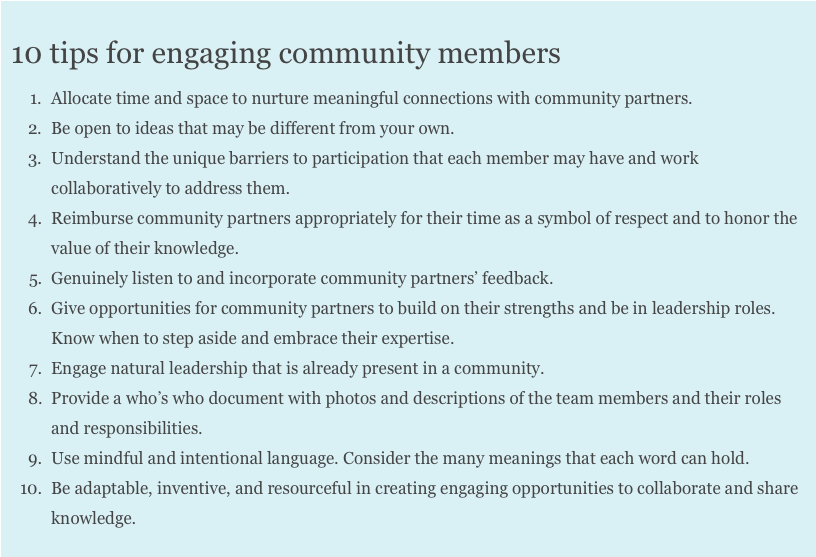
“Meaningful community collaboration in research, as we know it today, started during the HIV/AIDS pandemic as a grassroots movement to gain an equal voice at the table of scientific discovery. Today, participatory health research, community advisory boards, and knowledge translation are common buzzwords that look attractive to grant reviewers and journal editors. However, community partnerships cannot be reduced to mere tokenism or committee meetings. Meaningful community engagement involves lasting partnerships, a willingness to consider differing opinions, and elevation of lived experience to the level of academic credentials. It requires authentic collaboration at all stages, from generating research questions to translating findings into action, including community members in leading roles, building capacity, and providing ownership. Importantly, it is not a unidirectional process, but an interactive effort to embrace community wisdom, values, and priorities. Now, in the context of another infectious disease pandemic, lessons learned from engagement with the HIV community are more relevant than ever.”

More here on Practicable methods to overcome barriers to effective collaboration during a pandemic via BCMJ.

The Shift: Burnout to Joy

“I totally needed permission to take time off because medicine is all, it just pushes you to work so hard, and you always feel like you’re failing someone if you’re not there, not helping someone more.” ~ Dr. Micah Peters

Dr. Peters’ story on burnout is both refreshing and courageous. He talks specifically about the tools and mechanisms that supported his recovery and how he was able to bounce back and regain his health and sense of well-being.

(Thank you Dr. Kornelsen for the forward!)

The Shift: Physician to Patient

(Image Courtesy of James Maskalyk)

“An ER doctor says being diagnosed with a rare and serious form of cancer has been like ‘coming out as human.’ ‘I thought I knew all this stuff, I learned in school how to prevent these types of things, and now I’m just human after all,’ said Dr. James Maskalyk, an ER physician at St. Michael’s Hospital in Toronto. Maskalyk was diagnosed with stage 4 cancer in May, after he found a lump in his neck. A biopsy showed it to be a rare type of thyroid cancer.

‘That’s the healing process. It’s just a more complex idea of something that includes the mind and the body, and includes the community and ecology,’ he said. At the beginning of the pandemic, Maskalyk was leading people in daily meditation sessions on his social media accounts — and talked through that practice with The Current.

Maskalyk spent part of the summer at Indigenous healing centres (the Turtle Lodge in Manitoba, and the All Nations’ Healing Hospital in Saskatchewan), and said observing and working with elders there has helped him to process his diagnosis. He recalled advice he received from a knowledge keeper named Dave Courchene, who said that whenever anyone’s time comes to die, they ‘only get asked one question.’

‘Did you bring love into the world? … If you did, you’ve done it, you’ve done the work,’ Courchene told Maskalyk.”

More here on Dr. Maskalyk’s journey: Doctor who helped people meditate through pandemic fears diagnosed with stage 4 cancer via CBC Radio.