

A big thank you to Dr. Ian Martin for his academic half day presentation on “X-Rays: Part I” and for sharing his handout on upper extremity injuries for family practice.
A big thank you to Dr. Ian Martin for his academic half day presentation on “X-Rays: Part I” and for sharing his handout on upper extremity injuries for family practice.
“When I started my medical training in 1984, the general understanding was that clinical history contributed about 70% to establishing a diagnosis, with physical examination and investigations contributing about 20% and 10%, respectively. Since then, remarkable advancements in medical imaging (MRI became widely available only in the early 1990s), other rapidly advancing technologies, practice pressures, and virtual care have all influenced the role of the physical exam.
WorkSafeBC depends on external information to adjudicate a worker’s claim and relies on the information physicians submit to support the worker’s treatment and recovery from a workplace injury or illness. When a WorkSafeBC medical advisor (a physician) reviews claims, they also review the examination findings from attending physicians. Missing or incomplete findings can impact a worker’s entitlement to WorkSafeBC benefits such as physiotherapy and expedited assessments, investigations, and surgery. Missing information also makes it difficult to identify safe options for a graduated return to work, which can imperil a worker’s livelihood.”
More on Perspectives on the value of the clinical exam for your patients with work-related medical conditions via BCMJ.

“The way health care is administered in Canadian correctional institutions has led to a parallel, but unequal system of care for one of society’s most marginalized populations. With mounting evidence that inmates experience high morbidity and mortality, the inadequate delivery of health care within prisons only exacerbates the consequences of incarceration and the social determinants of health. Despite increasing health expenditures across provinces and territories and health care innovation occurring outside of the prison system, corrections services have often failed to protect the health of inmates. More troublingly, the current governance of health care in prisons under the CCRA is incongruent with the Minimum Standards of Care for Prisoners set out by the United Nations, of which Canada has been a committed member. The aforementioned guidelines describe that health care provision should be under the jurisdiction of health systems, rather than the justice system, to protect prisoners’ well-being. The poor health outcomes of inmates are directly related to administrative challenges, poor human resourcing, and lack of prioritization of preventative medicine and public health. As highlighted above, health care delivery in Ontario prisons is currently inequitable and of poor quality. Therefore, we believe that it is critical that the OMSA promote the issue of prison health care as both an advocacy and educational priority for Ontario medical students.”
Learn more on Health Care Reform in Canadian Corrections Facilities via Ontario Medical Students Association.
This topic recently addressed also in Criminal Justice Reform Is Health Care Reform via JAMA.

“Attachment theory postulates that there is a particular style of caregiving that, because of its interaction with our evolved psychology, is most likely to result in healthy psychological development. Attachment research has been criticized because most studies have been conducted with Western populations. Critics argue this has (a) overemphasized the importance of sensitive responsive caregiving and (b) limited our understanding of multiple nonmaternal caregiving (allomothering). Here, we analyze the extent of sensitive responsiveness and structural properties of allomothering networks among Mbendjele hunter-gatherers who reside in the Republic of Congo. Humans lived as hunter-gatherers for the majority of our evolutionary history, thus studying contemporary hunter-gatherers can offer insight into the caregiving children may be psychologically adapted to.
Based on 12-hr focal follows of 18 children (0–4 years old; 10 male), we constructed caregiving networks across the domains of responding to crying, physical contact, interactive care, and proximity. Crying was virtually always responded to rapidly via comforting and never via scolding. Children received physical contact and care for the majority of the day. Allomothering accounted for 40%–50% of caregiving in each domain. While allomaternal networks were large, they were highly concentrated—the majority of a child’s allocare was provided by just a few caregivers. Due to high caregiver:child ratios, “sharing” of caregivers was limited—a child typically had several allomothers who directed a majority of their allomaternal effort to him/her. These findings add to our understanding of the level and sources of sensitive responsive caregiving that children may be evolutionarily primed to expect.”
More on Sensitive Responsiveness and Multiple Caregiving Networks Among Mbendjele BaYaka Hunter-Gatherers: Potential Implications for Psychological Development and Well-Being via Developmental Psychology.

B.C. family physician Dr. Stuart Bax co-founded the virtual cancer screening service CanScreenBC.com to get people checked as early as possible so they don’t end up getting a cancer diagnosis too late. Listen here!

Team-Based from the Beginning: “When Drs. Leo and Flora Wong opened the doors to their practice, they informed patients of their team approach to care. They didn’t struggle to find patients who were comfortable seeing two physicians. Operating as a dyad from the beginning made them no strangers to working as a team. Since then, the St. Luke Family Practice clinic has grown with an increased number of care providers, and has become an established education environment for undergraduate and postgraduate learners. The St. Luke team provides full-scope family practice care, in-hospital care, palliative and hospice care, home visits, obstetrics and psychiatric community rehabilitation.”
Learn more about incorporating a team-based approach in family medicine here.
“The BC Coroners Service has issued a public safety warning for people who use drugs, saying it’s seen a recent spike in the number of people dying from the unregulated supply.
The service usually refrains from releasing its monthly toxic drug deaths report in December because of how difficult the holiday season can be for people who have lost loved ones. This December, however, the service said an increase in deaths warranted a warning.
Preliminary data suggests at least 200 British Columbians died from the unregulated toxic drug supply in November, the highest monthly total since July. The BC Coroners Service said those numbers are still under review, but would amount to seven people dying a day.”
More on Spike in toxic drug deaths prompts safety warning from BC Coroners Service via Abbotsford News.
A big welcome to all of you who are checking us out for Carms!
Take a look around, feel free to use our resources. Hopefully it gives you a glimpse into what our Site is like. To understand how life will be like for you next year, you should really chat with us at our upcoming Q&A sessions. There will be Residents there who remember what you wanted to know to make your decision and who want to help you decide on your future. So please register and see you there.
Warmly,
Drs. Holden Chow and Thanh Luu
The first CaRMS Q&A will be on Monday, December 11, 2023 from 17:00-18:00 PST (open to ALL interested potential applicants).
The second CaRMS Q&A will be on Saturday, January 13, 2024 from 1300-1400 PST (open ONLY applicants who have been offered interviews).
In addition, here’s the link to our training site info.
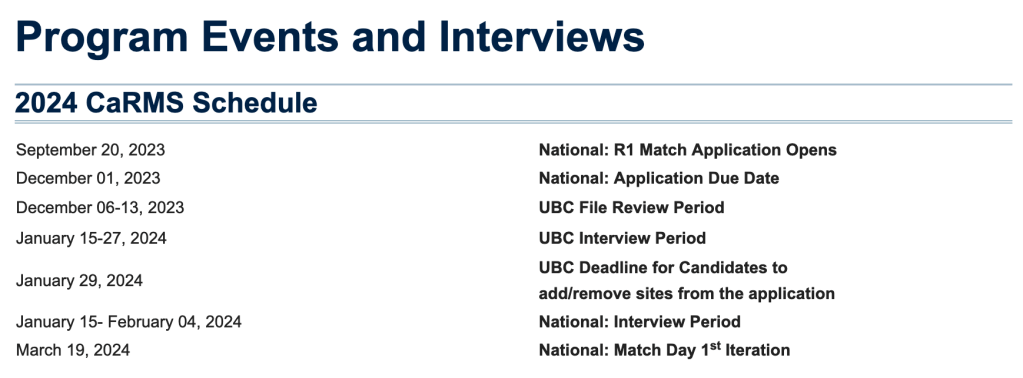
More on the UBC Program CaRMS Schedule below:
“According to Palestinian health officials, of the more than 10,000 Palestinians killed in Gaza in the past month, about 4,000 were children. Gaza is becoming a ‘graveyard for children,‘ U.N. Secretary-General António Guterres said on Monday.
And even as the World Health Organization warns about the spread of infectious diseases in Gaza, some researchers are concerned that those children who do survive might be scarred for the rest of their lives.
Researchers say the cumulative trauma of chronic ethnic-political violence has a profound and lasting impact on children’s mental health and development, affecting their functioning and outlook on the world as young adults. Studies show that even youth who seem to become desensitized to the violence around them remain deeply scarred — unless, that is, they are given a chance to recover.
This is especially a concern for children in Gaza, who were already struggling with significant mental health issues well before this conflict. For years, numerous studies have documented unusually high rates of mental and behavioral health issues among Gaza’s youth, who make up nearly half of the population in the territory. Most of them have never known a life without the threat of violence and conflict.”
Learn more on “How a history of trauma is affecting the children of Gaza” via NPR.
“The bankruptcy deal in question would have the Sackler family personally pay out between $5.5 billion to $6 billion over 18 years to help fight the ongoing opioid epidemic. Most of the money would go to states, local governments and Native American tribes.
The deal also sets aside $700 million to $750 million to pay individual victims and families of victims. The fund would pay out between $3,500 to $48,000, with payments to some victims spread out over 10 years. Purdue has said its bankruptcy deal is the only major opioid settlement to provide ‘meaningful recoveries’ to victims.
If the deal were to be approved by the Supreme Court, Purdue Pharma would cease to exist and a new company, Knoa Pharma, would be created in its place. Knoa Pharma would develop and distribute opioid addiction treatments and overdose reversal medicines, while continuing to produce Purdue Pharma products, including OxyContin. The company would be governed by a new independent board, and would have a ‘public-minded mission,’ according to Purdue Pharma.
In exchange for the deal, members of the Sackler family would be granted immunity from all other civil (though, not criminal) lawsuits.”
Read more on “US Supreme Court scrutinizes controversial opioid crisis settlement that would give Sackler family immunity” via CNN.
 Family Medicine Residency Site: Abbotsford-Mission