Figure from Patients’ Trust in Health Systems to Use Artificial Intelligence via JAMA.
After nearly a decade in medical education, I’ve seen AI quietly reshape both learning and clinical practice. But as educators, clinicians, and patients, are we asking the right questions about its use?
Too often, AI tools are implemented without transparency, oversight, or patient consent. Some platforms even guide users on capturing patient data—without clear governance—raising serious concerns about privacy, ownership, and compliance.
💡 Questions we all need to ask: 🔹 Patients: Is AI being used in my care? How is my data stored and used? Can I access my AI-generated records? Can I opt out?
🔹 Educators & Institutions: Are AI tools aligned with privacy laws? Have vendor agreements been updated to reflect AI-driven features?
🔹 Developers & Policymakers: Is AI implementation transparent and ethical? Are there built-in safeguards? Does the tool comply with FIPPA/HIPAA?
AI itself isn’t good or bad—it’s a tool. But without scrutiny, it can become a liability rather than an asset.
🔍 Never assume AI is being used ethically. Ask the hard questions. Demand clear answers. Protect patient trust.
~ Jacqueline
Learn more on Patients’ Trust in Health Systems to Use Artificial Intelligence via JAMA
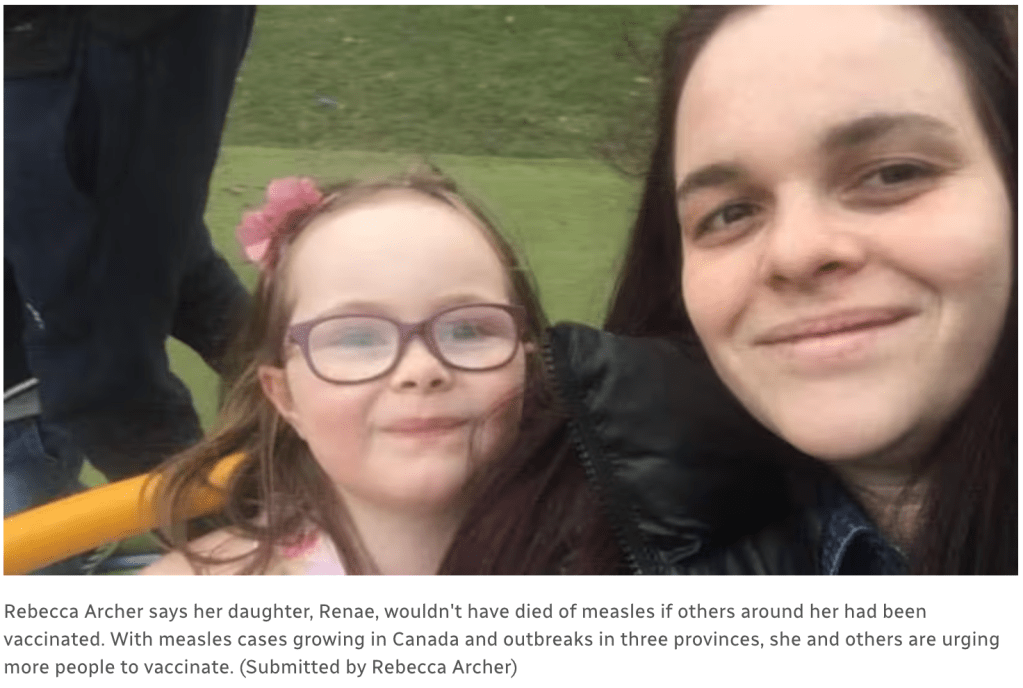
A measles outbreak is unfolding in Ontario, and health officials are urging parents to ensure their children are vaccinated. With cases rising across the province, the highly contagious virus is finding gaps in community immunity—gaps that could put infants, immunocompromised individuals, and unvaccinated children at risk.
Measles isn’t just a rash and fever; it can lead to severe complications like pneumonia, brain swelling (encephalitis), and even death. The good news? Vaccination works. The MMR (Measles, Mumps, Rubella) vaccine is over 97% effective after two doses and has been a pillar of public health for decades.
Unfortunately, declining vaccination rates have given measles a path to resurgence. Many cases are linked to international travel, where the virus spreads rapidly among unprotected individuals. The best defense is simple: Check your child’s vaccination status and book their MMR shot if they’re due.
Public health experts stress that herd immunity—where enough people are vaccinated to stop the virus from spreading—relies on at least 95% coverage. The more people delay or refuse vaccines, the more vulnerable communities become.
The takeaway? Measles is preventable, but only if we take action. Protect your child, your community, and those most at risk. Vaccinate.
Read more on Ontario measles cases more than double over last 2 weeks, 31 hospitalizations reported via CBC News.
“I know how much courage it takes for us to ask for help—but it is this courage that creates connection between a doctor and a patient, a teacher and their student, a parent and their child, that we as humans crave.” — Dr. Shahana Alibhai
As part of the UBC Dawn Patrol Faculty Development Series, we’re thrilled to welcome Dr. Shahana Alibhai—a former Abbotsford-Mission family medicine resident and physician at Foundry Youth Health Centre. She is the author of Feeling Better: How Understanding Your Emotional Palette Can Keep You from Getting Swept Away and a TEDx speaker with over a decade of experience in mental health.
Session Focus: Emotional literacy is more than just understanding our feelings; it’s about harnessing them to strengthen our well-being, relationships, and decision-making. In this session, Dr. Alibhai will lead engaging discussions and practical exercises to explore:
✅ The science behind emotional literacy ✅ How emotions shape communication and choices ✅ Strategies to foster resilience in healthcare and beyond
Winnipeg, Canada — Thousands of young men and boys have been targeted by financial sextortion crimes with numbers continuing to climb, a new international report by the Canadian Centre for Child Protection (C3P) has found.
An open-source analysis of 6,500+ first-hand accounts shared publicly by sextortion victims on a popular support forum sheds new light into what has quickly become a public safety emergency affecting many Canadians and online users abroad.
Key findings include:
The primary targets of financial sextortion are nearly always boys and young men, mostly targeted on Instagram and then moved to Snapchat, with payments often made through PayPal;
Complying with extorters’ demands generally leads to frequent future demands;
Some platform design characteristics, such as the public display of personal information and social networks, create favourable conditions for predation.
‘This is a public safety emergency – we are losing children to this organized attack against them,’ says Lianna McDonald, Executive Director of C3P. ‘Technology companies must be held accountable for the design choices they have made that facilitate harm against their youth users. Technical changes that would protect them are urgently needed.’
Read more on Thousands of boys, young men falling prey to financial sextortion crimes, Canadian report finds: Review of online victim support forum identifies major safety gaps; reveals males primarily targeted through Snapchat, PayPal via Canadian Centre for Child Protection.
UBC is hosting a webinar on the topic for all healthcare practitioners to learn more: Sextortion: Managing and Supporting Children and Youth Affected by Sexual Exploitation April 2 (Wed) | 12–1:30 p.m. PT | Webinar Audience: all health professionals. Overview: Learn to recognize the signs of sexual exploitation in children and youth presenting in your clinic. Gain practical strategies for managing cases and discover resources to support affected individuals. This webinar features expert panelists and a live Q and A session. Up to 1.50 Mainpro+/MOC Section 1 credits.
Exciting News! 🚀📢 Thrilled to share that Dr. Meera Anand and I have published our latest work, “APP that Map! Curriculum Mapping in Family Medicine”, in Medical Education!
What’s the challenge? Curriculum mapping is critical for ensuring equity, consistency, and accreditation across distributed medical training programs. In our case, UBC Family Medicine spans over 20 training sites—each with unique learning experiences due to regional differences. However, our previous Excel-based mapping method was cumbersome, time-consuming, and engagement was low.
What did we do? ✅ Redesigned the mapping process—streamlining 478 learning objectives into 42 core learning outcomes. ✅ Developed a custom app in Oracle Apex—allowing faculty to easily input and visualize data. ✅ Increased engagement—within 7 months of launch, all sites completed the process (compared to <50% using spreadsheets!). ✅ Enabled data-driven decision-making—helping us track curriculum trends and improve resource allocation.
Lessons Learned: 💡 Technology can enhance, but not replace, faculty engagement—ongoing training is key. 💡 Balancing simplicity and robust data collection is a continuous challenge. 💡 Visualizing trends improves decision-making for accreditation & program improvements.
This work demonstrates how thoughtful integration of technology can streamline curriculum mapping and enhance medical education.
WHO, as requested by its member states, launched the Expanded Programme on Immunization (EPI) in 1974 to make life-saving vaccines available to all globally. To mark the 50-year anniversary of EPI, we sought to quantify the public health impact of vaccination globally since the programme’s inception.
Methods
In this modelling study, we used a suite of mathematical and statistical models to estimate the global and regional public health impact of 50 years of vaccination against 14 pathogens in EPI. For the modelled pathogens, we considered coverage of all routine and supplementary vaccines delivered since 1974 and estimated the mortality and morbidity averted for each age cohort relative to a hypothetical scenario of no historical vaccination. We then used these modelled outcomes to estimate the contribution of vaccination to globally declining infant and child mortality rates over this period.
Findings
Since 1974, vaccination has averted 154 million deaths, including 146 million among children younger than 5 years of whom 101 million were infants younger than 1 year. For every death averted, 66 years of full health were gained on average, translating to 10·2 billion years of full health gained. We estimate that vaccination has accounted for 40% of the observed decline in global infant mortality, 52% in the African region. In 2024, a child younger than 10 years is 40% more likely to survive to their next birthday relative to a hypothetical scenario of no historical vaccination. Increased survival probability is observed even well into late adulthood.
Interpretation
Since 1974 substantial gains in childhood survival have occurred in every global region. We estimate that EPI has provided the single greatest contribution to improved infant survival over the past 50 years. In the context of strengthening primary health care, our results show that equitable universal access to immunisation remains crucial to sustain health gains and continue to save future lives from preventable infectious mortality.
Read more on Contribution of vaccination to improved survival and health: modelling 50 years of the Expanded Programme on Immunization via The Lancet.
We’re excited to announce that Okanagan Orchards is confirmed for Saturday, May 31stat the Eldorado Resort in Kelowna! This is the annual Family Practice Postgraduate Program’s faculty development and appreciation event.
After listening to feedback from past attendees, we are revising the format to allow more time for learning and networking. This year, Okanagan Orchards will be directly after the annual in-person PGEC meeting which will also be held in Kelowna on Friday, May 30th. More details to come regarding PGEC for those who are on the committee.
A travel reimbursement will be available to eligible out-of-town preceptors (more details to come when registration opens this spring). There is no registration fee for this event.
There are a limited number of guest rooms held at the Eldorado Resort as well as Manteo Resort (right next door) so booking early is recommended. Our event rate is $286/night plus taxes and fees. Please use the following links or call the hotel directly:
Reservations Department: 250-860-1031 ext.1103 or email reservations@eldoradoresort.ca To ensure you receive the special rate quoted above, you must identify yourself as a participant attending the UBC Department of Family Practice event.
This event is open to all preceptors and clinical faculty from across our beautiful province. Feel free to share this event with colleagues at your site. Stay tuned for further details, including an agenda and registration link. Please let me know if you have any questions.
We look forward to seeing you in May!
Larissa McLean, MHA Manager, Rural Education & Initiatives Faculty of Medicine | Department of Family Practice, Postgraduate Program The University of British Columbia
Join our panel of experts to enhance your knowledge and skills in addressing the critical issue of managing and supporting children & youth affected by sexual exploitation
Police reports of online sexual exploitation of children nearly tripled since 2014, reaching 160 incidents per 100,000 Canadian children and youth in 2022.
Sextortion reports increased by 150% since June 2022.
Online sexual luring reports have increased 815% over the last five years, along with a rise in child deaths by suicide linked to sextortion. Read more via Children First Canada Top 10 Threats.
Don’t miss this opportunity to better recognize signs of sexual exploitation in children and youth. Learn to implement effective management strategies in your clinical practice for cases of child sexual exploitation, and connect affected individuals with community and regional resources. The webinar features a panel of expert presenters, and attendees will have the chance to ask questions in real-time.
Date & Time: April 2 | 12:00-1:30pm | 1.5 hr 1.5 Mainpro+/MOC Section 1
Skills Gained:
Recognize indications of sexual exploitation in children and youth.
Utilize effective strategies for managing cases of child sexual exploitation in clinical practice.
Identify community and regional resources to support children and youth who have experienced sexual exploitation.
CONNECTION DETAILS
When you register, you will receive an email from UBC CPD with connection details. If you do not receive this email, please check your spam folders. You should add “@ubc.ca” to your safe sender list. If you do not see the connection email, please contact us.
Presenters:
Panelist: Natalie Davis | Staff Sergeant, RCMP Integrated Child Exploitation Unit (BC ICE) Panelist: Dr. Michelle Clarke | Emergency Pediatrician and member of the Child Protection team at BC Children’s Hospital Panelist: Meghan Donevan | Research Manager, Talita & PhD student, Child and Youth Psychiatry, Umeå University Panelist: Megan Lowe | Registered Nurse, Suspected Child Abuse and Neglect (SCAN) Nurse and Forensic Nurse Examiner Panelist: Emily Lindsey | Suspected Child Abuse and Neglect (SCAN) Nurse Panelist: Tracy Scott | Suspected Child Abuse and Neglect (SCAN) Nurse
Moderator: Dr. Shirley Sze | BMSc, MD, CCFP, FCFP, Family Physician; Steering Committee Member, Child and Youth Mental Health Substance Use Community of Practice
To register or learn more about the event, please click here.
“The people behind a year-old medical school dedicated solely to turning out family doctors say the small program based in Oshawa, Ont., is disrupting traditional medical education in a way that could help solve Canada’s shortage of family physicians.
‘The big idea here is to preselect a group of students who not only want to become doctors, but they want to become family doctors, and right from the outset to surround them with all the wonders of family medicine,’ said Dr. Jane Philpott, dean of Queen’s University’s Faculty of Health Sciences and a former federal health minister.
The first 20 students in the Queen’s-Lakeridge Health MD Family Medicine Program began their studies in September 2023. The school is a partnership between Queen’s University, which also operates a traditional medical school at its main location in Kingston, Ont., and Lakeridge Health hospital in Durham Region, just east of Toronto. The satellite campus is located right in the hospital.”
Read more on New med school for family doctors aims to help solve the shortage. Can it do so with doctors alone? via CBC Radio.