“In this episode, my guest is Dr. Martha Beck, Ph.D., a Harvard-trained sociologist, bestselling author, and one of the world’s foremost experts on personal exploration and development. Dr. Beck shares specific frameworks and practices to tap into your unique and deepest desires, core truths, and best life direction—all elements that comprise your authentic self. She also explains how to align your work and relationships of all kinds with your true self and how to embrace the discomfort and process of leaving unhealthy relationships. We discuss how to deal with negative thoughts and emotions, grapple with societal norms, and improve body awareness to gauge your inner truth. We also discuss codependency and self-abandonment – and how to exit and recover from these experiences. By the end of the episode, you will have learned numerous practical tools to access your best self and live a richly fulfilling life.”
Health care providers in Canada across all specialties are increasingly able to order industry-sponsored genetic testing at no cost to their patients or to the health care system, which seems like a solution to prevailing inequities in access to testing but comes with several important ethical, legal, and health care system–related considerations that must be addressed.
Most sponsored tests offered to people in Canada are performed in American laboratories, with the majority offering gene panel tests.
Whereas many of Canada’s provinces have centralized laboratories or programs that ensure the quality and appropriateness of any publicly funded genetic testing, including those sent internationally, sponsored genetic testing may not be subject to similarly rigorous quality assurance.
Despite benefits to patients in terms of simplifying access, broadening testing options, and potentially advancing research into genetic diseases, privacy risks related to data sharing and other downstream harms and costs require careful attention.
The Canadian College of Medical Genetics and Canadian Association of Genetic Counsellors recently published a position statement to outline key considerations; now is the time for health care jurisdictions to consider this important issue and to support the development of comprehensive guidance to help practitioners navigate this next generation of genetic testing and data sharing.
Learn more here on Free genetic testing is not free of clinical and ethical considerations via CMAJ.
On behalf of Dr. Dominique Pilon, outgoing Chair of the College of Family Physicians of Canada (CFPC)’s Board of Examinations and Certification (BEC), I am writing to advise you that, effective immediately, the BEC is no longer accepting requests for a waiver of training in family medicine using the special form and process introduced during the COVID-19 pandemic. This process allowed a program director to waive up to 12 selected weeks of a resident’s educational experience out of the required 24 months of training in family medicine, holidays excepted, if that resident was unable to gain certain educational experiences due to a COVID-19 illness or restrictions.
The BEC has reinstituted the waiver of training process used prior to the pandemic. A program director must apply directly to the BEC, via a written submission through ccfpexam@cfpc.ca, for consideration of any waiver of training, which will only be granted under exceptional circumstances. The maximum allowable training time that can be waived for any resident is four weeks.
A resident transferring into a family medicine residency program from a Royal College specialty residency can still have up to six months (i.e., 24 weeks) of training recognized as equivalent. This is not considered a waiver of training by the BEC. The decision of equivalency rests with the family medicine program director and does not need to be reviewed by the BEC.
For any questions or guidance, please contact me at bkvern@cfpc.ca.
Sincerely,
Dr Brent Kvern Director, Certification and Examinations
“For healthspan and lifespan, ERK, AMPK and mTORC1 represent critical pathways and inflammation is a centrally important hallmark1,2,3,4,5,6,7. Here we examined whether IL-11, a pro-inflammatory cytokine of the IL-6 family, has a negative effect on age-associated disease and lifespan. As mice age, IL-11 is upregulated across cell types and tissues to regulate an ERK–AMPK–mTORC1 axis to modulate cellular, tissue- and organismal-level ageing pathologies. Deletion of Il11 or Il11ra1 protects against metabolic decline, multi-morbidity and frailty in old age. Administration of anti-IL-11 to 75-week-old mice for 25 weeks improves metabolism and muscle function, and reduces ageing biomarkers and frailty across sexes. In lifespan studies, genetic deletion of Il11 extended the lives of mice of both sexes, by 24.9% on average. Treatment with anti-IL-11 from 75 weeks of age until death extends the median lifespan of male mice by 22.5% and of female mice by 25%. Together, these results demonstrate a role for the pro-inflammatory factor IL-11 in mammalian healthspan and lifespan. We suggest that anti-IL-11 therapy, which is currently in early-stage clinical trials for fibrotic lung disease, may provide a translational opportunity to determine the effects of IL-11 inhibition on ageing pathologies in older people.”
Read more on the Inhibition of IL-11 signalling extends mammalian healthspan and lifespan via Nature.
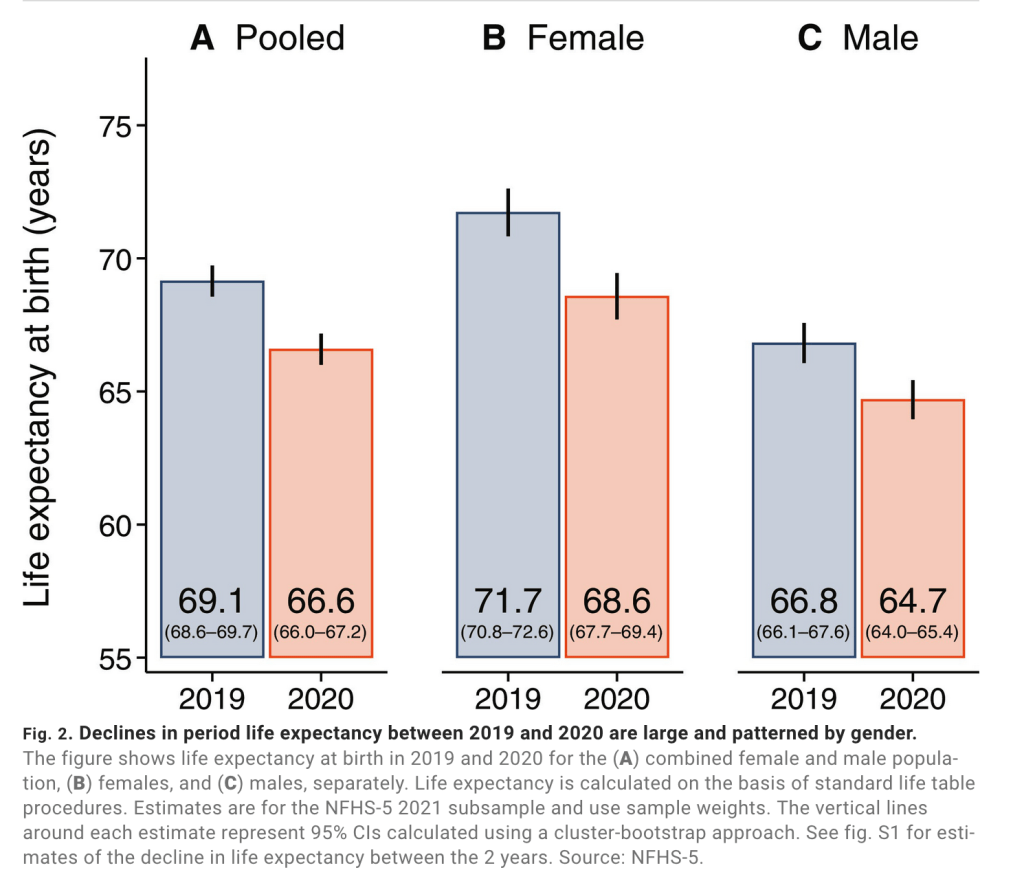
“Global population health during the COVID-19 pandemic is poorly understood because of weak mortality monitoring in low- and middle-income countries. High-quality survey data on 765,180 individuals, representative of one-fourth of India’s population, uncover patterns missed by incomplete vital statistics and disease surveillance. Compared to 2019, life expectancy at birth was 2.6 years lower and mortality was 17% higher in 2020, implying 1.19 million excess deaths in 2020. Life expectancy declines in India were larger and had a younger age profile than in high-income countries. Increases in mortality were greater than expected based on observed seroprevalence and international infection fatality rates, most prominently among the youngest and older age groups. In contrast to global patterns, females in India experienced a life expectancy decline that was 1 year larger than losses for males. Marginalized social groups experienced greater declines than the most privileged social group. These findings uncover large and unequal mortality impacts during the pandemic in the world’s most populous country.”
Large and unequal life expectancy declines during the COVID-19 pandemic in India in 2020 via Science Advances.
“Côte d’Ivoire will become the first country to roll-out the new R21/Matrix-M™ vaccine with the first child vaccinated in Abidjan, marking a critical step and historic milestone in the global fight against malaria.
Every year 600,000 people die of malaria in Africa, according to the World Health Organization (WHO). Children under five years of age make up at least 80% of those deaths. Although the number of malaria-related deaths has fallen from 3,222 in 2017 to 1,316 in 2020 in Côte d’Ivoire, the mosquito-borne disease kills four people a day, mostly small children, and “remains the leading cause of medical consultations, according to the Ministry of Health.
R21/Matrix-M™ was co-developed by the University of Oxford and Serum Institute of India, leveraging Novavax’s Matrix-M™ adjuvant technology. In December 2023, the WHO granted R21/Matrix-M™ prequalification status, following a rigorous regulatory process and clinical assessment. Trials also demonstrated that the vaccine was well tolerated, with a good safety profile, with injection site pain and fever as the most frequent adverse events.”
Read more on Côte d’Ivoire makes history as first nation to deploy R21/Matrix-M™ Malaria Vaccine via Oxford News & Events.
“’Despite this large potential for public health concern, very little research has been done to measure chemicals in tampons,’ said lead author Jenni A. Shearston, a postdoctoral scholar at the UC Berkeley School of Public Health and UC Berkeley’s Department of Environmental Science, Policy, & Management. ‘To our knowledge, this is the first paper to measure metals in tampons. Concerningly, we found concentrations of all metals we tested for, including toxic metals like arsenic and lead.’
Metals have been found to increase the risk of dementia, infertility, diabetes, and cancer. They can damage the liver, kidneys, and brain, as well as the cardiovascular, nervous, and endocrine systems. In addition, metals can harm maternal health and fetal development.
‘Although toxic metals are ubiquitous and we are exposed to low levels at any given time, our study clearly shows that metals are also present in menstrual products, and that women might be at higher risk for exposure using these products,’ said study co-author Kathrin Schilling, assistant professor at Columbia University Mailman School of Public Health.”
Read more on First study to measure toxic metals in tampons shows arsenic and lead, among other contaminants via Berkeley Public Health.
Dr Bibbins-Domingo: Let’s talk now about what AI is going to do for patients. We have our computers that we carry around with us in our phones and in our watches, and if we’re interested in more information about our health, those sensors are collecting data about us all the time. I’m a primary care clinician. My patients are bringing me that data all the time and they’re asking me to help make sense of that. So tell us what’s on the horizon and how might we think about these really wonderful ways in which these incredible sensors and other data collection tools will become better integrated into clinical care.
Dr Kheterpal: I think the most important thing that the modern sensors and wearables offer us is really understanding the patient’s daily lived experience. I think we can all agree that even the most conscientious clinician struggles to truly understand in that 15-minute primary care visit, where you see the patient every 6 months, when they say, “I’m feeling tired,” what does that actually mean? These symptoms that are coming to us in episodic moments, and we have episodic assessments of them, but they’re lived throughout the day and throughout the 6-month or 1-year period. And the beauty of the sensors we now have is that there’s potentially an objective way to get a sense of how that patient’s doing.
Read more on Tapping AI’s Strengths—From Operating Room Safety to Wearable Device Interpretation via JAMA.
“I’m struggling to stay in this world, because everything just touches me so deeply. I’m not doing this for attention. I’m doing this to be an inspiration and to show that I can be strong. I did things to myself to make pain go away, because I’d rather hurt myself then someone else. Haters are haters but please don’t hate, although I’m sure I’ll get them. I hope I can show you guys that everyone has a story, and everyone’s future will be bright one day, you just gotta pull through. I’m still here aren’t I ?” ~ Amanda Todd
Purpose: The purpose of this study was to understand the needs of youth and young adults, current gaps around safeguarding social media, and factors affecting adoption of data-driven auto-detection or software tools.
Methods: This qualitative study is the first step of a larger initiative that aims to use participatory action research and co-design principles to develop a digital tool that targets cyberbullying. Youth and young adults aged 16–21 years were recruited to participate in semistructured focus groups between March 2020 and November 2021. Thematic analysis was used to develop themes, with a member-checking process to validate the findings.
Results: Six focus groups were completed with 39 participants and five themes were generated from the analysis. Participants described the mental health impacts of cyberbullying on young people, the stigma associated with it, and the need for more mental health resources. They felt that additional efforts are needed to improve the school environment, school-based interventions, and training protocols to ensure that youth feel safe reporting cyberbullying. Most participants were open to using a digital solution but raised concerns around the trustworthiness of artificial intelligence and wanted it to be co-designed with young people, integrated across platforms, informed by data-driven decisions, and transparent with users.
Discussion: Youth and young adults are accepting of a low-risk digital cyberbullying solution as current interventions are not meeting their needs.
Read more on Digital Disconnection: A Qualitative Study of Youth and Young Adult Perspectives on Cyberbullying and the Adoption of Auto-Detection or Software Tools via Journal of Adolescent Health.
Young mother contemplating her sleeping child in candlelight Albrecht Anker, 1875
Purpose
Healthy sleep is essential for the physical, cognitive, and social development of children. Several studies have reported the increase in digital media use in preschool children and its association with impaired sleep. However, there is relatively little evidence on the effects of book reading as a potentially safe alternative. The objective of this study, therefore, was to investigate whether sleep in children could benefit from book reading, and whether the negative effects of media use on sleep can be mitigated by substituting book reading for screen time.
Participants and Methods
We used longitudinal data from three consecutive waves of the SPATZ Health study, including children at the ages of 4 (n=581), 5 (n=508), and 6 (n=426) years. All data were collected by self-administered questionnaires. Parent-reported child sleep was assessed by the Children’s Sleep Habits Questionnaire.
Results
Across the three waves, screen-based media use increased and was associated with lower sleep quality. In contrast, the time spent with book reading decreased; however, book reading appeared to be beneficial for children’s sleep. Substitution models revealed that the theoretical substitution of an equal amount of book reading for 50% of the time spent with screen-based media benefits several domains of preschoolers’ sleep health, including parasomnias, sleep anxiety, daytime sleepiness, and sleep onset delay.
Conclusion
Besides implications for population-wide and individual prevention, book reading may also be incorporated as a useful intervention to improve sleep quality in children who are already affected by sleep problems. Given that book reading is perceived as a safe alternative, the presented evidence may suffice to support recommendations in this direction.
Read more on Substituting Book Reading for Screen Time Benefits Preschoolers’ Sleep Health: Results from the Ulm SPATZ Health Study via Nature and Science of Sleep.




 Family Medicine Residency Site: Abbotsford-Mission